• Well, I missed my chance for a St. Paddy’s Day blog post in honor of my sainted dad, Eddie Clifford, but the magic of leprechauns that lived in his heart is not a Cliffordsbar
    one-day kind of magic,
    so today’s the day.

    I never met my grandfather, my father’s father. He hailed from County Cork, Ireland, but was murdered here in the U.S. when my dad was just seven years old. They found his body floating in the Hudson River.

    I didn’t know that until I was an adult. I chastised my father for never telling me about his father and he, the typical Irishman, replied, “You never asked.”

    I imagine my father’s love for all things Irish, and his delightful gift of storytelling came from his father, who worked in a cemetery and dug graves. 

    My dad could keep a table full of guests enthralled and laughing for hours or enchant them with stories of his dad bringing home old wood, possibly old caskets, for the wood stove and my grandmother throwing him and the wood out the door. 

    She’d rather be cold than warm the house with wood from someone’s casket, she would say. It was bad luck, and might bring the devil down on the house!

    My father spent a lifetime saving money to visit his father’s Ireland, and when he did, he came back elated, except for one thing. He had lost a roll of film from Blarney Castle because of the shenanigans of a leprechaun he had the unexpected pleasure of meeting.

    He had gone to a dinner, complete with lively Irish music, in Blarney Castle with my uncle, Donald, and stepped outside for a breath of air. There, at the bottom of the steps, was an unusually small man with an equally unusual appearance.


    MomdadgttMy dad struck up a conversation with the visitor, who at some point offered my dad a pipe. Not being a smoker, my dad turned him down but asked if he could take his photo instead.  They were having a grand ol’ time, each with their own unique gift of gab, and he wanted a keepsake of their time together.

    The wizened man smiled, so my dad snapped his picture. When he lowered the camera, the little man was gone. But there, on the steps, was a shillelagh. My dad brought it home with him.

     When my father took the role of film to be developed, it was blank, so his trip to Blarney Castle was something for which he would have to rely on memory.  When he died, I inherited the shillelagh.

    Today I’m making our corned beef and cabbage dinner that we couldn’t have yesterday.  I can just imagine dad sitting in the living room recliner, appreciating the aroma while enjoying a cup of coffee, followed by “just a half- Shillelaghgtt
    cup” so as not to spoil dinner.

    He would be carefully perusing the Sunday paper or enjoying the latest in British comedies, his shillelagh resting
    in the corner of the room.

    Miss you dad. I hope you and Uncle Donald are celebrating with the angels.

  •                                                                                                                                                                                                                                                                                                      Dandelion dawid-zawila-279998-unsplash

    Many people have morning rituals. Mine include stretching, prayer, a good cup of tea and catching up with on-line news I missed during the night. As might be expected from a person of varied interests, and a grandmother, I am often distracted by other interesting tidbits, like the recent story, ‘The scary truth about what’s hurting our kids.”

    As a grandparent, I just had to read it. It was worth the time and underscored the damage social media and an obsession with mobile devices causes to children’s mental health.

    The article notes that, among other things, children suffer from an absence of dull moments and are being deprived of the important fundamentals of a healthy childhood, including opportunities for boredom.

    As most wise grandparents will share, boredom is a nurturer for children, giving them a much needed absence of stimulation, a blessed silence, moments when they can hear the whirring of their own minds in creative endeavors, an opportunity for them to hear the whisperings of God instead of the noise of everything else.  Children, like adults, need time to think.

    When my husband was a child, before the advent of taking “time out” in some specially designated place in the house after a childish transgression, my mother-in-law, Muriel, wise as she was, doled out the punishment of pulling weeds. No sitting in the corner for my husband or his siblings.  They could reflect on their wrong-doings and make themselves useful at the same time.

    I often wondered if Muriel took her cue from Bishop Fulton J. Sheen, whom she greatly admired, and who once said, “We can think of Lent as a time to eradicate evil or cultivate virtue, a time to pull up weeds or to plant good seeds. Which is better is clear, for the Christian ideal is always positive rather than negative.”

    Muriel, who was no shrinking violet, would no doubt have reminded Bishop Sheen that you can’t plant the good seeds until you pull the weeds.

    For today’s adults, who are continually lulled into a spiritual malaise by the white noise of a world where the absence of anything is considered deprivation, a time of emptiness devoid of worldly distractions is a feast for the spiritual life.

    And so we come to the wisdom of Ash Wednesday, and the days of Lent, time set aside in the liturgical year to focus interiorly on our relationship with God, and subsequently, our relationship with others.  It is a time to strengthen both, realizing that our relationship with God is meaningless if some good for the other does not flow from it.

    Too often, it seems we approach Lent with a serious solemnity, brought about by our sense of suffering through sacrifice. I am guilty of it, as much as at other times I am guilty of having no feelings about Lent whatsoever. I simply go through the motions, wear ashes and purple and convince myself that I am doing Lent because I am making sacrifices.

    I have actually learned to do Lent better by watching my grandchildren in those rare dull moments when they are not distracted by toys or technology, when they have been sent outside because they are bored, and are soon excitedly gathering stones and pine cones, examining bugs or catching toads and crickets, pulling apart fallen seed packets and planting seeds with great expectations that they will return in a few days to find new seedlings growing. And at the end of their unexpected adventure they run to you and say, “Look what I found!”

    That is how I wish to approach Lent, when making sacrifice is a time of discovery, and when an examination of conscience leading to change is an experience of joy.

    I want to keep in mind the thoughts of Thomas Merton who wrote, “Even the darkest moments of the liturgy are filled with joy, and Ash Wednesday, the beginning of the Lenten fast, is a day of happiness, a Christian feast.”

    “Lent comes providentially to reawaken us, to shake us from our lethargy.” ~Pope Francis

    Photo by Dawid Zawiła on Unsplash

  • With Ash Wednesday approaching, the words of Pope Francis’ 2016 Ash Wednesday message are worth reflection: Cullan-smith-465981

    With great wealth and power, there often comes a “blindness … accompanied by the proud illusion of our own omnipotence, which reflects in a sinister way the diabolical ‘you will be like God’ (Gen. 3:5), which is the root of all sin. This illusion can likewise take social and political forms, as shown by the totalitarian systems of the 20th century, and, in our own day, by the ideologies of monopolizing thought and technoscience, which would make God irrelevant and reduce man to raw material to be exploited. This illusion can also be seen in the sinful structures linked to a model of false development based on the idolatry of money, which leads to lack of concern for the fate of the poor on the part of wealthier individuals and societies; they close their doors, refusing even to see the poor. …


    … Let us not waste this season of Lent, so favorable a time for conversion! We ask this through the maternal intercession of the Virgin Mary, who, encountering the greatness of God’s mercy freely bestowed upon her, was the first to acknowledge her lowliness (cf. Luke 1:48) and to call herself the Lord’s humble servant (cf. Luke 1:38)."

  • Can't believe I just discovered these 11 tips by George Orwell yesterday for the first time! It seems they were posted in the Evening Standard, Jan. Dave-michuda-54058 12, 1946.


    If you look up 'tea' in the first cookery book that comes to hand you will probably find that it is unmentioned; or at most you will find a few lines of sketchy instructions which give no ruling on several of the most important points.

    This is curious, not only because tea is one of the main stays of civilization in this country, as well as in Eire, Australia and New Zealand, but because the best manner of making it is the subject of violent disputes.

    When I look through my own recipe for the perfect cup of tea, I find no fewer than eleven outstanding points. On perhaps two of them there would be pretty general agreement, but at least four others are acutely controversial. Here are my own eleven rules, every one of which I regard as golden:

    • First of all, one should use Indian or Ceylonese tea. China tea has virtues which are not to be despised nowadays — it is economical, and one can drink it without milk — but there is not much stimulation in it. One does not feel wiser, braver or more optimistic after drinking it. Anyone who has used that comforting phrase 'a nice cup of tea' invariably means Indian tea.
    • Secondly, tea should be made in small quantities — that is, in a teapot. Tea out of an urn is always tasteless, while army tea, made in a cauldron, tastes of grease and whitewash. The teapot should be made of china or earthenware. Silver or Britanniaware teapots produce inferior tea and enamel pots are worse; though curiously enough a pewter teapot (a rarity nowadays) is not so bad.
    • Thirdly, the pot should be warmed beforehand. This is better done by placing it on the hob than by the usual method of swilling it out with hot water.
    • Fourthly, the tea should be strong. For a pot holding a quart, if you are going to fill it nearly to the brim, six heaped teaspoons would be about right. In a time of rationing, this is not an idea that can be realized on every day of the week, but I maintain that one strong cup of tea is better than twenty weak ones. All true tea lovers not only like their tea strong, but like it a little stronger with each year that passes — a fact which is recognized in the extra ration issued to old-age pensioners.
    • Fifthly, the tea should be put straight into the pot. No strainers, muslin bags or other devices to imprison the tea. In some countries teapots Cole-hutson-81377are fitted with little dangling baskets under the spout to catch the stray leaves, which are supposed to be harmful. Actually one can swallow tea-leaves in considerable quantities without ill effect, and if the tea is not loose in the pot it never infuses properly.
    • Sixthly, one should take the teapot to the kettle and not the other way about. The water should be actually boiling at the moment of impact, which means that one should keep it on the flame while one pours. Some people add that one should only use water that has been freshly brought to the boil, but I have never noticed that it makes any difference.
    • Seventhly, after making the tea, one should stir it, or better, give the pot a good shake, afterwards allowing the leaves to settle.
    • Eighthly, one should drink out of a good breakfast cup — that is, the cylindrical type of cup, not the flat, shallow type. The breakfast cup holds more, and with the other kind one's tea is always half cold before one has well started on it.
    • Ninthly, one should pour the cream off the milk before using it for tea. Milk that is too creamy always gives tea a sickly taste.
    • Tenthly, one should pour tea into the cup first. This is one of the most controversial points of all; indeed in every family in Britain there are probably two schools of thought on the subject. The milk-first school can bring forward some fairly strong arguments, but I maintain that my own argument is unanswerable. This is that, by putting the tea in first and stirring as one pours, one can exactly regulate the amount of milk whereas one is liable to put in too much milk if one does it the other way round.
    • Lastly, tea — unless one is drinking it in the Russian style — should be drunk without sugar. I know very well that I am in a minority here. But still, how can you call yourself a true tealover if you destroy the flavour of your tea by putting sugar in it? It would be equally reasonable to put in pepper or salt. Tea is meant to be bitter, just as beer is meant to be bitter. If you sweeten it, you are no longer tasting the tea, you are merely tasting the sugar; you could make a very similar drink by dissolving sugar in plain hot water.

      Some people would answer that they don't like tea in itself, that they only drink it in order to be warmed and stimulated, and they need sugar to take the taste away. To those misguided people I would say: Try drinking tea without sugar for, say, a fortnight and it is very unlikely that you will ever want to ruin your tea by sweetening it again.

    These are not the only controversial points to arise in connexion with tea drinking, but they are sufficient to show how subtilized the whole business has become. There is also the mysterious social etiquette surrounding the teapot (why is it considered vulgar to drink out of your saucer, for instance?) and much might be written about the subsidiary uses of tea leaves, such as telling fortunes, predicting the arrival of visitors, feeding rabbits, healing burns and sweeping the carpet. It is worth paying attention to such details as warming the pot and using water that is really boiling, so as to make quite sure of wringing out of one's ration the twenty good, strong cups of that two ounces, properly handled, ought to represent.

    (taken from The Collected Essays, Journalism and Letters of George Orwell, Volume 3, 1943-45, Penguin ISBN, 0-14-00-3153-7)


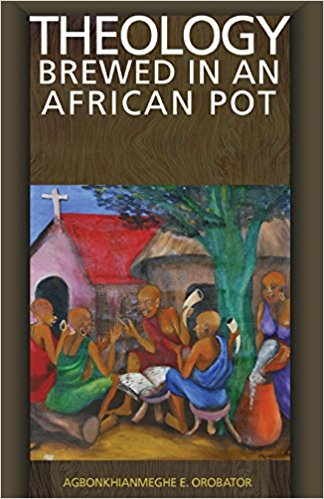
  • Some years ago a friend asked why I didn't write pieces that were more theological, or offer in-services on St. Augustine instead of videos like "The African pot Rabbi's Gift."  I'm not quite sure he was satisfied with my explanation. Then I happened upon a wonderful book that I wish I had read before he asked the question. I just love the idea of theology as talking sensibly about God!

    "We need to dispel the notion that theology is the exclusive preserve of experts and academicians. Theology is something that we all do all the time, even without actually paying attention to it. I find no better illustration of this than the conversation between Mr. Brown and Chief Akunna. The former had probably spent a few years studying the Bible and theology in his native England to prepare for his missionary journey to the African village of Umuofia. He possessed an impressive mastery of the religious vocabulary and could reel off the theological terminologies with ease.

    "Chief Akunna had not received any formal theological training in the knowledge of his religion. Notwithstanding, he possessed a native sense of religion that made him a theologian of no lesser statue and repute than Mr. Brown. He knew how to talk sensibly about God—the nature of God, the meaning of worship, meditation and creation, divine providence, and divine retribution. In the course of this engaging conversation between Mr. Brown and Chief Akunna we get a clear idea of the meaning of theology: talking sensibly about God." Father Agbonkhianmeghe E. Orobator

  • After yet another of DT’s ignorant, racist comments, in which he questions why the U.S. has to accept people from “shithole” countries like Haiti and the continent of Africa, I saw a response from a FaceofGod1supporter that encapsulates the dangerous racism, nationalism and arrogance that mars this country: “Like always he is telling the truth, Americans that have never wonder outside the US have no idea, when they start complaining about this Country they should be sent to one of these places for a week or two. No electricity, no water, no food, crimes with no punishment, no decent places to live, shitholes is a compliment. Face Reality and apriciate this Country. GOD BLESS AMERICA”

    It is sickening, and I have to wonder how anyone could use the words “God Bless” when supporting  a statement which implies some people are devoid of basic human dignity. This supporter’s use of this phrase God Bless America is blasphemous, and certainly no prayer.

    It is a nationalistic cry which touts some perceived U.S. superiority, as a country and a people, over other countries and people. Be assured, as a country and a people we will suffer for such arrogance. We are suffering for such arrogance.

    Yes, we are fortunate to have a decent standard of living in the U.S. Most of us have homes with utilities, food and water, access to health care, safe places to live and work, but perhaps, surprisingly to some, not all of us.  

    Poverty should never be the measuring stick of human dignity. The fact that so many other people in other countries are deprived of the basic necessities should not be a cause for our flag waving but our compassion, and our acknowledgement that in our basic humanity we are no different and no better than anyone else.  

    A sense of superiority is what breeds white nationalism, an anathema to faith in God, whose face is not white; whose loves extends to all of God’s children of every race.

    Things did not go wrong in this country when we took prayer, and God, out of the classroom. If God is missing anywhere it is in the hearts and minds of too many people who resort to the rally cry of God Bless America. We can love our country, without promoting racism, bigotry and a nationalism which breeds hatred.

    For those Christians, specifically Catholics, who insist on supporting this kind of ignorant rhetoric, be reminded, through the words of Evangelii Gaudium, of the teachings of Jesus who came for the poor and disadvantaged in body and spirit, not the arrogant or self-promoting, and certainly not for the good of any particular nation or any particular race.

    “This divine preference (for the poor) has consequences for the faith life of all Christians, since we are called to have 'this mind… which was in Jesus Christ' (Phil 2:5). Inspired by this, the Church has made an option for the poor which is understood as a 'special form of primacy in the exercise of Christian charity, to which the whole tradition of the Church bears witness'.

    “This option – as Benedict XVI has taught – ‘is implicit in our Christian faith in a God who became poor for us, so as to enrich us with his poverty’. This is why I want a Church which is poor and for the poor. They have much to teach us. Not only do they share in the sensus fidei, but in their difficulties they know the suffering Christ. We need to let ourselves be evangelized by them.

    “… We are called to find Christ in them, to lend our voice to their causes, but also to be their friends, to listen to them, to speak for them and to embrace the mysterious wisdom which God wishes to share with us through them.

    “Our commitment does not consist exclusively in activities or programmes of promotion and assistance; what the Holy Spirit mobilizes is not an unruly activism, but above all an attentiveness which considers the other ‘in a certain sense as one with ourselves’.

    “This loving attentiveness is the beginning of a true concern for their person which inspires me effectively to seek their good. This entails appreciating the poor in their goodness, in their experience of life, in their culture, and in their ways of living the faith.

    “True love is always contemplative, and permits us to serve the other not out of necessity or vanity, but rather because he or she is beautiful above and beyond mere appearances: 'The love by which we find the other pleasing leads us to offer him something freely’. 

    “The poor person, when loved, ‘is esteemed as of great value’, and this is what makes the authentic option for the poor differ from any other ideology, from any attempt to exploit the poor for one’s own personal or political interest. Only on the basis of this real and sincere closeness can we properly accompany the poor on their path of liberation.

    “Only this will ensure that ‘in every Christian community the poor feel at home. Would not this approach be the greatest and most effective presentation of the good news of the kingdom?’ Without the preferential option for the poor, ‘the proclamation of the Gospel, which is itself the prime form of charity, risks being misunderstood or submerged by the ocean of words which daily engulfs us in today’s society of mass communications’.”    Evangelii Guadium

    Photo by Ursula Spaulding on Unsplash

     
  • Here we are at the start of Advent, and many of us are already saturated with Christmas.                                                                                                                               Trevor-cole-389921  

    We’ve all talked about it, or griped about it – stores filled with Christmas before Jack-o-Lanterns were carved , round-the-clock Christmas movies on multiple TV stations before Thanksgiving turkeys were even delivered to the supermarkets, and an endless stream of Christmas music to accompany our fall day trips to the beach or hiking trails.

     It’s not yet December and many of us have already had our fill.

    For many, Christmas is not the holly, jolly season our culture insists it must be.

    Our family, like many families, faces circumstances that could easily rob us of Christmas spirit.

    Who wants to think about decorating the house or a tree when the pain of losing a spouse, a child, a parent, a sibling, a dear friend, or other loved one fills your heart and mind?

    And death is not the only loss. Absence is also painful, as families experience when a loved one is deployed and facing danger daily, or when there is a divorce or there are broken family or personal relationships.

    It is also hard to appreciate the cheerful songs of Christmas when serious illness has taken over your life, or the life of someone you love.

    This season of joy is difficult when a family struggles with addiction and there is a heavy unease accompanying every tomorrow. Addicts and their families live from moment to moment waiting for the next shoe to drop, creating an environment thick with apprehension.

    Then there are the often seemingly insurmountable financial problems, stress and anxiety, which is made all the worse by the dreaded feeling of expectation fed by our indoctrination into the commercialized version of Christmas.

    Still, for many, this season of sharing gifts and joy with family and friends is made almost unbearable by sheer loneliness.

    These are the times in our lives when we most need God, but sometimes God seems so very far away, or absent altogether.

    Enter, the beauty of Advent.

    Here, in the midst of the most stressful season of the year, is an oasis of time, a time to breathe and to focus on God coming to us and God being with us – now and always. Every Advent I am grateful for the opportunity to rediscover this remarkable truth which I sometimes lose sight of during the rest of the year.

    “It does not seem right that the greater should come seeking the lesser; it is we who need God, and we should be coming to Him. And yet while we were yet sinners, when we did not love Him or seek Him, when we were too preoccupied with our busy and important lives to give Him a thought; He comes to us. This is the remarkable humility and love of God poured out upon us again and again,” writes Father Patrick Cardine, a priest of the Antiochian Orthodox Christian Archdiocese of North America, the Church of my mother.

    Though I was baptized into the Roman Catholic faith, I have fond memories of Mass in the small Syrian Orthodox church at the end of the street where my family lived, chief among them lots of icons, lots of incense and the beautiful sound of hymns and prayers in the Arabic language.

    Sadly, I don’t remember as much as I should about the liturgies or rituals of the Orthodox Church, but I do have a vague memory of the Nativity fast – the fast of Advent before the feast of the Nativity.

    We fasted on Wednesdays and Fridays (some say Mondays as well, but I don’t remember that) much the same as Lent, and our mini-fast after midnight before receiving Communion. Perhaps that spiritual discipline begun at an early age, and which I will admit I have fallen away from, is one of the reasons I still find Advent to be a blessing, a time when we prepare for Christmas by not planning, not spending, not worrying, not feeling isolated and alone, because God is with us.

    At the close of every year, after dealing with all that life heaps on us, Advent, for me, is a time to recover the courage, the hope and peace of mind God brings, and is a reminder that I can do all things through God who loves me and who strengthens me … even celebrate the holy day of Christmas.

    Because I still have a fondness for the beloved Church of my mother, where I spent happy times with my Syrian side of the family, I still often read reflections from my Orthodox brothers and sisters. This one, from Father Mark Dunaway, pastor of St. John Orthodox Cathedral in Alaska, is most meaningful as we move into Advent: “The usefulness of Advent depends on your perspective of Christmas. If the aim of a ‘holiday season’ is simply to seek cheer in winter through gift exchanges, office parties, and family gatherings, then Advent really has little place. The holiday celebrations can begin as soon as Thanksgiving is over and end in a party on New Year’s Eve.

    “However, if Christmas Day itself is first of all a ‘holy day’ to remember the birth of Jesus Christ as God becoming one of us, then the grandeur and wonder of that singular event summons those who believe to prepare themselves through prayer, fasting, and acts of kindness, so that they might properly esteem and celebrate this day and let it change their lives. This preparation is the ancient purpose of Advent. Granted, it is difficult to go against the current tide in this regard, but perhaps even a modest effort to renew Advent among Christians could make the difference between a holiday that for many rings hollow and sad, and a celebration that brings true joy in the revelation of God’s great love for the world. If that is the case, it should be an effort worth making.”

    Let us allow ourselves … to teach hope, to faithfully await the coming of the Lord, and whatever desert we might have in our life will become a flowering garden.” Pope Francis

    Photo by Trevor Cole on Unsplash

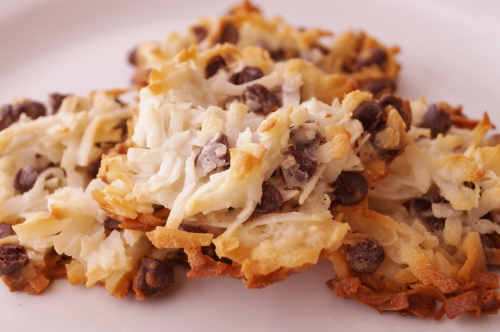
  • So…today is National Cookie Day! Who knew? I didn’t until I saw it on Twitter. Not sure where all these national days come from, so I thought I'd Chocolatechipmacaroonslook it up. This interesting tidbit of information came from Muppet Wiki (didn't know about that either!):

    National Cookie Day is a minor holiday, celebrating cookies in all their sugary glory. It occurs on December 4th of every year, but is not widely observed. Cookie Monster proclaimed his own National Cookie Day in the 1980 book The Sesame Street Dictionary

    Read more about the history of National Cookie Day at Days of the Year and get a recipe for peanut butter cookies, as well.

    I thought I'd get in on the celebration and share the recipe for these awesome cookies. They get rave reviews whenever I make them, and are included in the Morrell Family Cook Book. I don't remember where I got the recipe, but they're super easy and just as delicious!

    Chocolate Chip Macaroons

    ¾ cup sweetened condensed milk

    3 cups shredded coconut

    1 teaspoon vanilla

    ¾ cups chocolate chips

    Preheat over to 350. Grease cookie sheet. Combine all ingredients. Stir well. Drop by teaspoons on cookie sheet about 1” apart. Bake 10 minutes or until golden brown. Makes about three dozen.

    Don't forget to let me know how they come out! Of course, you have to love coconut.  ~ Mary

  • We had barely digested our Thanksgiving meal and I found myself out amongst the craziness looking for bargains. The parking lots were packed with everyone Clem-onojeghuo-178228 going every which way and the stores were over-crowded. We were filling our cart with things that we thought were great Christmas present deals and items we just couldn’t do without for that price.

    Really?

    The following day I disrupted my son and hubby during the football game to move our furniture around to make room for our Christmas tree. Then off to the basement I went, pulling out the tree and numerous boxes of decorations for both inside and outside. The pressure to get my decorations up and the gifts bought was already over-whelming me.

    It wasn’t’ soon before I found myself slumped on the couch too tuckered out to continue. My head was swirling and filled with everything but sugarplums. The Christmas season has not yet begun and I’m already coming unwrapped!

     It’s so easy to get swept up in the frenzy of the commercial aspect of the holiday season when everywhere you go there are glistening lights, over-sized decorations and the impulse to buy, buy, buy stuff.

     And that’s exactly what it is, just stuff that clutters our lives.

    After sitting for a while and thinking, I decided to take a deep breath and declutter this Christmas season, remembering what the true meaning of Christmas is about. It’s not about the lights, decorations, parties, and presents … it’s about our presence.

    This holiday season I’m making a conscious effort to slow down and pay attention to what really matters in my life … God, family and friends.

    Join me in focusing on the true meaning of Christmas by preparing spiritually and not commercially. Advent (the four weeks before Christmas) is the perfect time for preparation and praying leading up to the celebration of Christmas, the birth of Jesus Christ.

    By all means, let’s have fun, enjoy the holidays and each other. And take some time to think about what really matters to you. Show your loved ones how very dear they are to your heart and how much you love them.

    Reach out to others who may need your warmth and friendship. Do something nice for a neighbor. Spend time with an elderly person or someone who is lonely during this season. Share a kind word with a stranger. Reach out to the less fortunate. A small gesture goes a long way. I guarantee it will help you celebrate and enjoy the holiday spirit more thoroughly.

    And I quote…

    “Well, in Whoville they say – that the Grinch's small heart grew three sizes that day. And then – the true meaning of Christmas came through, and the Grinch found the strength of ten Grinches, plus two!”  ~Dr. Seuss

    Photo by Clem Onojeghuo on Unsplash

  • It's fall. I absolutely love the beauty of this season. It’s quiet and peaceful. I find it a good time for me to reflect on days gone by and those yet to come, before the hustle and bustle of the Pro-church-media-441073 holidays begins.


    I like to be a little selfish during this time of year and take some time to myself. Something I rarely ever do.


    This is when I start to venture out for brisk walks in the evening. The leaves have begun to change color and crinkle under my feet and the sky falls dark earlier, as I make my way through the path in our nearby park.


    These walks are a time for me to think about Thanksgiving and what that means to me. My childhood memories swarm through my thoughts like bees to a hive. Those days seem so long ago, yet are fresh in my mind. They are happy and sweet memories, like the honey that comes from that hive.


    I remember the large extended family Thanksgiving dinners where my Dad built two tables to seat 20 or so that made our table look like a feast in a banquet hall fit for a king. The plates were passed from person to person. The talking and laughter went into the wee hours of the night until family members made their way off the tables or couches and out the door.


    But now the days leading up to Thanksgiving are bittersweet for me. My Dad and two of my brothers are no longer with us and Mom is getting up in age. The older family members have passed and those that were young are the older folks now, including myself, with their own families and grandchildren who have separated off on their own.


    I desperately have tried to hold onto family traditions that have been handed down to me through generations. I feel like by holding onto them, I hold onto those memories and somehow a piece of those that have gone before me. They give me a warm nostalgic feeling. And I want my children to know and remember that feeling and to carry on the traditions as well. Traditions give each family a special meaning, a sense of home.


    Our Thanksgiving chicken liver stuffing is one that I have mastered and held onto with my mother’s watchful eye and approval. A dish that only a kid that grew up on it would love! My mother also passed down how to cook a juicy turkey that is never dry and all the trimmings, but it is that stuffing that makes my dinner and heart feel complete.


    And although our table is on a much smaller scale and surrounded by only a few these days, I find those few to be a true blessing in my life. I decided it would be nice if I incorporated some of my own traditions. One that I will share is that I ask everyone at the table to tell us something they are thankful for after we say “Grace” and before we stuff ourselves. It kind of stops everyone in their tracks and makes them think for a second. It’s heartwarming to hear what means the most to everyone at your table.


    As the family circle has changed and evolved over the years, I wait patiently for my family to grow in size and my children to hopefully have children of their own and carry on our family traditions. I look forward to the banquet size table again and the coming of family crowding my house one day.


    But for this year, I will be very thankful for what I already have been blessed with, who I have sitting beside me at the table and what I have to look forward to!


    May you have a blessed and Happy Thanksgiving!