•                                                                                                                                                       Stefan-kunze-18467

    This year I spent Mother’s Day away from home, without spending any time with my sons and their families. I had been sick for several weeks and my husband thought a few days away at the shore would give me time to rest.

    The hotel was lovely, as was the ocean view.  Still, I was feeling sad about missing my family. Then we went to eat lunch in the hotel restaurant .

    An elderly woman, probably in her 80s, came into the restaurant where the waitress greeted her as if they were friends, asking her if she had a good winter.

    The older woman replied, “Well, not really, but we have to deal with things as they come, don’t we.”

    She went on to explain that her daughter had become very ill with cancer during the winter and had died. The waitress was stunned, and unsure about how to respond, asked, “She wasn’t your only child was she?”

    The woman, now seated with a young man, shared that she lost her only other child, a son, two years ago. He had a heart attack at the age of 63.

    Now I was stunned. I couldn’t imagine the pain of losing one child let alone both children, and within such a short period of time. How did she cope? How was she sitting here getting ready to have a Mother’s Day lunch?

    A moment later the gray-haired woman smiled at the waitress and said, ”I’m just so grateful to be here with my nephew, and for my four grandchildren and eight great-grandchildren.”

    I felt myself getting choked up, but I was starting to understand.

    Later that evening, when we went for dinner, my husband struck up a conversation with our waitress and discovered that she was the single mom of three children, ages nine, seven and two. She was spending mother’s day working her second job at the restaurant.

    “It’s been hard,” she said, “but I was so happy to get this job. My kids are having a hard time adjusting to not seeing me but I explain to them it’s not a forever
    thing.  The extra money gives me, and them, security for the things we need. I’m very grateful to have been hired.”

    There it was again, the one thing that seemed to make the impossible, possible – gratitude – a powerful state of mind that serves as a wellspring for strength, persistence, positivity and growth. Rather than live in their pain and their struggles, these two women made the decision to live in a state of gratitude.

    Of course, there is always a need to first work through our grief, our anger, our pain when we are suffering, but eventually there comes a time when we must move forward. Sometimes our losses are so traumatic that we need the support of professionals or others who have been through a similar experience. But, when we find ourselves healing, choosing to live in gratitude can be an important step in reclaiming a life of hope and meaning.

    Priest and author, Father Henri Nouwen, explains that gratitude is not as much a decision as a discipline: “The choice for gratitude rarely comes without some real effort. But each time I make it, the next choice is a little easier, a little freer, a little less self-conscious. Because every gift I acknowledge reveals another and another until, finally, even the most normal, obvious and seemingly mundane event or encounter proves to be filled with grace.

    “There is an Estonian proverb that says: ‘Who does not thank for little will not thank for much.’ Acts of gratitude make one grateful because, step by step, they reveal that all is grace.”


  • In my lifetime as a Catholic, and particularly as a Catholic writer and journalist, I have been called a lot of things. Beata-ratuszniak-5428 - pathoffaith

    Often I am charged with being a bleeding heart liberal, other times a right-wing conservative. I’ve been called a heretic, a Jesus freak and a Church lady.  I’ve been accused of having delicate sensibilities, while others have charged me with being outspoken and ideologically aggressive.

    I guess I am either living my life as a pendulum, or I suffer from schizophrenia.

    Or maybe it’s just that for me, my faith in God and my attempts to live what Jesus taught is not a political issue or a social ideology. It is a way of life that transcends all attempts at definition.

    The reality is, I do not belong to the left or the right. I belong to Christ.

    The heart of my faith rests in a God who created all things, especially humanity, with love and for a purpose, and integrated all things into an interdependent whole.

    In this world which God created, all life is sacred, and we are called to care for and respect the life of the world that harbors us.

    I am pro-life, from the moment of conception until natural death, but I believe that education, not legislation, is our greatest weapon against abortion.  I also believe that one does not have to exclude the other.

    It seems obvious to me that if we poison and adulterate God’s creation, our anti-abortion, pro-life efforts are for naught. How will new life, or any life, survive on a planet that we have destroyed?

    Personally, I am grateful for the teachings of Pope Francis who, in this harsh and divisive world, is attempting to renew our understanding of the Gospel of Christ, the Gospel of Love.  I was deeply encouraged to read his words to the American bishops in 2015 when he spoke about the challenging issues of our time. His words speak to the laity, as well:

    “Ever present within each [challenge] is life as gift and responsibility. The future freedom and dignity of our societies depends on how we face these challenges.

    The innocent victim of abortion, children who die of hunger or from bombings, immigrants who drown in the search for a better tomorrow, the elderly or the sick who are considered a burden, the victims of terrorism, wars, violence and drug trafficking, the environment devastated by man’s predatory relationship with nature – at stake in all of this is the gift of God, of which we are noble stewards but not masters. It is wrong, then, to look the other way or to remain silent.”

    Being a Christian is not easy. It is not a warm and fuzzy, feel good faith that allows us to be armchair commentators. We are called to thought, to prayer, and then to action, which is why we often hear that faith is a verb. It is why so many of our saints are also martyrs.

    As we head into the Lenten season, and prepare for Easter by examining our relationship with God and our journey on the way of Christ, Pope Francis’ words to his brother bishops can serve as an opportunity for our introspection, as well:

    “I trust completely in the voice of the One who ‘teaches all things’ (Jn 14:26). Allow me only, in the freedom of love, to speak to you as a brother among brothers. I have no wish to tell you what to do, because we all know what it is that the Lord asks of us. Instead, I would turn once again to the demanding task – ancient yet never new – of seeking out the paths we need to take and the spirit with which we need to work.”

    “Each year, Lent offers us a providential opportunity to deepen the meaning and value of our Christian lives, and it stimulates us to rediscover the mercy of God so that we, in turn, become more merciful toward our brothers and sisters.”  Pope Emeritus Benedict XVI


  • As I sat down to order breakfast in our local diner, I remembered a time years ago having dinner here with friends we hadn't seen in a long time. They ordered Childrenelders
    their perfect meal from the senior menu, but when I attempted to do the same, I was looked at with furrowed brow by the server. “M’am, you have to be a
    senior to order from this menu.”

    I proudly pulled my license from my pocket and said, “Here’s my proof.”

    The young man tried to hide a snicker, “Fifty-five is not a senior in this restaurant,” and proceeded to turn the menu over so I could order something else, something more costly.

    “Well, it is by AARP standards,” I muttered under my breath.

    Who would have thought I’d be at a place where I was proud to be 55 years old?

    It’s not the case for many my age or older who often feel a terrible competition from the younger generation.

    I think many of us seniors would benefit from having a fairy godmother of our own, perhaps an older version of Cinderella’s, a little bent here and there, with a few brown spots and definitely a knee problem. She would, unashamedly, wear purple dresses and red hats and eat ice cream sundaes when everyone else is eating sherbet. Children, especially, would love to be around her because she would be REAL, authentically herself, and fully aware of the hard earned wisdom she had to share with others.

    And rather than appear when we need help finding our Prince or Princess Charming, she would appear to us senior folks when we focus too much on how good we used to look or feel, or how we never accomplished our dreams or maybe even, now, feeling that we have no purpose in life.

    It’s then that our fairy godmother would do one of those, Cher “snap out of it!” routines, and remind us in no uncertain terms that we are “all that” and more, especially when it comes to having a purpose in the lives of our families, and especially, in the life of our Church.

    My 25 years of work in religious education has shown me that, in many ways, our children are hurting and our families are hurting, and in that hurt they need their faith. But, for many families, faith and religion receives just a tiny portion of their attention, if any at all.

    So what happens to our children? What legacy is being left to them and their relationship with God and the Catholic family to which they belong? There is a real disconnect for them, a loss of their sense of roots and an emptiness that comes from a lack of tradition and ritual.

    How are they to come to know God, to learn to love God and to learn to love an imperfect Church without someone to guide them?

    I believe that seniors are integral part of the solution. Seniors are the elders of the Church, the wise ones, the people who must share their story with the younger generation so they may share the story with their children, keeping the cycle of faith and love alive and well in the American Church and in their homes, as well.

    Mary was such an elder, one who guided, sustained and comforted the faithful of her time by her presence and holy examples. She must be our example, too.

    Children may be the future of the church but without elders guiding them through the present with our witness and our wisdom, the future will continue to look bleak, especially the future of the Church as we know it.

    As ancient cultures knew well, the special gift of elders is not is knowing everything but in being able to tell the stories – whether it is the story of your family or the story of the parish, the stories that have happened over the many years of our lives, leaving us with gray hairs and wrinkles and bad knees and worse eyesight, or most importantly, the story of our faith. There is wisdom in these stories and that places seniors among the greatest treasure our parish families have.

    Tell the story of your Catholic faith to a child today. You can give them no greater gift.

  • Inevitably, while sitting at my computer trying to write, e-mail notifications distract me.  Perch

    “Let me just respond to these few,” I think, because, of course, they’re important. Behind me, the phone rings every few minutes, some calls I take, some I let go to voice mail, certain to store them in my mental “things to be concerned about” file.

    Today, a new bounty of mail sits on my desk, added to the pile from the past week or so that is screaming to be opened.  As I answer the phone, a letter from the tax attorney catches my eye and I decide it’s best to take a peak.  After a minute of reading and sighs, I realize there is no longer any sound on the other end of the line.  My caller has been waiting for more than a few seconds for me to respond to her question, which I never heard because I was distracted; a case of being so busy nothing gets done.

    And my writing? Now I need to reboot the entire process because in multitasking I lost valuable time and energy on my most important project. Besides, it will have to wait until I return from the supermarket and finish cleaning the house because my grandchildren will be here bright and early tomorrow morning.  And then there’s that on-line class I’m facilitating tonight.

    Suddenly I am thinking of Dr. Seuss and The 500 Hats of Bartholomew Cubbins.

    Bartholomew is young boy who wears a plain red hat and lives in a hut on the edge of a cranberry bog. His family lives in the Kingdom of Didd. When mighty King Derwin comes to town and expects all the townspeople to take off their hats as a sign of respect, Bartholomew runs into a problem. Every time he removes his hat a new one appears on his head. Will he ever be hatless?

    It’s a question to which many of us can relate, including the 16th century Spanish mystic Teresa of Avila who I am happy to have as my patron saint. Now here was a multitasker and wearer of many hats.

    Teresa’s childhood desire was to follow in the footsteps of the martyrs, but fortunately her life unfolded according to God’s plan. She became a mystic, a writer, a poet, a bold religious reformer and businesswomen, and the foundress of the Discalced Carmelite order. She continually had to dodge the inquisition as she strove to do God’s work, frequently wore the hat of a politician to get what was needed for her order, her nuns and priests, and eventually became the first woman to be declared a doctor of the Church.

    Though she originally desired only to establish a monastery for contemplative prayer, this passionate saint with a keen sense of humor eventually traveled thousands of miles of poor roads across Spain and Portugal by curtained carriage or mule carts, to found 17 monasteries for nuns, and with St. John of the Cross, two for friars. She also composed a body of mystical literature that continues to inspire and strengthen the faithful worldwide.

    As a tireless fighter for her faith and her God, her life was a whirlwind of responsibilities, and while the rule in her Carmelite monasteries was one of discipline, intense prayer and work, in solitude and community, she wisely recognized that such effort needed to be balanced by recreation.

    St. Teresa was so convinced of the value of rest and enjoyment she wrote it into her rule, requiring her nuns to take two recreation breaks a day. Joy was a hallmark for her, and she lived that joy, often singing and dancing for convent occasions and sharing her talents with the castanets, drums and tambourine,   In fact, the image of St. Teresa with a tambourine was written into a beautiful icon by Franciscan Brother Robert Lentz, and is a wonderful tool for meditation.

    In her spiritual memoirs, St. Teresa offers some invaluable advice to those of us who sometimes struggle with many hats and many tasks, while our spiritual lives, and our joy, flounder in our busyness: “I am amazed by how much can be accomplished on this path by being bold and striving for great things. Even if a soul is not quite strong enough yet, she can still lift off and take flight. She can soar to great heights. But like a fledgling bird, she may tire herself out and need to perch for a while."

  • Near the end of the beloved Charles Dickens’ classic, “A Christmas Carol,” the cold heart of Ebenezer Scrooge is transformed and he exclaims, “I will honor Christmas in my heart, and try to keep it all the year.”

    That was London in 1843 and Dickens was writing about making Christmas something joyful for those in need. Simplechristmas

    In 21st century America, we are faced with the consumptive Christmas, crafted by marketers and advertisers for the sake of business profits. To be effective it must keep the focus of Christmas on us. Sadly, it works.

    For nearly three months we are assaulted by the “Christmas is coming” frenzy that eats away at what should be a  peaceful, reflective Advent, and imbues our Christmas with a compulsion to spend money we don’t have on things no one needs.  

    I saw it for the first time this season in mid-October. Two women in the local toy store were pushing around several baskets filled to overflowing.  I thought they were store employees restocking the shelves.

    But when I got to the check-out, they were at customer service with six shopping carts piled high with toys. My daughter-in-law engaged them in conversation and learned they were Christmas shopping – for two children age three and five.

    “You’re buying all those gifts for just two little boys?” I asked.

    The grandmother assured me that was the case, and there was more to come.

    Our faith assures us it is love, not presents, that makes Christmas the season of more.  But over the years, Christmas has become the season of consumption, buying more gifts, spending more money and running ourselves ragged attending to the superficial trappings of a “perfect” Christmas.

    All of this adds to stress and frustration, and, often, to the sadness and depression many already feel at having to navigate a season of joy when they are impoverished, sick, grieving, or alone.

    Faced with an ever expanding commercial Christmas, how can we ignite the true spirit of Christmas in our hearts, and “keep it all the year”?

    First, we can take a lesson from Santa and keep a tight hold on the Christmas reigns.  He knows how fast joyful gift-giving can deteriorate into chaos if he lets Rudolf and the rest run wild through the sky.

    For us, keeping control of our Christmas doesn’t mean giving up our love of all things Christmas – twinkling lights, a beautifully decorated tree, gift giving or even Santa – but it does mean scaling back and prioritizing.

    Most importantly, it means refocusing on the Christ-child and the Holy Family. Their Christmas story should be our Christmas story – a story of saying yes to God, of humility, gratitude and love.

    Our Christmas spirit is wrapped up in swaddling clothes. Like Mary, we need to keep the story of the Nativity in our hearts and reflect on it throughout the year.

    Pope Francis has said, “In switching on the light of the Nativity scene, we wish for the light of Christ to be in us. A Christmas without light is not Christmas. Let there be light in the soul, in the heart; let there be forgiveness to others; let there be no hostilities, which are dark. Let there be the beautiful light of Jesus. This is my wish for all of you, when you turn on the light of the crib.”

    We can keep that light burning throughout the year by celebrating Mass and receiving Jesus in the Eucharist. We can also be the light of Christ by serving others.  Whether we help one or many, service can lift us out of ourselves and our own pain. And as we move into the New Year, we can remember the Magi, making our resolutions as gifts to the Christ child.

    Of course, we are people moved by our senses, so I’ll admit I cheat a bit. I have a small pine tree next to my front door and keep it lit all year round with little white lights. Visitors are often surprised by the aroma of balsam in the middle of the summer. And since I spend a great deal of time in my car, I listen to the words of a beautiful hymn:  “More love, more love, the heavens are blessing, the angels are calling, O Zion, more love …”

  • With Thanksgiving around the corner, and Christmas not far behind, thoughts of gratitude and giving are close at heart. Twombly12

    For those of modest means, the holidays are also a time to be mindful of money, to keep within a budget. But let’s face it, the pressure to spend is sometimes overwhelming.

    While mulling over our holiday budget, I recalled a news story that popped up on my Facebook page.

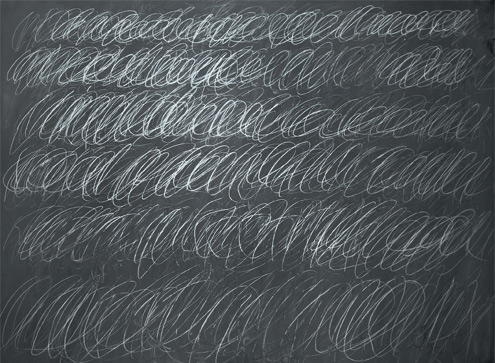
    The image that accompanied the story reminded me of a child’s blackboard covered with rows of circles, the kind you draw when covering up a line of text or doodling on a page. 

    Actually, the image was a renowned work of art by American abstract artist Cy Twombly, and it brought in $70.5 million at a recent
    auction at Sotheby’s.

    A description of the painting explains it was created in 1970, as part of a blackboard series made of white wax crayon lines aginst a gray background, executed in four rows of exuberant scrawl … using a strict process that was derived from handwriting techniques that children first learn in school.

    I was speechless…except for the “seriously??” that slipped out of my mouth.

    In reviewing the list of artwork sold at that auction, my incredulity grew. Forty-four pieces made sales of nearly $295 million, more than the gross domestic product of some small countries.

    I realized I had no true sense of the wealth some people have accumulated, people who think in millions the way most of us think in dollars and cents.  I could not fathom having $70 million in pin money and certainly could never rationalize spending it on a piece of art … not when there was so much good that could be done with so much money.

    Imagine the communities that could be helped, the food pantries that could be filled to overflowing for years, the homes and lives that could be rebuilt following a hurricane or other natural disaster, the people who could be trained and employed so families could have a decent standard of living, the children who could be educated.

    To put it in just a bit of perspective, $70 million could pay for cleft palate repair for some 280,000 children through an international organization. No piece of art is more beautiful than the smile of a child.

    The Gospel of Luke is clear: Much will be required of the person entrusted with much, and still more will be demanded of the person entrusted with more. 

    Still, it is easy for us to fall into the trap of expecting those who have so much, an obscene amount my dad would say, to foot the bill for good deeds, for making the lives of others better. Our true task as Christians is to evaluate what it means to have much, and then reflect on what God is calling us to do.

    I remember a YouTube video of shoppers in a food court in a local mall. A young man went to some tables and told the customers he hadn’t eaten for a while and asked if he could have a bit of their food. Across the board, they said no.

    The scene changed to some who were homeless and who had just been given a bag of food from a local restaurant. The recipients were generous in their gratitude, so much so that when a young man approached each of them, separately, and asked if they could give him something to eat because he was hungry, they all shared the little they had been given without hesitation.

    It seems to me that Thanksgiving is the perfect holiday to celebrate before Christmas, because it can help us to focus on the blessings of God, and to enter Advent and Christmas from a place of gratitude for our God who gave us a priceless gift – his son.

    Much will be required of the person entrusted with much, and still more will be demanded of the person entrusted with more.  Luke 12:48

  • Hate is an ugly word, an ugly emotion and an ugly ideology.                                                                                                                                                                                                                                                            Roadtohell
    It is the antithesis of natural law, the Ten Commandments and every teaching of Jesus Christ. It is responsible for murder and mayhem and the unspeakable torture and decimation of whole races.

    It is something I have rarely, if ever, written about in the 20 years of this column – until now; until I woke up one morning and had the awful realization that I am capable of hate.

    The school for this very disturbing lesson about myself was this year’s political campaign. As it progressed, a change came over me, imperceptible at first, and when I began to sense it, I turned to the always handy tools of rationalization and justification.

     I was moving down what C. S. Lewis called, “the safest road to Hell … the gradual one.”

    The seeds of anger were taking root – not with any one particular group of people but with one particular person – and the ugly fruit of hatred was blossoming.  What woke me up was a reminder from Martin Luther King, Jr.:  “Let no man pull you so low as to hate him.”

    The realization forced me to take stock of my own thoughts and emotions, to evaluate how much attention I was giving to my feelings of anger, fully aware that the more attention you give something, the more it grows.

    I needed to understand the basis for the anger that was eating at me, and what I discovered was fear, a bottom-line fear that we, as a society, are moving backwards. Fear that, in spite of thousands of years of growth and what we sometimes mistakenly refer to as civilization, we have come no further along the path of becoming fully human than we were when Cain killed Abel.

    And why is it that, for us who claim to be Christians, we are often less a part of the solution than we are a catalyst for the problem?

    At what point in our lives does it become necessary to reconsider what it means to live as Christians, specifically Catholic Christians, in a world that seems, at times, to be running in reverse, and all because of fear? Of course, many of our fears are well-founded. The problem comes when we allow our fears to push us into isolation, irrational behavior, escalating conflict, and the demeaning and mistrust of our fellow human-beings.

    The great rabbi, Abraham Heschel, a contemporary of Martin Luther King, Jr., left all of us his profound insights on what it means to be people of faith.  Reflecting on one part of his commitment to the civil rights movement, he said, “For many of us the march from Selma to Montgomery was about protest and prayer. Legs are not lips and walking is not kneeling. And yet our legs uttered songs. Even without words, our march was worship. I felt my legs were praying.”

    Rabbi Heschel underscored the truth that our involvement in the real world is a spiritual involvement, as well as a practical one. This spiritual engagement must be our foundation in all the arenas of our lives – family, work, cultural, environmental and political. It must direct our decisions and behaviors, from the seemingly insignificant to the profound, especially where fear exists.

    Our Catholic faith should lead us away from a purely emotional reaction to our fears and encourage a rational, responsible, intelligent response that fosters the unity on which our faith is built – the Trinity, the communion in love of Father, Son and Holy Spirit.

    Jesus’s own words call us to live for this unity:  “I in them and you in me, that they may be brought to perfection as one, that the world may know that you sent me, and that you loved them even as you loved me.”

    Even Scripture never offers any assurances that being a follow of Christ and living the Gospel will be easy. It’s not. But it’s worth the effort.

    “Indeed the safest road to Hell is the gradual one – the gentle slope, soft underfoot, without sudden turnings, without milestones, without signposts … ”  ― C.S. Lewis,      
     
    The Screwtape Letters


  • Today a beautiful red cardinal lighted on the head of a cement pelican that sits on one of the posts on my front porch railing. Feathers2
    He cocked his head to the side and looked in the window at me, where I sat at my desk, as if to ask what happened to all the food I left for my feathered friends earlier in the morning.

    I laughed to myself and thought, “You were not the early bird today, dear friend. You were beaten by several blue jays, a host of finches, some blackbirds, and of course, the local squirrels.”

    Obviously, I love birds.

    There are few things that give me a greater feeling of contentment than to watch the birds come to the railing outside my den window and eat the bread or seed I’ve left for them. Seeing their unique beauty, listening to their chatter with each other, even observing their squabbles, are some of the best moments of my day.

    I have often wondered how these amazing creatures weather the varied and severe storms that could prove to be a mortal danger.

    A professor in Tufts University explains that aside from a bird’s natural built-in protection such as feathers, which offer remarkable insulation from cold air reaching the skin, and feet designed so body heat is not lost to cold air, there are two things that help birds survive – location and preparation.

    Being small allows birds to take advantage of microhabitats, such as the lee side of trees or deep inside thick hedges.  He notes that wind speeds, and even the effects of driving rains, are dramatically decreased in these microhabitats. As long as the birds stay put and fluff up their feathers for increased insulation they can usually weather the worst of storms.

    But staying put also means they cannot forage for food, so an important part of their preparation for storms is to get as much nourishment as possible before the storm hits. Many birds can sense changing air pressure and, in preparation, spend as much time as possible foraging and eating.  Because eating produces metabolic warmth for birds, who need to consume one-third to three-quarters of their weight daily, food is imperative if they are to survive.

    It is no different for us when we are faced with so many of the severe emotional and spiritual storms that often hit without warning. We are strongest when we weather the storm from within the shelter of our faith and when we keep ourselves nourished with prayer, the Word of God, Eucharist and the support of our faith community.

    Preaching in one of his weekly Angelus messages, Pope Francis taught on the Gospel of Matthew and the story of Jesus walking on the water to his Apostles during a storm. He recalled how Jesus instructed Peter to come to him on the water and, with his eyes on Jesus, Peter did just that, and walked on the water – at least for a few seconds. Peter then yells out to his Lord, “Save me!” and Jesus reaches out his hand and saves him.

    Pope Francis reminds us, “The faithful and ready response to the Lord’s call always enables one to achieve extraordinary things. But Jesus himself told us that we are capable of performing miracles with our faith, faith in Him, faith in his word, faith in his voice. Peter however begins to sink the moment he looks away from Jesus and he allows himself to be overwhelmed by the hardships around him.

    “But the Lord is always there, and when Peter calls him, Jesus saves him from danger. Peter’s character, with his passion and his weaknesses, can describe our faith: ever fragile and impoverished, anxious yet victorious, Christian faith walks to meet the Risen Lord, amid the world’s storms and dangers.”

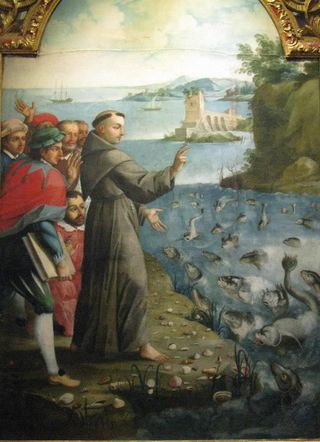
  • Miracles-of-St.-Anthony-of-Padua-with-the-fishesThe stories of the saints are chock full of inspiration, so when I had the chance to speak to more than 400 Catholic school teachers recently, I decided to share one of my favorite stories, attributed to an event in the life of St. Anthony, a powerful preacher and insightful teacher.

    When preaching in a town near Padua, where there were heretics in great numbers, St. Anthony became frustrated that his words and teaching about Christ were falling on deaf ears. So, after a prayerful discussion with God, he made his way to the shore to preach to the fish.

    “"Listen to the word of God, O ye fishes of the sea and of the river, seeing that the faithless heretics refuse to do so," St. Anthony proclaimed.

    No sooner had he spoken these words than a great multitude of fishes, both large and small, swam to the bank where St. Anthony stood. All the fish held their heads out of the water and seemed to be keeping their attention on St Anthony's face.

    St. Anthony began to preach to them, saying: "My brothers the fishes, you are bound, as much as is in your power, to return thanks to your Creator, who has given you so noble an element for your dwelling; for you have at your choice both sweet water and salt; you have many places of refuge from the tempest; you have likewise a pure and transparent element for your nourishment.

    “God, your bountiful and kind Creator, when he made you, ordered you to increase and multiply, and gave you his blessing. In the universal deluge, all other creatures perished; you alone did God preserve from all harm.

    “He has given you fins to enable you to go where you will. To you was it granted, according to the commandment of God, to keep the prophet Jonah, and after three days to throw him safe and sound on dry land. … Because of all these things you are bound to praise and bless the Lord, who has given you blessings so many and so much greater than to other creatures."

    At these words the fish began to open their mouths, and bow their heads, expressing reverence and praise for God in their own way.

    There is more to the story, of course, and it turns out well for the heretics, as you might expect. But what resonated with me the most, at least the first time I read the story, is the honor and praise of the fish, offered out of gratitude for the many blessings of God.

    But the image that will stay with me from my recent presentation came from a creative group of teachers who pointed out that fish come to the surface of the water when they are being fed. It was an observation and a lesson powerful in its simplicity, which good teaching most often is. I know I will never look at fish in the same way again, especially those in a fish tank or fish bowl.

    They will always be a symbol and a reminder of the need to come up to the surface from the deep recesses of our lives to be fed by the Word of God. They will bring to mind the many blessings that call us to gratitude, especially those we have failed to consider. And they will help me to remember that we are unique, among God’s creatures and among our sisters and brothers.

    Just as a fish will not sing God’s praise with the voice of a sparrow, we must offer our love and gratitude to God in our own voice, with our unique gifts through the work of our own hands and hearts.

    May the New Year be a time of imitating the fishes – being grateful, being ourselves and praising our God.


    "Blessed be the eternal God; for the fishes of the sea honor him more than men without faith, and animals without reason listen to his word with greater attention than sinful heretics."  St. Anthony


  • The man behind me in the checkout line greeted the cashier with the standard, “How are you?”                                                                                                           Joycomestext

    The cashier responded with a broad grin. “I’m good!” she said. “It doesn’t serve any purpose to be miserable, does it?” 

    My father had little patience for miserable. He used the word to describe people who were not simply unhappy, perhaps for good reason, but more to the point, those who were nasty, irritable and just plain unpleasant.

     He saw their behavior as spoiled and self-centered, people unable to be grateful for the many blessings in life. His feelings stemmed from having lived through the depression, which forced him to financially support his mother when he should have been starting high school.

     His father was murdered when my dad was only eight, his brothers had families of their own, leaving him as man of the house. Surely, he had reason to be miserable, but his life-long habit of whistling, even when life brought its challenges, revealed a man with a happy heart. 

    My father would have liked the cashier. He appreciated people who embraced life in spite of its difficulties, especially when they could smile. A smile is a contagious joy, he used to tell me, which is probably why he was drawn to my mom. Her smile was enchanting, and the simplest pleasure would light up her face. 

     One of my favorite memories of my mom was her unabashed delight in musicals. Every Tuesday, for a time, she used to take me to the Strand movie theater to see shows like Flower Drum Song, Carousel, Brigadoon, Kismet and South Pacific. Never did she miss an opportunity to watch the films on TV, and every production had her singing throughout the house. She even bought me all the piano scores so I could serenade her from our old upright.

     Needless to say, the songs and lyrics from dozens of musicals have a special place in my heart. So it was not surprising when, during a recent conversation, someone said “you’ve got to have a dream,” I immediately recalled the music and lyrics from, “Happy Talk,” one of the songs in South Pacific: “Happy talk, keep talkin’ happy talk, Talk about things you’d like to do. You got to have a dream, If you don’t have a dream, How you gonna have a dream come true … If you don’t talk happy, and you never have a dream, how you gonna have a dream come true?” 

    I’ve always thought of the Gospel as happy talk, which is why, as a newspaper editor who routinely reviews photos for print, I am always surprised at the dearth of smiles among worshipers in photos of the celebration of Mass. I am more reminded of the words of St. Teresa of Avila, who asked God to deliver us from “sour-faced saints.” 

     I suspect it is more cultural than a real lack of joy. Our tradition as western Catholics is serious, respectful devotion. Besides, it seems strange to be sitting in a pew smiling for no apparent reason. 

    Still, I’ve decided to give it a try. Hopefully, it will be a reminder for me that our faith in Christ should permeate our very being with profound joy. At the very least, people will wonder what I’ve been up to. 

    Mary Clifford Morrell is the author of "Things My Father Taught Me About Love," and "Let Go and Live: Reclaiming your life by releasing your emotional clutter," both available as ebooks on Amazon.com.