• When my son, a father of two young sons himself, posted a Facebook photo of a little hand trying to Bubblespush under a bathroom door, and the photo title was “They Will Find You,” I laughed out loud.

    As a mother of six sons it often seemed like there was never a day when a flurry of little feet and hands weren’t running to me all day long, even to the bathroom, bringing me the skinned knee, the crayon scribbled work of art, the yellow dandelions, the impromptu hug, the gold star on a homework paper, or an invitation to hear "Chop Sticks" played for the first time on the piano.

    Those are the times when our child calls out our name – Mom, I'm hurt! Dad, can you fix this? Grandma, Look what I made! Poppy, this is for you! Mom, I love you!

    Those times are expressions of love and trust on the part of the child and moments of joy for us.

    Jesus spoke often in Scriptures of our need to be like little children, but how often do we, like our child, call out the name of the one we love and trust? How often do we run to our God, not only when we are hurt or afraid, but with our creative endeavors, no matter how scribbled they are, to say unashamedly, "This is for you!"

    So many times, when I have given a workshop or retreat day, participants will share with me their insecurity about praying. They feel they don’t know how.

    I assure them that God does not wait impatiently for us to come to him, expecting us to use only "this" phrase or "these" words. Rather, he waits for us expectantly, desiring to see us running to him with trust and delight, calling out the most beautiful prayer ever created – his name.

    God desires an intimate relationship with us, not a routine one.

    I have always loved the story of an old Irish woman living alone in a cottage tucked away in the mountainous crags along the coast of Ireland. One day, a visitor made his way to the cottage and, upon entering, announced to the old woman he had come to see her because she was alone and in need of company.

    "Alone, is it?!" she laughed with delight, "With Himself and his Blessed Mother keeping me company?" She waved a gnarled hand at the pictures that hung over the hearth – the Sacred Hearts of Jesus and Mary.

    Later, that same visitor would return to the cottage and find one of the beloved pictures missing from its place of honor. The old woman furrowed her brow, saying, "We're having a tiff, he and I!"

    Then she pointed to the drawer where she had stashed her dearest friend, face down no less.

    But tiffs come to an end, and this wise, delightful woman, who loved and trusted God with the heart of a child, could most often be heard praying, in joy and in anger and in grief, "Sweet Jesus!"

    Pope Francis once posed a question to be considered by every Christian: “Do you think of God as someone who loves you?”

    Our perception of God, he explained, has a great deal to do with our prayer life.

    “A heart inhabited by the love of God makes prayer become even a thought without words, or an invocation in front of a sacred image, or a kiss sent towards the church,” he said.

    If we reflect on the Pope’s question, and remember to pause in wonder at God’s unconditional, passionate love for us, we will be able to keep the name of Jesus in our hearts and always be at prayer.
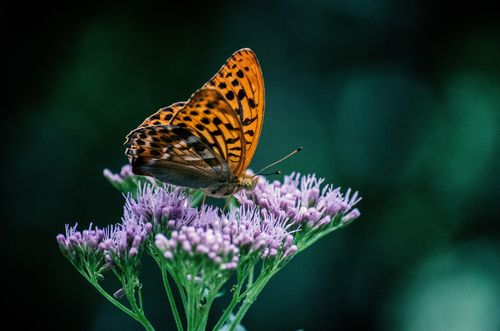
  • There is nothing my father enjoyed more in the spring than a visit to the local nursery. There I Butterflyonpurple flowers

    would watch him wander through aisles of colorful blooms and I could almost see the wheels of his brain spinning with wondrous plans for that summer’s garden.

    He would carefully choose a variety of plants, some of which would begin blooming in spring and
    others that would bloom later, ensuring that our yard had the beauty of flowers throughout the fall.

    He was diligent in caring for his tender charges and when dahlias, geraniums and irises were in full bloom it was a glorious site. One of his favorite flowers was the portulaca, an amazing plant that would fill up his planting boxes with sunny, multicolored flowers. They seemed to proliferate even in the worst of conditions, a trait inherent in the plant, I would learn. But my father loved to take credit for lush growth, always with a twinkle in his eye.

    He shared with me the story of the Irish pastor who decided to hire a gardener for the parish grounds, which had been completely overtaken with weeds and vines. From spring to summer the wiry old man worked diligently to restore the place. Then, one fine day, the pastor strolled out into the flower garden with a neighboring priest, anxious to show off the new creation.

    Gesturing toward the many neatly trimmed bushes and plants burgeoning with flowers, the pastor said, "I praise the good Lord for all of his handiwork!"

    Stepping out from behind a bush with clippers in his hand, the gardener quickly chastised the pastor, saying, "Don't you go giving all the credit to God. Just remember what this place looked like before I got here and God had it all to himself!"

    The story still makes me laugh, but, having failed at a number of gardens, it also reminds me of what’s required of us as co-creators with God. A failed flower garden is one thing, but a failure to grow what is good and beautiful and fruitful in our relationships is another.

    Imagine if we were to have the passion for growing our relationships as author Nathaniel Hawthorne expresses for growing a garden: “I used to visit and revisit it a dozen times a day, and stand in deep contemplation over my vegetable progeny with a love that nobody could share or conceive of who had never taken part in the process of creation. It was one of the most bewitching sights in the world to observe a hill of beans thrusting aside the soil, or a row of early peas just peeping forth sufficiently to trace a line of delicate green.”

    This summer we planted portulacas in our flower boxes. We learned about their need for full sun and their shallow roots which don’t require an abundance of watering.  My father would be proud of the results and I often imagine him sitting on the deck with a cup of coffee enjoying the beauty of God’s creation, nurtured by my husband’s daily oversight.

    I think my dad would especially like the additional, unexpected gift that came with caring for the gardens.  Butterflies.

    These delicate, winged, living works of art, in a variety of sizes and colors are daily visitors to the vibrant portulaca flowers.

    I know there is a lesson in there somewhere.

     “The best place to seek God is in a garden. You can dig for him there.”   George Bernard Shaw

  • One of the things I love about my home is the small library created for me by my husband, a gifted
    carpenter.  Whitewashed shelves and crown molding wrap around three walls, giving me a lovely Unsplash hidden saints
    place to house my oversized collection of books.

    Over the years, it seems I have developed a habit of writing notes, poems and prayers and then saving them in a favorite book. So recently, as often happens when I pull out a long untouched volume, a small piece of paper fell from between the pages.

    Unfolding the paper, I saw a circle in which I had written two letters of the Hebrew alphabet – Lamed and Vav.  I have no recollection of why I wrote them, unless it was one of my rushed attempts to simply practice the alphabet when reading Hebrew was a requirement of my graduate degree.

    Curious to remember what I had forgotten, I decided to Google the letters to find out what they meant and soon discovered the Jewish “Legend of the Lamed Vavniks.”

    To understand the legend one has to first know a bit about Hebrew numerology, where each letter has a numerical value – lamed is 30 and vav is six. Together, the two letters equal 36 – the number, so the legend goes, of the righteous in every generation whose virtue keeps the world from destruction.

    If the concept sounds familiar it’s because the legend is based, in part, on the story of Abraham who beseeched God to save Sodom and Gomorrah for the sake of a small group of righteous people. God replied to Abraham, “For the sake of ten I will not destroy it.”

    So, what is the work of the lamed vavniks? They are fonts of loving-kindness, pouring compassion on the world and using the gifts and talents they were given by God to raise up those around them.

    “Without their acts of lovingkindness,” writes Rabbi Rami Shapiro, “life on this planet would implode under the weight of human selfishness, anger, ignorance, and greed.”

    In his book, “The Sacred Art of Lovingkindness,” Rabbi Shapiro explains, “Cultivating the sacred art of lovingkindness is enrolling yourself in the ranks of the lamed-vavniks.

    “The tipping point for maintaining human life on this planet is thirty-six people practicing the sacred art of lovingkindness at any given moment. These need not be the same thirty-six people at each moment, however. I believe that people step into and out of the lamed-vavnik role, and that at any given moment thirty-six people are stepping in.”

    The heart of this legend is meaningful for people of all faiths, and is reflective of the lives of so many saints who lived with a knowledge of God’s presence and a desire to be God’s love for a wounded world and wounded people.

    Rabbi Shapiro calls us to a similar mission, and offers some sage advice. He writes, “Once you realize that the whole world depends on you for its very survival, you will not lack in opportunities to serve. Just remember that you are a hidden saint. While it is fine to invite others to join with you, make sure you don't advertise your own saintliness. While being a lamed-vavnik may be good for your soul, it doesn't belong on a resume."


  • The morning news disturbs me.                                                                                                                                             Olafquotelove

    I know what I’m going to see and, yet, I am regularly overwhelmed at the capacity of human beings to hurt each other, not just in small ways, which are damaging enough, but with viciousness and a total disregard for the life of another person. I am often reminded of my father’s prediction when there was a steady stream of bad news: The world is going to hell in a handbasket.

    The morning news scares me.

    It seems our ability to be self-focused at the expense of others is gaining ground. In fact, there are days when it seems to be snowballing out of control. If we were really to examine even our own lives honestly we might be surprised at the depths of our ability to be selfish, to rationalize our need to put ourselves first – our wants, our needs, our political ideologies, our race, our ethnic group, our religion.

    The morning news propels me.

    The more disturbed, scared, confused or hurt I am, the more I turn to God.  I have found that when I ignore Scripture and put my faith only in my own thoughts and feelings, I become less than I am meant to be and less capable of being a part of the goodness in the world.  Bad news propels me to turn again to God’s command, “Trust in the Lord with all your heart, on your own intelligence do not rely.”

    The morning news reminds me that we are the ones who make life more difficult and more painful for ourselves and for others because we allow our lives to be ruled by our feelings.  I was reminded of this at morning Mass when Father Emeka preached on the story of Abram and Lot who found it necessary to separate their flocks.

    Abram put Lot first and allowed him to choose the land he wanted. Lot chose what he thought was the choicest land for himself, “all the valley of the Jordon,” near the city of Sodom,  without consideration of what would happen to Abram, who was left with the dust of the land on which he stood. But Lot’s happiness and prosperity would be short lived. Moses reminds us that, “This was before the Lord destroyed Sodom and Gomorrah” (Genesis 13:10).

    Lot would lose everything, but God blessed Abram for his faithfulness, and promised to give him all the lands for as far as his eyes could see, including the valley of the Jordon.

    Reflecting on the choices of two very different men, Father Emeka stressed that we are also “called to go beyond what we feel and make choices from our hearts.”

    This may seem like a contradiction, since in our society we treat the heart as the center of all feeling.  But in Scripture, the heart has much more depth and purpose. As the organ of life, it is the seat of will, the center of both emotional and intellectual life, it reflects our nature and our true character.

    When we allow the heart to be formed by God, it will lead us to do good rather than cause harm. The heart molded after the heart of God can transform the bad news of the world, of our communities, our workplaces, our parishes, schools and families, into good news.

    And who couldn’t use some Good News.

  • During my visit to North Carolina for my granddaughter’s third birthday I had the chance to sit in the upstairs gallery of the gymnastic studio and watch this petite
    Handwrittennotewhirlwind and her classmates run, climb, tumble and spin their way to pure enjoyment.

    At several points during the class, when the instructor had assisted my granddaughter in some way, I heard her adorable, three-year-old voice say, “Thank you.”

    Her expressions were priceless, and memorable, especially in a culture that seems to have all but forgotten the value and meaning of gratitude.

    I’m proud to say her cousins have learned the same graciousness. My sons and their wives are passing on something that was taught to them, and it is something that was certainly handed on to me by my parents, especially my mom.

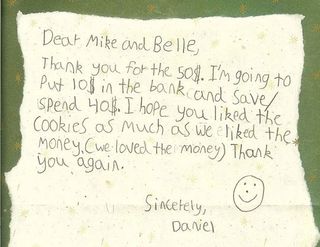
    I was raised during the time of Emily Post manners, which meant white gloves when you went shopping, dress-up for outings and cultivating the now lost art of the thank you note.

    I lost the gloves in high school, and today a tasteful dress-down has replaced the dress-up for most outings, but what I learned is that manners, and particularly expressions of gratitude, are more than just trite social mores.

    They are opportunities to express respect and appreciation of others, to build relationships, and to be reminded that we are not the center of anyone’s universe except our own.

    I was pleasantly surprised to discover that Emily Post’s great-great-grandson, Daniel Post Senning, is carrying on Emily’s legacy. He wrote, “Good manners are about more than fulfilling bare-minimum social obligations. They are an opportunity for us to connect to the people in our lives in a meaningful way. In an increasingly informal digital world, continuing to pull out pen and paper is a way to distinguish yourself. The handwritten thank-you note speaks volumes simply as a medium and sends the message that you care enough to invest yourself personally in acknowledging another.”

    In my work as a writer and columnist, one of my greatest pleasures has been the notes I’ve received from readers, some of whom have stayed in contact and who I consider as friends. I have kept all the notes I’ve received during the past 20 years and I take them out every once in awhile and re-read them.

    The thank-yous I’ve received for my writing give me the boost of encouragement I need sometimes when my spirit is lagging. I am grateful for them and the people who wrote them.

    One of my greatest regrets is losing the envelope with the return address of a reader who sent me the very meaningful gift of a dishtowel from the Sunrise Café in Ortley Beach. I tore my office, at home and at work, apart looking for it because I wanted to send a thank-you note. I actually lost sleep over it.

    Perhaps, she will read this post and know that I absolutely loved the towel and have it hanging in my kitchen. It is especially meaningful now that the café is gone, a victim of Sandy, and we are forced to sell our home in Ortley Beach.

    You just never know how much a handwritten note, or seemingly small gift, will mean to someone.

    “Giving thanks always and for everything to God the Father … ” Ephesians 5:20

    Image from apartmenttherapy.com where there’s great article on making thank-you notes a fun activity for kids.

  • On a recent fast food run, my son brought home a bag of tacos and more than a few packages of Sylvesterhotsauce
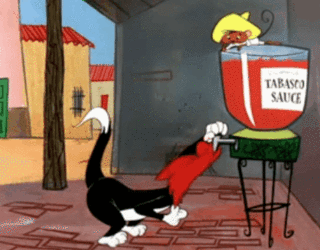
    spicy condiments.  As I tore open a package I noticed the words: Sauce responsibly.

    I have to admit, I chuckled, having on more than one occasion been irresponsible with the jalapeno pepper sauce. Wow.

    Soon, a flurry of other “responsibly” options were running through my head, like “walk responsibly,” as in look up from your cell phone before you step in front of my car in the supermarket parking lot. There have been way too many close calls on shopping trips.

    Or “Facebook responsibly,” with more reasons than could ever be addressed in this brief column.

    But related to this is an option that holds the most meaning for me: “Use words responsibly.”

    I never bought into the “sticks and stones can break my bones but words can never hurt me,” adage.

    It has been my experience that poorly, thoughtlessly or maliciously used words can be as damaging to the human spirit as a bruised body or broken bones.

    Four hundred years ago, William Shakespeare wrote:  “Words without thoughts never to heaven go.”

    Considered by many to be the greatest writer, and most certainly the greatest dramatist, in the English language, Shakespeare understood the power of words as well as he understood the intricate workings of the human spirit.

    However, compared to Scripture, Shakespeare’s prediction for words without thoughts is very generous. In the Gospel of Matthew we are warned, “I tell you, on the day of judgment people will render an account for every careless word they speak.”

    Scripture is clear that words, through us, have the ability to create or destroy, to heal, to injure or to bless.

    As such, our ability to create with words and to influence others through our creation comes with a serious responsibility for meaning and truth, presented in a way that reflects our dignity as children of God.

    One of the problems with today’s social media is the temptation for an immediate response, a problem warned of in Proverbs some 3,000 years ago: “Do you see someone hasty in speech? There is more hope for a fool!”

    Throwing caution and good sense to the wind, and often feeling empowered by the digital distance afforded by the medium, we spout words, emotions and ideas better suited for the recycle bin than the eyes, hearts and minds of family, friends or strangers around the globe.

    The Psalmist reminds us often that God created the world with words. God spoke and all that exists came into being.

    As God’s children we have been gifted with a similar ability to create, but as human beings we need to prayerfully ask ourselves the question: What kind of worlds are we creating with our words?

    Are we creating worlds in which relationships are strengthened, where bridges of understanding are being built, where healing has a chance, where people come to recognize their own ability for holiness?

    If our honest answer is no, then we have another choice which has as much power as any word – silence.

     “Let your speech always be gracious, seasoned with salt, so that you know how you should respond to each one.” Colossians 4:6

    Googles   images – original source unknown.  Information welcomed.

  • Recently, during an extended time at home recuperating from a medical procedure, I whiled away a BRV3_MMorrellCol_scan003Sunday afternoon watching a marathon of Mario Lanza movies.

    I grew up with Mario Lanza, the renowned American actor, tenor and opera singer who was known as one of the great romantic performers of his time, because my mother, Georgette, was smitten by his voice.

    Sundays in our home were times of a special Sunday dinner and a few hours of watching musicals or my mom’s favorite movies, which often featured Mario Lanza, Errol Flynn or Robert Taylor. Of course, in Maria Lanza’s case, if there were no movies on, there was always our record collection.

    There were many nights as a child when I fell asleep with his beautiful voice swelling from the record player or kitchen radio and filling our small home. My mother knew the lyrics to all the songs he sang, but one in particular had found a place in her heart: "Be My Love.”

    Sometimes, when I would hear the moving melody of that song, I would sneak out of bed and tiptoe into the hallway to get a glimpse of her singing as she cleaned up after dinner: “Be my love, for no one else can end this yearning, this need that you and you alone create…”

    Often, her face bore an entranced expression of being carried away to a different time and place, and I wondered if there were some secret of her heart to which I had never been privileged.

    So, my Sunday afternoon marathon became more than a time of enjoyable movies. It became a time of memories and being teary-eyed, and when, during “The Toast of New Orleans,” Mario began singing “Be My Love,” it became a full-blown cry-fest needing half a box of tissues.

    Memories are powerful things. They are moments from the past that have the power to transform who we are into who we were meant to be, or they may be pieces of time that serve as obstacles to our wholeness.

    When my mother became seriously ill with cancerous lesions on her brain, and had lost her ability to walk or talk or see, and certainly to sing, I bought the tape of “Be My Love,” and a set of headphones and played the song for her every day. I prayed that, in listening, she would be transported once again to a place far away from her pain and impending death.

    For a long time, the memory of her suffering and death paralyzed me with grief, and the lyrics of that song were unbearable. Now, as time and prayer have sealed the wounds and made healing possible, those words have taken on a new and deeper meaning in light of a beautiful Lenten meditation: "Nothing can satisfy the deepest longing and desire of the heart, except God alone."

    The longing that inevitably overwhelms our hearts and minds when we lose someone we love is often the powerful, though deeply painful, experience that leads us to an understanding that our emptiness, our incompleteness, will only be filled with God.

    The certain way for our imperfect human hearts to recover from what often seems like an endless succession of losses is to fall in surrender to the God whose divine heart is always open to take us in and hold us until the pain has subsided.

     I may never know, in this earthly life at least, what my mother yearned for, but I know that somewhere deep in her soul she knew a longing for God that is now fulfilled, a need for her Beloved that is no longer a need but a moment to moment communion.

    “Something quite unexpected has happened. It came this morning early. For various reasons, not in themselves at all mysterious, my heart was lighter than it had been for many weeks. … Suddenly, at the very moment when, so far, I mourned [her] least, I remembered her best. … It was like the lifting of the sorrow removed a barrier.”  C. S. Lewis, “A Grief Observed”

    Image is of my mom, Georgette Regina Clifford, circa 1945?

    Related articles

    Think before you speak is divine wisdom
    Reflect on the past, consider the future, live in the present
    A mother's presence is full of lessons
  • “Thoughtlessness – I try not to think about it.”                                                                                                            Thinkbeforeyouspeak

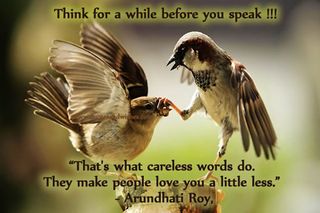
    Actually, it’s been on my mind a lot lately, and since I read this quote from young contemporary author Jarod Kintz, I’ve been thinking that he might have stumbled upon the mantra of the 21st century.

    Thoughtlessness, it seems, has become not only an acceptable state of affairs, but an expected one as well. Just open up many a Facebook page, read any comment thread, or listen to the conversations of store clerks and managers the next time you’re shopping. It won’t be hard to hear them as they stand among a mass of customers, talking about people and problems as if they were behind closed doors – where they should be.

    While social media has the potential for accomplishing great things, it also has the potential to become a repository for careless words, perhaps not of the same magnitude as malice, but hurtful none-the-less. The human penchant for expression, unencumbered by limits or good sense, can damage a heart or a reputation, and, yet,  it’s so easy to be drawn into the opportunity of letting the world know what we think when we are angry, hurt or just full of ourselves.

    I frequently hear from bewildered readers, friends or family members asking some variant of, “How could they have said that? Didn’t they stop and think about how much that might hurt me?”

    The answer is usually, “They didn’t.”  That’s the meaning of thoughtlessness – a careless indifference to consequences.

    I have often wondered why we feel we should be able to say or write or do whatever we want, regardless of who it may hurt.   Perhaps we have embraced it as our right because we have been led to believe that the “I” is more important than the “thou” – a premise that would be challenged by all of the world’s religions that value reciprocity and the relationship of humanity to God. It is in our relationship with God, and God with us, that we discover our relationship with others.

    In a society that glorifies the self, that feeds the ego with an unbalanced emphasis on the importance of personal satisfaction, achievement, and awareness, we are blessed still with the beauty of God’s wisdom, commanding us to “do nothing out of selfishness or out of vainglory; rather, humbly regard others as more important than yourselves,each looking out not for his own interests, but [also] everyone for those of others” (Philippians 2:3-4).

    The Book of Proverbs also teaches us to forsake all thoughtlessness, and live; and walk in the way of understanding.”

    We are challenged by our faith to be more than what our society and our culture tell us we should be. It is not an easy challenge to take up. But as Christians we are graced with something powerful that I think we often forget about – the Gifts of the Holy Spirit: Wisdom, Knowledge, Understanding, Fortitude, Counsel, Piety, and Awe.  

    We may remember those gifts as a list we needed to memorize as we prepared for Confirmation, but in reality they are tools of God’s grace, of God’s life within us, making it possible for us to take up the challenge and live with the mind of Christ – who never spoke a thoughtless word.

    “Let your speech always be gracious, seasoned with salt, so that you know how you should respond to each one.”  Colossians 4:6

    Image from http://www.quotesandwishes.com/tag/positive-thinking/. Visit for some great photos, quotes.

  •                                                                                                                                                                                                           
    Plunged_into_sea_platitudes


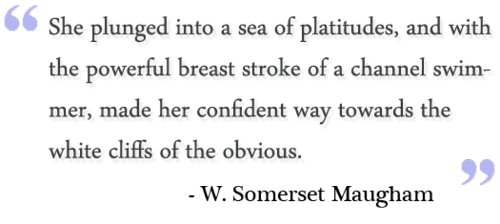
    Can I tell you just how much I have come to hate platitudes,
    motivational tomes and the faux wisdom of self-empowerment gurus? 

    After 13 years of posting prayer requests to my network of
    women pray-ers,  of responding daily
    during those years to the intentions of those who are struggling with some of
    the most painful circumstances imaginable, platitudes make me see red.

    What pithy phrase can you offer the friend who, within the
    past 12 months has lost two sons – one to cancer and another to suicide? What
    do you say to the family of the young man, a football player with college
    scholarships lined up, who tried to cross the street only to be hit by an
    18-wheeler? The doctors already had to amputate one leg above the knee and the
    last I heard they were trying to save the other. He was still in a coma. Or the
    young mother of three who was just diagnosed with a virulent form of cancer,
    who is not expected to live more than a few months, or the father who
    accidentally ran over his own child. 

    We have prayed for spouses who have disappeared, new parents
    of infants who have died, families who have lost everything, including family
    members, in a fire, flood, tornado, hurricane; husbands and wives who have lost
    their jobs after 40 years with the same employer, families who are dealing with
    addiction or abuse or have become homeless – the amount of prayers sent up to
    heaven in the almost 5,000 days since this group was founded is beyond
    counting.

    Or perhaps we should we have told them – Choose success! Change
    your attitude, change your life. Pain is inevitable, suffering is optional.  Maybe a few well chosen happy faces or an
    illustration of the power of intention would have helped them move forward in
    their pain and grief.

    I remember the first few moments after my father died. He
    was in a hospital bed in the Hospice unit in the room next to my mother, who
    was terminally ill. I sat at the foot of his bed and sobbed, yelling at God,
    demanding that he explain why all this was happening.  Exactly what was it he expected me to learn
    from all that I had been through in the past few years, and now, losing my
    beloved father who hadn’t even been sick a week before. I received my answer
    immediately – I have forged you in the fires of grief to form a jewel of
    compassion. My response was immediate as well – I don’t want to be a jewel of
    anything. I want my father back. I want my mother to be healed. I want my
    children to grow up with their grandparents. I want my life to go back to the
    way it was!

    But it was in that moment that I truly understood that life
    is suffering, as much as it is joy, perhaps more so.  And those who can move through the times of
    struggle, of grief and suffering, with integrity, without losing  hope in the future, who get up every morning
    and carry on in spite of the emotional or physical pain and find ways to help others
    do the same – these are successful people, these are life’s heroes.

    When I stopped trying to hold God’s feet to the fire, I
    looked around and saw all the other jewels of compassion milling about the room
    with me – people who would take their new found wisdom born of grief into the
    world and be of support to others. I thought of Enid Starkies profound words:
    Unhurt people are not much good in the world.

    There’s nothing trite about that.

  • A mother never knows just how much attention her children are paying to her, but every once in a
    Green shutters while she discovers they know her better than she thinks they do.

    That was my discovery when my son, an eighth grade language arts teacher sent me an email explaining that they were writing memoirs in class, and, I guess while his students were writing, he was inspired to write a “Slice of Life” piece which was inspired by my style of writing.

    Always the wise guy, as all my sons seem to be, he titled it as being from Things My Parents Taught Me (a take-off on
    my long-running column, Things My Father Taught Me). I share it with pride, and a tear or two. It seems he does know me – not just my style of writing – better than I thought, though he probably doesn't know how often I've read and re-read this brief reflection, and treasured the wisdom he shares.

    There’s a weathered house around the corner from me, where the bushes grow feverishly, aiming to devour the tattered relic.

    Where a faded American flag flutters solitarily. It’s a home where a shutter gracefully dangles on paint-chipped cedar shingles. Where cracked windows are marked with the battle scars of childhood rock throwing. Where a gate sways on a hinge, drunkenly guarding the distant memories etched in the house’s history. Where a broken rocking chair sits on time warped planks, grayed by years of weather. It’s the kind of place many passer-bys would miss.

    It’s the kind of place my mother would love.

    She’s always had a penchant for gentle simplicity and for distinguished houses. The kind of house that needs some work and calls for that special someone to restore the beauty, to realize the potential. I think a dream exists for her – a dream of moving into a house around the corner and accepting the challenges that await, even if they are daunting.

    She is not one to shy away from difficulty, to allow the task to leave its mark on her. She would see the house for what it could be – and who knows, maybe she would bring her husband to help, because it seems he’s pretty good with his hands, and I’m sure there would be a leaky roof and damaged walls and worn floorboards.

    But I also know that it’s easy to miss that house, if we’re not looking for it. And it seems that often we, as people, don’t see it. We don’t see that we have become like the house around the corner, battered by many storms, grayed by time.

    We don’t realize that we have left too many repairs unattended, that we have forgotten to make an investment in ourselves and in others. And as we examine who we are or who we have become, hopefully we see that, in the end, we are worth restoring.

    I wish I wrote that.