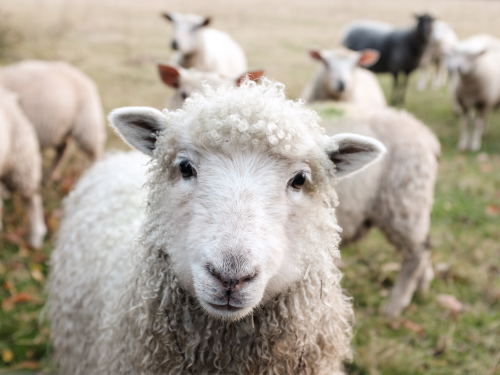
• My dad loved to tell stories. Not surprising considering he was Irish, and Irishmen are known for that.        Sam-carter-GHOiyov2TSQ-unsplash (1) SHEEP
    One day, probably when I was complaining about something, he told me the parable of the long spoons.

    A Rabbi decided he want to know the difference between Heaven and Hell.  He studied all the great books of Hebrew wisdom and finally found what he was looking for. He created a blade with magical power to tear a hole in the veil between this world and the next.

    Think Harry Potter!

    He used his blade to visit Hell where he found many people sitting at long tables in the middle of beautiful fields filled with flowers. The tables were loaded with all the delicious food and drinks you could imagine.

    But the Rabbi noticed the people were all skinny, sickly-looking, angry and sad. They were miserable.

    Upon looking more closely, he realized their elbows had been tied in place with angel hair so they couldn’t bend their arms. Since the forks and spoons had exceptionally long handles, they weren’t able to bring the food to their mouths.

    So, while the food was there, and the tantalizing smells filled their noses all day, they couldn’t eat.

    I’d be miserable, too!

    Then the Rabbi used his blade to get into Heaven. Here he saw exactly the same thing, rows and rows of people sitting at tables filled with delicacies, but everyone was smiling and happy and looking very healthy.

    What made Heaven different was the people. While they couldn’t feed themselves, they could feed each other. They filled up their long spoons and forks with food and fed the people sitting across from them. That way everyone ate.

    The Rabbi learned that the only difference between Heaven and Hell was how people treated each other.

    Let’s face it. Sometimes life, especially school, seems like Hell on earth and usually it’s because of the way others treat us.

    It’s especially hard for teens who now have to deal with other’s bad treatment of them 24 hours a day because of social media. The wise cracks, the bullying, the criticism is there for the world to see around the clock.

    The truth is we can’t change other people. We can’t make them nicer, more considerate, or less in your face. But we can make it a point not to respond to them, because when we do we give them our power.

    I know how hard that is.

    As a writer, I get mail that is not always easy to read and is sometimes hurtful. And usually, it’s on Facebook or Twitter or some other social media site where many others can read it.

    It is so tempting to vent my feelings by writing back and letting everyone else see my responses. That’s when I’m feeling, “I’ll show them!”

    But I’ve learned the hard way that you can never take back what you put in print, and sometimes you are the one who suffers for your responses.

    What can we do instead?

    Feed the sheep.

    At the end of his earthly life, Jesus came back to have one last heart-to=heart talk with Peter, his friend and number one Apostle. Three times he asked Peter, “Do you love me?”

    Three times Peter responded, “You know I love you.”

    Jesus asked him for one thing. “Then feed my sheep.”

    We have many opportunities to feed others with more than food, and those others could be your fellow teens – a simple smile, encouraging words, listening well, giving affirmations, volunteering at a food pantry, gathering gently used clothes to donate to the Veterans or other groups, finding a few like-minded friends to send cards or letters to children in the hospital or adults in nursing homes.

    Two of the amazing gifts of Generation Alpha, which is what you are being called now if you didn’t know, is their generosity of spirit and their intelligence.

    You could probably think of dozens of more creative ways to feed others than I can because the world is different today than when I was young. And you are different. Which is a good thing.

    If we put our minds to it, there are so many things we can do, instead of responding to those who treat us badly.

    Those people are not worth our time or our energy. But there are people in need of what we all want for ourselves. Love.

    When we take the time to feed others, our lives take on a special meaning that pushes Hell, and those that create it for others, into the background.

    My father reminded me that when you feed others, you feed yourself. I think he kind of adapted that from Jesus' second greatest commandments: "Love your neighbor as you love yourself."

    Imagine that. Self-care is a commandment from God!

    Photo by Sam Carter on Unsplash

    Copyright © 2022 Mary Clifford Morrell. All rights reserved.
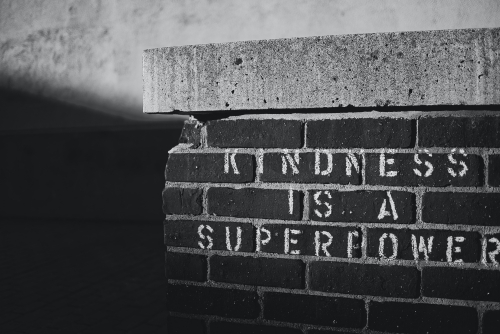
     

  • Violence and schools –there is just NO way those two things should go together.                                                                          Andrew-thornebrooke-WRAHkIAr2_E-unsplash (1)

    Schools are places of promise, filled with young people engaged in learning, preparing for their futures, making friends and enjoying what should be the safe and carefree time of youth.

    But every day, across the nation, there is some incidence of school violence, whether it is a glaring tragedy like a campus shooter, or a student crushed by cruelty or indifference.

    One newspaper source reported that since 2013 there have been 100 people killed and 155 injured by gunfire in 54 school shootings, Often the perpetrators are current or former students.

    Why, in the name of God?

    Well, that could be part of the problem. God has been struck from the hearts and minds of many people. And when we lose sight of God, we lose sight of what is most important – life and love.

    We lose sight of the faith and hope that we need to make that life into a meaningful one and a peaceful one.

    What does that mean to the ordinary teen struggling to make sense of their own world and their own challenges?

    Everything.

    Even our popes know that young people are the world’s best hope for an era of peace and justice, a time when violence in our schools and our world becomes a thing of the past.

    When St. Pope John Paul II spoke to millions of youth who had come to be with him in Rome for one of the World Youth Days, he referred to the youth as “apostles of hope.”

    The Holy Father told them, "Today you have come together to declare that in the new century you will not let yourselves be made into tools of violence and destruction, you will defend peace … You will defend life at every moment of its development, you will strive withal your strength to make this earth ever more livable for all people…”

    After the shootings at Columbine High School in Littleton, Colorado, an archbishop wrote these words, “God created us to witness His love to each other, and we draw our life from the friendship, the mercy and the kindness we offer to others in pain. The young Columbine students I listened to, spoke individually, one by one, of the need to be strong, to keep alive hope in the future, and to turn away from violence.”

    Turn away from violence.

    Jesus said it, too. “Blessed are the peacemakers … “

    Each one of us is called to be a peacemaker, whether in schools or in families or in institutions, and we do that through one thing – love.

    And when we love, we listen to other people's pain, to other people’s fears.

    We let them know we care when we take the time to listen. And everyone needs to know they are cared for.

    Is this too big a job, too monumental a responsibility for youth?

    Dorothy Day didn’t think so. She was a convert to Catholicism, a pacifist and founder of the Catholic Worker Movement. Today she is on her way to sainthood.

    We should all remember her words: “Young people say, ‘What is the sense of our small effort?’ They cannot see that we must lay one brick at a time, take one step at a time, we can be responsible only for the one action in the present moment.

    “But we can beg for an increase of love in our hearts that will vitalize and transform all our individual actions and know that God will take them and multiply them, as Jesus multiplied the loaves and the fishes.”

    Today there are more than 43 million teens and young people in the United States. Imagine what just one act of kindness or action against violence from each of them would have on the world!!

    Photo by Andrew Thornebrooke on Unsplash 

    Copyright © 2022 Mary Clifford Morrell. All rights reserved.

  • Every year, at the beginning of Advent, I take a small dollar store ornament out of the kitchen cabinet where it sits all year – a tiny Debby-hudson-fmIqBhtpsWU-unsplash (1) advent rejoice glass snow globe with a snowman inside and ‘Joan’ written across the front.

    It spends Advent and Christmas on my counter next to an icon of Mary and small prayer candle. Here it serves as a daily reflection about the power of love and the joy of friendship, perfect lessons for this holy season.

    I bought the ornament, not because of its affordable price, but because it had the name of my dear friend Joan, who died before I could give it to her.

    Joan was a woman whose simple and sincere devotion to family and friends was extraordinary. As holidays come and go, I am always struck by a wave of sadness that we no longer share those heartwarming gatherings around her table with friends, talking and laughing for hours until our stomachs hurt. Missing them, and her, is an ache even after all these years.

    Sadly, we don’t always recognize how much friends impact our lives until they are gone.

    I am grateful that memories of Joan are a frequent reason to smile. I think of her when I try to make Christmas cookies like her, and fail, knowing she would be laughing and filling a box for me of her own amazing treats, or when my roast comes out dry, remembering the two perfectly cooked roasts she brought to me when I was sick and caring for my large family.

    Generosity and compassion were her hallmarks, not just for her friends and family but anyone who she knew needed something, and when Joan was in need of help herself, after her husband died unexpectedly leaving her with two young sons, Joan was humble enough to allow others to share what they had with her.

    Even then, Joan would be helping to fill Thanksgiving baskets for parish families in need, or buy gifts for the Jesse Tree, or bring groceries and food to friends who were sick or in need.

    Joan loved Jesus, something she chose to share with young people as a parish coordinator of religious education. Her joy showed in the warmth of her smile across the parish choir loft, and at the table where parish catechists gathered after class and sat for hours sharing stories and ideas and, often, some of her home baked breads and a few welcomed cups of coffee.

    Most recently I recalled Joan’s remarkable heart when I read a homily by Pope Francis about the meaning of the Works of Mercy as sharing the suffering of others.

    The Holy Father stressed, “We do not do works of mercy to assuage our consciences, to make us feel better. Rather, the merciful person is the one who has pity on others and shares in their suffering. We must ask ourselves, am I generous? Do I know how to put myself in another person’s shoes? Do I suffer when I see another person in difficulty?”

    Today, I am reminded of Joan who is obviously still reaching out with love to those of us who knew her.

    Mutual friends were having marital problems and the wife was ready to call it quits. She went to the attic to start cleaning out some things and there, laying out in the open where she was bound to see it, was a “Marriage Advice” card Joan had filled out for her at her wedding shower many years prior.

    Joan’s advice: Forgive, always forgive.

    It was advice taken, and another friend is still gathering the graces of the friend who loves Jesus.

    Photo by Debby Hudson on Unsplash

  • When I was growing up, and walking the mile to grammar school (yes, that really happened, every day for years), my cousin and I Loren-cutler-L0yM16akO5s-unsplash would get there early so we could stop at the little candy “store” run by a neighbor out of her porch.

    We would stock up on penny candies, like fireballs and licorice, and I’m not sure why, edible vampire teeth, sometimes attached to edible lips. I don’t remember the flavor, but I remember they were waxy, and for the life of me I don’t know why we wasted our precious pennies on them when we could have had chocolate.

    Maybe it was the lure of the vampire!

    For vampires at that time, we had Nosferatu (really old), Dracula (eternally vintage), and on T.V., Dark Shadows – my mother’s favorite. Since then, it seems fascination for vampires has rocketed and even some of my adult, married children would binge watch TV shows like True Blood or Vampire Diaries.

    Wikipedia lists 100 vampire TV series as far back as 1978 to today, and that doesn’t include animated and web series.

    Many of the newer vampire shows, now available on streaming services, are focused on teens, like the Legacy series and First Kill.

    Personally, I don’t understand the fascination, and I don’t think it’s just because I am also eternally vintage. But that’s the beauty of human beings – we are all unique.

    Still, I wonder if today’s teens, many of whom are really into the vampire craze, realize they already have something in their lives that sucks the life blood out of them daily.

    Maybe you guessed it – cell phones, and for others, computers or tablets, where youth spend hours on social media or gaming. Cell phone obsession is not just an obsession for talking to friends, it’s an obsession with feeling a part of something, waiting for the likes on a text, a mention on social media, a confirmation that you are valued, attractive, funny.

    And if you don’t get those likes, that affirmation, you often feel discouraged and left out. It ruins your day and your mood. It is also a source for bullying, criticism and critique, all of which can dimmish your, our, self-image and do irreparable damage.

    It sucks the life out of you, and it worries me, and it worries parents, and it worries anyone who sees the beauty and potential in every young person, that is before it is sucked into the vacuum of social media.

    One of the most disturbing images for me is not the TV vampire, but a load of kids, with their mom, getting out of their car in the supermarket parking lot. Four kids and an adult.

    All of them were looking at their cell phones when they got out of the car, and never lifted their heads up once from the screens as they walked, perilously, across the parking lot into the store. One young boy walked into the backend of a parked car, and barely looked up from the screen.

    They were oblivious to the world around them. They ignored their family members. They were lost in social media. Land of the Lost.

    Life is too short to live it inside a cell phone. It’s a false world which gives you false messages about who you are, before you’ve even discovered who you really are.

    Garlic may be used to ward off vampires, but the only thing that is going to protect you from the damage of being tethered to your cell phones is you.

    You are graced with the wisdom of the Holy Spirit, but sometimes even the those who have lived many years lose sight of that. Do not be ashamed to ask for help. Do not be ashamed to pray, so you may remember who you are – a child of God.

    Have faith in yourself. I do.

    Photo by Loren Cutler on Unsplash

    Copyright © 2022 Mary Clifford Morrell. All rights reserved.

  • At some point in their lives, each of my six sons was given a bike. Some took better care of their bikes than others. The one with the Greg-rakozy-oMpAz-DN-9I-unsplash CREAtION greatest challenges “Drew” (name changed to protect the not-so-innocent).

    At first, Drew was very excited about his bike with the flashy trim and the pegs on the wheels. It was just “too cool!” That was then. I’m not sure what kids today would say.

    Pretty soon, Drew decided it was too much trouble to put his bike in the shed at the end of the day. So, it sat out in the rain.

    Then it became too much trouble to put down the kick stand, so he let it fall on to the street when he got off. So, it started to get scratched, and the wheels became bent.

    He began to complain that his bike was “falling apart and getting rusty.” And I saw him eyeing up the newest bikes that appeared in the sales flyers.

    “Take care of that bike, Drew,” I would always tell him. “It’s the only one you’ve got, and the only one you’re going to get.” When you are raising six sons you have to set some serious limits.

    But Drew never learned to take care of the gift that had been given to him out of love. A gift he had not earned but had received, none-the-less. And one day, because he was too lazy to put the bike in the backyard after dinner, someone came along and stole it.

    Drew had no more bike. He cried, but that didn’t bring the bike back.

    I was reminded of Drew and his bicycle last week when I was visiting a school and saw some of the children had illustrated some poems about Earth Day. Many of them had drawn pictures to go with this poem:

    “Every day is Earth Day,

    If it’s cold or wet or hot.

    Pitch in to save the planet.

    It’s the only one we got.”

    I wish I had some copies to hand out to the guy who opened his car door and dumped his ashtray full of cigarette butts on the supermarket parking lot.

    Or the young woman perhaps driving to work who threw her styrofoam coffee cup out the car window.

    Or the adults, young and old, who leave glass bottles, cans and tons of garbage in the sand at the beach instead of using the garbage cans just feet away.

    I mean, really, how lazy can you get?

    When I see this kind of behavior, I often wondered, “These are the people God put in charge of caring for creation? God must have been partying hard before making THAT decision.”

    After all, God was the Creator, the Boss, the Gift-Giver, and God saw that everything he had made was good! Scripture repeats it. It was good! It was very good!

    Now, if you had made something really special with your own hands, or head, or heart, something that you believed was really, really good, something you really cherished, would you turn it over to the crowd at the last concert or sporting event you attended?

    Well, that is actually what God did. God put us, the unruly crowd, in charge of caring for creation. But we forgot that Creation belongs to God, not to us.

    “The earth is the Lord’s and everything in it, the world, and all who live in it” (Psalm 24:2).

    God says, “The silver is mine, and the gold: (Haggai 2:8); Every beast of the forest is mine, and the cattle on 1000 hills …: (Psalm 50); The land is mine, you are sojourners with me” (Leviticus 25).

    God is inviting us to sojourn with Him, or Her. What an awesome invitation! What incredible trust God has placed in us by giving us so enormous a gift as all of creation and asking only that we love it, care for it and cultivate it for the benefit of all without destroying it.

    But too often we have been faithless stewards, and worse, cruel and selfish adversaries of the earth that sustains our lives. So, what can we do, just one person at a time?

    Be aware of the treasure, express gratitude, learn how the gift works, use your God-given right to free expression to let others know that you expect them to be responsible for the world that you and your children and your loved ones live in, or will live in.

    Most importantly, learn to live a simple life in harmony with God’s gift of the earth. And remember “it’s the only one you got.”

    Photo by Greg Rakozy on Unsplash

    Copyright © 2022 Mary Clifford Morrell. All rights reserved.

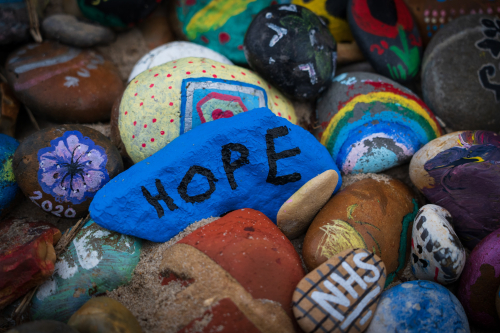
  • When I was young and I would complain about some injustice in my life, my father loved to say, “Life’s not fair. Deal with Nick-fewings-ioNNsLBO8hE-unsplash HOPE it.”

    I thought it was just his way of skirting the issue, of not having to deal with my earth-shattering problem of the moment.

    Now I realize it was one of the wisest things he would ever say to me, and I know it came out of his own experience.

    My dad lived through the Great Depression when even the basic necessities of life, like food and housing and clothing, were luxuries that few could afford. People lined up at food kitchens, hoping to get something to eat. Many had no jobs and were homeless.

    He couldn’t go to the excellent high school that accepted him because there wasn’t enough money. He ended up dropping out of school in eighth grade to get a job and support his mother. That was because his dad died when he was seven years old. The worst thing was that his dad was murdered, a victim of random violence.

    At 13 years old, my dad’s meager salary helped pay the rent and put food on the table. It didn’t buy movies or records (there were no CDs or digital music) or nice clothes or new phones. It didn’t pay for lunch at the nearest fast-food restaurant, a year’s membership to the local gym or something as boring as simple school supplies.

    My dad’s teenage salary kept a roof over their heads, coal in the furnace and, sometimes, a big block of ice in the freezer.

    To me, that’s one big, “life’s not fair!”

    But my dad never complained. He was always aware of the blessings he still had – his health, his family, his friends, his freedom, his job and the incredible beauty of the created world. And he was very grateful for them all.

    That “attitude of gratitude” is something I wanted my own children to have.

    And so, as a parent in the 20th century, I told my kids the same thing my dad told me: “Life isn’t all beer and skittles!”  Ok, so it’s almost the same thing.

    I also learned from my father that sometimes one of the best ways to deal with the frustration and pain when life is unfair is to spend time making life better for someone else.

    My dad did that best by giving himself, his time, his presence, his love, and his laughter. And he always told me that it was the hard times in life that were the most important times of learning and growing.

    Those were the time, he said, that God used most often to make good things happen.

    And he was right. Just look at what happened to Paul and Silas. They were disciples of Jesus who preached the Gospel wherever they went so others would come to know and follow the Lord.

    They were attacked and thrown into jail.

    “Then the official tore the clothes off the two men and ordered them to be beaten with a whip. After they had been badly beaten, they were put in jail and the jailer was told to guard them carefully. The jailer did as he was told. He put them deep inside the jail and chained their feet to heavy blocks of wood.

    “About midnight Paul and Silas were praying and singing praises to God while the other prisoners listened. Suddenly a strong earthquake shook the jail to its foundations. The doors opened and the chains fell from all the prisoners.

    “When the jailer woke up and saw that the doors were open, he thought that the prisoners had escaped. He pulled out his sword and was about the kill himself. But Paul shouted, ‘Don’t harm yourself!’ (Acts 16:33-38).

    Do you know what happened next? The jailer led Paul and Silas to freedom, cared for their injuries and he and his whole family were baptized and became followers of Christ. All because Paul and Silas never lost hope even when things were bad and sang their praises to God for all to hear.

    To be a person like my dad, or like Paul and Silas, is to be a person of hope for others, especially when life has been unfair to them. And isn’t that what God taught us to be through Jesus?

    “We have run to God for safety. Now his promises should greatly encourage us to take hold of the hope that is right in front of us. This hope is like a firm and steady anchor for our souls” (Hebrews 6:118b-19).

    Live with faith and hope in the Lord and you will sing like Paul and Silas even on the most unfair days of your life!

    Photo by Nick Fewings on Unsplash

    Copyright © 2022 Mary Clifford Morrell. All rights reserved.
  • The girl in the advertisement was really pretty – sparkling smile and big brown eyes. Maybe 15 years old, maybe younger. That’s why it seemed Kubra-acikgoz-xqw8rr8bUpo-unsplash MIRRORS strange that she was in an ad for hair coloring.

    I mean, why would a teenager feel the need to dye her hair? That’s like saying, “I’m not good enough the way I am, the way God made me, so I have to change something.”

    I guess she looked in the wrong mirror that morning. You know the one I’m talking about – the Judas mirror – the one that betrays your true self, the one that makes you see things about yourself that aren’t really there – like a nose that’s too big or breasts that are too small, eyes the wrong color or hair that’s just not the right shade of brown.

    Now if she had looked in the Jesus Mirror that day, she would have seen something spectacular –perfection! – a child of God, made in the image of God, a reflection of Christ himself.

    The Judas mirror only reflects what’s on the surface. When we look in that mirror, we only see half of who we are and we see that half through a mirror that’s made dirty and cloudy by the shallow values of a culture that says only our appearance is important.

    The Jesus mirror reflects the true beauty of both body and soul and reflects the truth that we are good enough just as we are because we were made in the image of God. The Judas mirror tries to convince us that we should reflect the values of the world, but the Jesus mirror proves that we reflect the Lord who is truth and light and goodness.

    The Bible tells us over and over again that we are created for and by a God of Love:

    “O Lord, you have searched me and known me.

    You know when I sit down and when I rise up.

    Even before a word is on my tongue,

    O Lord, you know it completely.

    Where can I go from your spirit?

    Or where can I flee from y our presence:

    For it was you who formed my inward parts;

    You knit me together in my mother’s womb.

    I praise you, for I am fearfully and wonderfully made.”

    (Psalm 139:1-2, 4,7,13-14)

    What a beautiful truth – wonderfully made and filled with more gifts that we can image! Is it really our face, our body, our clothes that make us special to other people, or is it how we make them feel about themselves?

    Is it how we talk or is it how we listen? Does our “perfect” wardrobe make them feel better when they are sad or hurting, or is it simply our presence and our smile – the most beautiful thing a person can wear?

    When we look in the Jesus Mirror, we are able to see all those beautiful things that make it possible for us to love ourselves – this self-love is not selfishness. Jesus told us that the greatest commandments, the ones that summed up all the rest, were “love God with all your heart, all your mind and all your soul,” and “Love your neighbor as yourself.”

    It seems you can’t do one without the other.

    So, if you have a Judas Mirror in your house, get rid of it.

    Start and finish every day looking in the Jesus Mirror to remind yourself that you are a reflection of Christ, and you can’t get any better than that.

    Photo by Kubra Acikgoz on Unsplash

    Copyright © 2022 Mary Clifford Morrell. All rights reserved.

  • So, here’s the question.

    How do we keep walking with God when there is no way to make sense of the senseless? Davide-cantelli-H3giJcTw__w-unsplash walk with God

    How do we keep walking with God when we are carrying so much pain?

    How do we keep walking with God, when every day we see the evil of violence that tears apart families, schools, communities, religious congregations and nations?

    We can do it by walking in the footsteps of the Apostles. They walked with God for three years. During that time, they saw what Jesus did, heard his words, witnessed his prayer life and understood his powerful call to peace. He gave people hope.

    And then he was gone, a victim of fear, hatred and violence.

    Our challenge is the same challenge the Apostles faced after Jesus was crucified.

    The need to carry on.

    This is the same challenge individuals and communities have faced whenever some form of violence robbed them of the ones they love and deprived them of the safety and security everyone should have when they think about home.

    The Apostles carried on, strengthened by their faith in God, the power of the Holy Spirit and each other, friends who believed in the same things and had the same mission.

    Together, they changed the world.

    They had heard the words of their Lord when he spoke to the great crowds who had gathered for the Sermon on the Mount – kind of like the crowds who gather for outdoor concerts today except the only music was the voice of Jesus.

    It was then that they heard Jesus say, “Blessed are the peacemakers, for they shall be called the children of God.”

    Peacemakers.

    Now that’s a real challenge – especially when we are hurt and filled with anger. But that is when we are called to be that
    one person, changing one heart at a time if that’s all we can do.

    It’s in the heart that peace has its beginning. That’s why we need the Grace of God, his help to make what seems impossible possible. That’s why we need prayer.

    The Apostle Paul saw the effects of the peaceful, prayerful heart of Christ, the man who loved the world into goodness through his death.

    Paul later wrote to the community of the Romans and told them what he had learned from Jesus. “Do not be overcome by evil, but rather overcome evil with good.”

    To respond to evil with evil, to become people of rage, would be to become less that God calls us to be. We cannot change the evil that rips thousands of lives apart through war, terrorist attacks or violence of any kind.

    But if we answer Jesus’ call to be people of peace, youth committed to a peaceful world, we can continue to walk with God in faith and hope and love.

    Martin Luther King once said that “peace is not merely a distant goal that we seek, but a means by which we arrive at that goal.’

    Martin Luther King was a wise man. If we are not at peace with each other in our homes, in our schools and in our workplaces, we cannot be at peace in our communities, in our nation or with other countries.

    So what should we do now?

    Make peace – one prayer and one person at a time. Continue walking with God and take friends with you.

    Davide Cantelli photo on Unsplash.

    Copyright © 2022 Mary Clifford Morrell. All rights reserved.

  • The morning a baby blue jay landed in our yard was memorable. Mark-olsen-iu9v3LeT9C4-unsplash BLUE JAY

    The chubby chirper had obviously been pushed out of the nest by Mamma blue jay but was now having trouble with a second lift-off.

    Confident I could handle the situation, I strolled across the lawn in my pajamas, carrying a laundry basket. But as I approached the little blue ball of feathers, something swooped down from the sky and hit me on the top of my head. At first, I thought it was my imagination, until it happened a second time, and a third.

    I dropped the basket, raising my arms up to protect my head and ran back to the porch. From that vantage point I could see the attacker was Mamma blue jay.

    She made it clear, no one was going to mess with her baby, even though the littlest blue jay had outgrown the relationship of the dependent nestling. It was time for him to take the next step or, better, the next flight.

    It might have seemed like the end of the world when his own mother gave him the boot, but that was just one necessary step in the process of becoming the bird he was meant to be.

    Believe it or not, dating relationships can be like that. Sometimes, we start out a relationship thinking we have fallen in love with someone, but at some point, we begin to feel that things are just not right. We are outgrowing the relationship.

    Maybe it’s something as simple as changing interests. Maybe it’s more serious, like being treat with disrespect, or a lack of honesty. Perhaps there is poor communication or excessive jealously.

    More serious are those times when the person you’re dating uses drugs or alcohol and tries to get you to do the same, or pressures you to become involved sexually. Then there are those very serious times when they abuse you physically, verbally or emotionally.

    Whatever the reason, when a relationship stops you from becoming all the God intends you to be – and that includes safe and happy – when it stops you from growing and isn’t a source of joy and peace in your life, then it’s time to consider ending the relationship.

    And we all know how hard that can be!

    The hurt is hard enough to bear ourselves, but sometimes harder to inflict on someone else. And then there’s that whole idea of failing – talk about pain.

    But, if we remember the blue jay, we can see that all relationships are a time of growth and learning. For the bird, it may mean learning to fly, find food and feed itself.

    For people, even the relationships that don’t work out help us learn how to communicate (sometimes by showing us what happens when we don’t) and how to manage anger (again, sometimes by experiencing what happens when we don’t).

    Most important, they can teach us how to forgive.

    All these lessons will make it possible to finally be in a loving and committed relationship that endures, with our work and God’s.

    Rather than being failures, we need to see the end of relationships as new beginnings. Endings are not always something to be feared, but rather, something to trust, especially if we have kept God in the picture through prayer.

    If we ask God for help in making the right decisions when it comes to relationships, God will prepare our hearts and minds for whatever is best for us, even if it doesn’t seem that way right now.

    That day in the backyard was both an ending and a beginning for the little blue jay. With my help, he learned to fly, and I learned that you should never let your kids see you running around the backyard in pajamas and a football helmet.

    Mark Olsen photo on Unsplash.

    Copyright © 2022 Mary Clifford Morrell. All rights reserved.

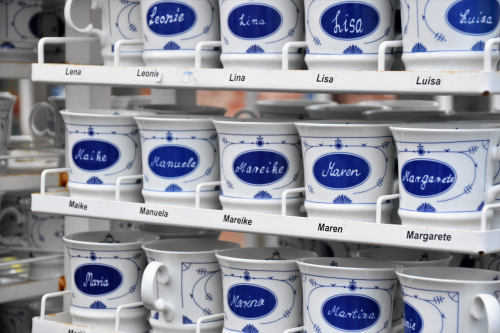
  • Hanging on the wall of my local Christian book and gift store is a poster entitled, “And He Shall Be Called.” It’s a simple poster comprised solely of the Waldemar-brandt-qqxDmJpMhAk-unsplash various names or titles referring to Christ found in the Bible. Below each name, in very small print, is the scripture reference that includes the name.

    Given its simplicity and lack of artistic images, its notable that in the 20 years since it was first printed, it has sold nearly 1.5 million copies. That speaks, I think, to the power of names.

    In ancient times, names tended to have more meaning when it came to the character of the person named, which is why God or Jesus Christ often changed the name of someone chosen to be something more, someone for whom there would be a new path in life. Perhaps the most memorable is the disciple Simon whose name meant “one who hears or listens.” 

    When Simon was brought to Jesus, the Lord told him, “You are Simon the son of John. You shall be called Cephas” (Peter). Simon had no idea why his name would be changed, but Jesus knew that Peter, whose new name meant “rock,” was the one upon whom Jesus would build his church. Simon most likely had no idea he had that kind of leadership or strength in him.

    The same is true for our children, especially as they become teenagers and are carrying heavy baggage we may not know about or understand. They may not be aware of the many gifts, God-given gifts, or talents they have. By valuing and respecting their names, we start our relationship with them by giving them the opportunity to value and respect who they are, with all their potential and not just all their mistakes.

    What are the fruits of learning and remembering student names?

    Building community – Learning student names is the first step in the process of getting to know them and ensuring that they feel like they are an important part of a community. Using student names, and saying them correctly, builds connection and a sense for students that they are being seen and heard.  Experts in the field also observed that using a child’s name when speaking to them helps encourage positive behavior.

    Seeing Every Child – Many years ago, at the request of a Catholic school teacher, I wrote a story that included every student in her elementary classroom by name. I designed the story into a small booklet and printed enough so every student in the classroom would have one. The class had students of many different nationalities, so many of their names were unique and, for some, challenging to read and pronounce. This short story made sure that each of them felt a part of the classroom community.  How might you make sure every name counts?

    Nurturing respect – Respect is an important Christian value, not only the respect of others but, as importantly, self-respect. A child’s name is crucial to their identity as a person and member of a family. By remembering their names and using them as often as possible, especially if we can look at them eye-to-eye at their level, we reinforce to students that they are worthy of our love and respect.

    Growing student rapport – For each student, learning other students' names is important to building respect, rapport, trust, and accountability between students. Part of the process is learning how to say names correctly.  It becomes easier the more often names are said aloud in class. All teachers have their own ways of memorizing student names, which might include desk name tags. These are not only valuable for teachers, but for younger students, as it helps them develop a sense that their desk is their own personal space.

    This post appears on Faith Fuel, a blog by RCL Benziger Publishers.

    About the Author
    Mary Clifford Morrell, mother of six and grandmother to ten, is a Catholic journalist, editor, and author who has served the Dioceses of Metuchen and Trenton, New Jersey; Burlington, Vermont, and RENEW International in the areas of religious education and communication.

    Waldemar Brandt photo on Unsplash.