• Normally, I’m a very patient person. I like people, as a whole, and make an effort to get along well Haughty queen with everyone I meet. But there are times when someone pushes your buttons, and you forget your good intentions, especially when their behavior hurts others.

    Did you ever meet one of those people who gives you the not-so-subtle once over; the head-to-toe evaluation that makes you wonder, if only for a split second, whether you forgot to change out of your pajamas in the morning? My father would call them haughty. I call them arrogant.

    This kind of in-your-face arrogance is usually accompanied by frequent verbal spills intended to show off how much they know, or how much they’ve accomplished (at least in their own mind), in a poor attempt to elevate themselves by knocking you to the floor.

    I have to wonder why people who profess to know so much don’t know that their arrogance is a neon sign flashing a serious lack of self-confidence and over-inflated ego, supporting a sense of superiority that is truly just a flight of fancy.

    My advice, passed down from my father, of course, is to ignore them. Nothing will burst an over-inflated ego faster than a lack of attention,  that is until they find someone else to buy in to their fantasy.

     “For by the grace given me I say to every one of you: Do not think of yourself more highly than you ought, but rather think of yourself with sober judgment, in accordance with the measure of faith God has given you.”   Romans 12:3

    Link to image: http://www.fotosearch.com/IMZ005/pbu0127/

  • Being the founder and facilitator of an on-line network of intercessory pray-ers has had an  IMG_ 048  unexpected perk – outside of the privilege of praying for others. The payer network, and the daily requests of those who carry the cross of Christ, has the unique ability to keep me grounded in gratitude, encouraging me to refresh the happiness page of life when I  allow the ordinary challenges of being human to become extraordinary problems draining me of joy.

    In any given day I may receive requests to pray for families whose children are suffering with cancer, or who have lost an infant or toddler to illness or accidents. Others may be grieving for loved ones who are missing, or who have committed suicide. Vibrant, healthy people are struck down in the prime of life by freak accidents or debilitating illness, while others have lost their jobs, their life savings and their homes, perhaps living in a shelter or relying on the generosity of family or friends.

    Then there are those families who are struck again and again with one tragedy after another.  For them, especially, my heart breaks. At the same time, I am humbled by their continued strength and perseverance, something I have often lost in less trying times.

    I have one such friend who will always be an inspiration to me. In the space of two months she lost her husband, her mom and dad, and her brother.  As I watched her move from one funeral Mass to the next, and in the months following, I marveled at her ability to carry on – and to smile whenever I saw her. I asked her how she was handling so much and she simply said, “If I didn’t have my faith, I wouldn’t have anything.”

    Famed English poet and playwright, John Dryden once wrote, “We first make our habits, then our habits make us.”  It seems my friend’s faith has enabled her to make a habit of happiness, and that's the kind of habit that's worth cultivating.

  • There is a story of a pastor who decided to hire a gardener for the poorly kept parish grounds. Year Iris-blue-dark round the gardener worked diligently, preparing the soil, weeding, planting, pruning and nurturing the plants with great attention, until one fine day the pastor strolled out into the flowering garden with a neighboring priest, anxious to show off the magnificent new creation.

    Gesturing to the many different plants and flowers, the pastor said, “I praise God for all of his handiwork!”  Stepping out from behind a bush with clippers in his hand, the gardener chastised the pastor, saying, “Don’t you go giving all the credit to God! Just remember what this place looked like before I got here and God had it all to himself!”    

    At an educator’s conference, I used this story to stress the importance of the work Catholic educators do on God’s behalf, but today I realize the story has another lesson: You tell the world what, and who, you love by your attention.

    Henry Miller wrote, “The moment one gives close attention to any thing, even a blade of grass, it becomes a mysterious, awesome, indescribably magnificent world in itself.”

     Imagine the change in our lives if we gave that kind of attention to other people, especially the one’s we love.


    Link for photo: http://www.flowers.vg/flowers/iris-blue-dark.htm

  • Every generation has its own unique turns of phrase.Th_jiminy_140x143

    My mother had a favorite whose origin long eluded me, until I discovered Google and was surprised by what I learned.

    The clearest memory of my mother launching into this phrase was when my cousins, Lynn and Michelle, were over for a pajama party. They slept in the spare bedroom on a double bed. In the morning, the very early morning, I slipped into their room and we found any and every reason to laugh. My house was very small and the bedroom, with paper thin walls, was next to my parents’ room.

    In our silliness, I began to trampoline across the bed, causing my cousins to bounce off the mattress. Of course, we found this hysterical. My mother was quick with the warnings to cease and desist.

    We took our chances and ignored her until we heard it; the phrase meant to send us off quaking in our boots but, instead, turned us into a quivering, laughing mound of childish uproar.

      “Listen to me, by Jiminy Cricket!!”

    For a brief breath-holding second we paused, but only to look at each other with wide eyes of disbelief, mouthing “Jiminy Cricket??” to each other. When that second was over we exhaled for our next round. There was no way we couldn’t laugh.

    A singing cricket dressed in spats, a top hat and carrying an umbrella, was supposed to be a threat?You can be sure that phrase got a real workout from the three of us—under our breath in the classroom, the lunchroom, girls’ room, slumber parties, whenever we were in the mood for a good laugh. I even used it at a wake once, but nobody knows the trouble I saw for that one.

    Jiminy had become a hazy memory until recently, when I was attacked by none other than a real cricket—an escapee from the lizard cage upstairs. Well, maybe attacked is too strong a word, but when you are diligently working away at your computer and a crazed cricket, who must have had some serious training from Mr. Miagi, leaps over the screen at your face, I consider it an attack.

    In the midst of the arm flailing, he escaped into my printer, only to try another assault a few minutes later. This time I was ready and deflected him onto my Etz Hayim (Torah and Commentary), and there he sat staring at me with beady little cricket eyes and I thought he doesn’t know how lucky he is to be sitting where he is sitting since I couldn’t squish him on a holy book.

    It was then that I started thinking about memories.

    The Torah is a book of memories, but not the Jiminy Cricket kind of memories that bring a nostalgic tear to the eye or smile to the lips. They are not vague shadows of the past but vibrant pieces of time, when God entered into the history of the Jewish people; experiences that remain expectant, living, and transforming in the present.

    And so it is with the Mass, the celebration of the Paschal Mystery.

    Jesus, the devout Jew, embraced such memory when he instructed the disciples to “Do this in memory of me;” Jesus, the devout Jew, present in the Eucharist and transforming God’s people through his life, death, resurrection and ascension.

    This is memory that is alive, that gives life because it is life.

    See what God has done for us.

    As for “Jiminy Cricket,” I discovered that the phrase came before the character and that it is known as an expletive euphemism; a polite way of exclaiming Jesus Christ. My mother could have also used, “Jiminy Christmas!” or “Jiminy Crispus” but somehow the memory wouldn’t have been the same for children who were fans of Saturday morning TV.

    Who would have thought back then that a cricket would end up becoming part of a faith journey?


    Link to photo http://i35.photobucket.com/albums/d167/brynniev/jiminy_140x143.gif

  • In all of human experience I think there is nothing more painful than feeling abandoned.Alone

    The gnawing pain of loneliness, the feeling of being unloved and unlovable, robs life of hope and purpose and intensifies any suffering we may be going through. It was my experience when depression took over a significant part of my life for a time, and it made recovery all the more difficult.

     I thought no one could really understand the suffering. But my spiritual director reminded me that Jesus also knew what it was like to be abandoned in his darkest hour by those he loved most and the people for whom he sacrificed his life. Broken, bleeding, suffering excruciating pain, his last words from the cross in the Gospels of Mark and Matthew were, “My God, My God, why have you forsaken me?”

    There were times when I asked the same question, and tried to get rid of the pain by writing it out of me. On the journey, God sometimes answered my cries with sparks of hope—glimpses of beauty, the right words, moments of laughter, the healing power of music, even the simple gift of birds keeping me company each morning. But nothing meant more to me than the gift Jesus gave to the thief on the cross next to him – an assurance of love. Love listens. Love forgives. Love gives hope.

      Joy is a memory

     fading softly in the gray mist

    of pain.

    I am helpless to stem its going

    and too weary to worry

    of its return.


    If joy is the nature

    of the soul,

    I fear mine has died

    a somber death of loneliness,

    withered in a tomb

    of broken promises.


    Still a heartbeat echoes

    in the poet’s words.

    His psalm of life

    ignites a spark of hope

    where hopelessness

    has reigned.


    “Life is real! Life is earnest!

    And the grave is not its goal,

    dust thou art, to dust returnest,

    Was not spoken of the soul.”

    Henry Wadsworth Longfellow is the poet who wrote “A Psalm of Life.” His words came, for me, at the perfect time, and were part of the lesson of depression that we can all be sparks of hope for those who are suffering or feeling abandoned, if we are willing to love.

    Longfellow ended his poem, in part, with these words: “We can make our lives sublime, and, departing, leave behind us footprints on the sand of time; footprints, that perhaps another, sailing o'er life's solemn main, a forlorn and shipwrecked brother, seeing, shall take heart again.”

     I can’t think of a greater gift than enabling someone to take heart again.


    Link to photo http://i170.photobucket.com/albums/u255/lop_truong_4_mat/alone.jpg


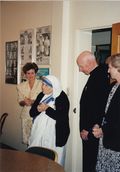
  •   Perhaps one of the most extraordinary moments in my life came when I was given the privilege of Motherteresasmiling photographing Mother Teresa on her visit to our diocese. I was so nervous I failed miserably at the shots I took, but I was delighted to snap one image of her laughing with her fellow sisters.


    In looking through the few photos I have left, I also realized that what was most extraordinary was sharing the moment with other people who have made a mark on my life, most especially Bishop Edward T. Hughes.


    It is sad that during our lifetimes, the people who have had the greatest impact on us often never realize how they’ve touched us. Perhaps we are not aware of it ourselves, until they have left us, or we find it difficult to express our gratitude. Perhaps we just never think of it.


    Perhaps this is the year when we should change all that—returning to the long lost art of the IMG_0005 handwritten note (taking a cue from my dear friend, Pat G., whose notes never fail to make me smile).


    For now, I will just say, it was an extraordinary moment when I held Mother Teresa’s hand, but more meaningful for me were the years when I worked in the presence of an extraordinary man and took away wisdom that will last a lifetime.


    Many thanks, Bishop Hughes, and may God continue to bless you with good health!

  • It doesn’t seem possible that my dad could be gone 16 years already. But every year, as Valentine’s Love is patient Day rolls around, I am reminded of the last Valentine’s Day we spent together, him in a Hospice bed, me in tears hoping that he could at least sense how much I loved him. He would die the next day, and forever change Valentine’s Day, and so much more, for me.

     I was reminded again of what he meant to me when I read a quote from Paul Gallico, who wrote the American classic, The Snow Goose. I don’t know which of his dozens of books this quote came from, or what the context was, husband and wife, lovers, or maybe friends, but his words moved me to tears.

    “When two people loved each other they worked together always, two against the world, a little company. Joy was shared, trouble split. You had an ally, somewhere, who was helping.”

     I guess the quote spoke to me, not only of what is ours when we are loved, but what we don’t have when love is no more—no matter what the reason. It is the aloneness of grief, the realization that you are a company of one.

     Thank God, for time.

  • I have made an amazing discovery. Nothing says "I love you," better than a four gallon container Images 
    of cannoli filling. That is, if you are my dear friend John, whose appreciation of food belies family roots that stretch back to Norcia, Italy.

    And cannolis are at the top of his list, along with chocolate layer cake, grilled kielbasa, pasta fagioli, and a quality "gravy." Actually, the only food not on the list is potatoes, though he’ll eat them without complaint if they’re served.

    The discovery came about because one of my sons works each summer at a bakery at the Jersey shore, within walking distance of John’s house. The bakery closes for the fall and winter so rather than throw out remaining stock, my son delivered a number of goodies to John and his family. Included with the surprise was a large tub of cannoli filling.

    John has been trying to track my son down for a week to thank him "Norcia" style, because, really, how many people can say they were ever the recipient of several gallons of cannoli cream?

    For John, this was not just a little treat or simple pleasure. It was a gift from the angels, a reason to celebrate, and the makings of a family story that will be retold time and time again: "Do you remember the time when Chris brought me four gallons of cannoli filling??! And we ate it all even without any shells?!"

    In my life, John has been the epitome of gratitude, and not just because he responds to every meal as if it was the best he’d ever eaten! Throughout the many years of our friendship I have learned that John lives on the breath of gratitude and his response is always celebratory. If an exclamation point had arms and legs, its name would be John.

    It is a rare person who lives in awareness of the gifts in life. Such a person also lives in awareness of the presence of God.

    In the Jewish tradition there is a deeply meaningful practice of reciting blessings throughout the day. There are blessings for eating bread, drinking wine, smelling spices or fruit, upon arising, when bathing, at bedtime, to name a few. This practice requires that a person pause in the moment, focus their attention on the gifts of God, which we too often overlook, and offer an intention of the heart full of gratitude. In so doing, we acknowledge that God is the source of all good and the reason for our joy.

    No doubt in my mind that God is the mover and shaker behind canolli, the Jersey shore, and a very special friend like John!

    You say grace before meals. All right. But I say grace before the concert and the opera, and grace before the play and pantomime, and grace before I open a book, and grace before sketching, painting, swimming, fencing, boxing, walking, playing, dancing and grace before I dip the pen in the ink. ~G.K. Chesterton


    Copyright © 2010 by Mary Regina Morrell

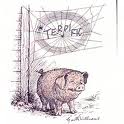
  • Who would have thought that, in the middle of winter while taking garbage out to the deck, I would run Charlotte into a very large spider hanging down from a single line of web? In the warmer weather, we seem to have an overabundance of spiders, but I’m not accustomed to seeing them when there's frost on the windows. Still, I don’t know much about spiders, except, perhaps, for the compassionate, intelligent Charlotte of “Charlotte’s Web” fame.

    For some reason, I never read the award-winning children’s book until I was an adult, and I still got weepy, especially when Charlotte says to Wilbur, the pig, “You have been my friend. That in itself is a tremendous thing. I wove my webs for you because I liked you. After all, what’s life anyway? We’re born, we live a little while, we die. A spider’s life can’t help being something of a mess, with all this trapping and eating flies. By helping you, perhaps, I was trying to lift up my life a trifle. Heaven knows anyone’s life can use a little of that.”

    What’s life anyway?

    There seem to be days when we just can’t find an answer, when things seem so overwhelming that we wonder why we are here in the first place. But then, in those moments when we are able to lift up someone’s life a trifle, or when our lives have been enriched by someone else, we know, like Charlotte, that we are here for each other.

    "Wilbur never forgot Charlotte. Although he loved her children and grandchildren dearly, none of the new spiders quite took her place in his heart. She was in a class by herself. It is not often that someone comes along who is a true friend and a good writer. Charlotte was both."

  • Yesterday, while visiting my sister-in-law who is caring for her mom—a Hospice patient—I heard a Grumpy  funny, but also disturbing, story about what happened when my sister-in-law called the parish to ask for a priest to come and visit. The conversation went something like this:

    “Hello?”  (no introduction)

    “Oh … Hi, is this the Church of the Saints and Angels?”

    “No, that’s not what we’re called. We are referred to as Saints and Angels Church.”

    “Oh, OK, I’m sorry … umm … but the sign in front of the church says, ‘Church of the Saints and Angels.’ Anyway, I was calling to ask for a priest to come and visit my mom and bring Communion. She hasn’t been able to get to Mass.”

    “She hasn’t been to Mass?” (uh oh, disparaging tone is slipping into ‘get thee to confession’ mode!)

    “Well, no, she’s 89 years old and under Hospice care. Could I leave a message for one of the priests to…”

    “No, you’ll just have to speak to him yourself.” (an abrupt version of ‘I’m really not interested in hearing your story so save it for the priest’)

    “What?” (I must be dreaming. What happened to ‘What would Jesus do?’ Maybe I should hang up and try again.)

    “Hang on!”

    A few seconds later a warm, engaging priest gets on the line, offers to be at the house in half-an-hour and the pastoral nightmare of the earlier conversation fades into a funny story to be told around the dinner table.

    In reality, the tone and unprofessional behavior of this particular secretary is all too common in our parishes and schools, stories of which often overshadow the good work of secretaries who instinctively know the power of respect and kindness; to say nothing of the damage done to communities built by evangelization and hospitality.

    Maybe it would help if new titles were awarded.

    Today, while I was doing some research on how best to create a resume in today’s market, I came across a list of some workplace titles that have emerged during the past few years. My favorite was Director of First Impressions, formerly known as receptionist.

    I like it, because it recognizes the importance of those who have a difficult job dealing with the often rude and crude general public, and it emphasizes the critical role of those who answer the phones and emails, build relationships and serve as the voice of a community.

    And when that community is formed by disciples of Jesus, the voice should be one of joy, or at the very least, good humor.

    Not always easy, to be sure, but curmudgeons are not a good fit for the job.