• As a mom of many, my thousands of trips to the supermarket have taught me an important Schooloffish truth.The chances of my leaving at least one bag of groceries behind are pretty high. The chances of my retrieving what I’ve lost are just about zip.

    So when I was leaving the supermarket, my attention quickly turned to a young man who whizzed by me yelling, “You left this behind!” High above his head he held a plastic bag containing a carton of  eggs.

    When it seemed he would lose his customer out the revolving front doors, he quickly shouted, “MOM! You left this!”

    In an instant the woman had spun on her heels and was facing the young man. Realizing that a stranger was holding her grocery bag, she began to laugh, explaining that, for a second, she thought it was her son calling her, and that she always turns around when she hears “Mom!”

    Most moms would agree, it’s instinctual.

    Obviously, the young man had learned that lesson, as well, having observed that just about any mom will respond to that small but powerful word. With a big smile, and certainly happy to be of service, he still apologized for using the strategy saying, “Sorry for any disrespect, M’am. I just wanted to make sure you got your package!”

    His sincerity, good humor and broad grin was infectious. Everyone within earshot was smiling.

    As I drove home, I thought the incident would make a good piece about the devotion of being a mom, but as I set to writing, I decided the more meaningful story was about the young man, and his obvious potential for leadership.

    Sure, he was all of about 19 years old, wearing oversized, low riding jeans and a baseball cap, but like the invisible, unique qualities of a flower still in the bud, the capacity for leadership resides unseen in the heart until it has the opportunity to bloom. And as any gardener knows, without the proper nurturing many flowers fade before the bud ever opens.

    Good leaders are hard to find.

    Leadership experts point out that among the many necessary traits of effective leadership is charisma, the ability to draw people to oneself. Unfortunately, writes leadership authority Dr. John C. Maxwell, all too many possess what he calls, “roadblocks to charisma.”

    Maxwell identifies pride, insecurity, moodiness, perfectionism and cynicism as being obstacles, turning others away from a leader and impeding the ability to cultivate the “othermindedness” that is required of charisma.

    My own experience has shown that pride is among the most damaging of qualities. As Maxwell states so simply, “Nobody wants to follow a leader who thinks he is better than everyone else.”

    Certainly, we all know a few people who should keep that priceless piece of wisdom hanging near their desk.

    “The first step to leadership is servanthood.”   John Maxwell

    SDG

     

  • Last week it was Pinocchio, today it’s Popeye. He came to mind when I was cooking up some Popeye spinach, of course. When I was young, I didn’t care much for this gnarly sailor. Snagglepuss was more my type. But as I got older, I had a new appreciation for Popeye’s wit and wisdom.

    Well before the proliferation of today’s self-affirmation gurus, Popeye pointed us toward self-acceptance: I yam what I yam and that’s all that I yam! Try repeating that to yourself in the mirror as your morning affirmation!

    For those who are uncomfortable with the jargon, a simple translation will work: I am what I am and that’s all I need to be!

    But my favorite expression, as a wife, a mother of six, and woman who often finds it hard to say no, is Popeye’s admission of his breaking point: That’s all I can stands, I can’t stands no more!

    Translation, in today’s terms: NO! I’m done! Fini! Change the channel! Hand over the belt because today I’m number one!

    However it’s stated, it’s all about self-care, acknowledging your limits and your needs. And finally, after what seems a life-time, I’m getting the hang of it. But Popeye knew it wasn’t enough to just acknowledge your limits. He had a formula for overcoming them.

    Now, if I could only master the spinach thing, aka, giving my body, mind and soul what it needs when it needs it. Today, it’s physical and mental rest, a peaceful place, time for prayer, and laughter. Tomorrow, it may be something else.

    So, what’s your spinach?

    SDG

  • God forbid this kind of thing should ever happen to Pinnochio!Pinnochio  

    It started a few days ago, uncontrollable bloody noses, two trips to the ER, and now a face that looks like snorkel gear has been surgically implanted.

    The clinical name for my new attachment is an air-inflated epistaxis device, which is another name for a nose tampon that blows up like a balloon, with lovely plastic tubing hanging out of your nostril that must be taped across your cheek.

    When the ER doctor inserted it I moaned, loudly I’m afraid, and afterwards I whined. It burned, my eyes and jaw now hurt, my head ached and I rapidly developed symptoms of a fierce head cold. Tears pouring out of my eyes, my unpacked nostril closed up and I could only breathe through my mouth. I need chapstick, Vaseline, water, anything!

    You must keep this in for 48 hours, he said, and take antibiotics so you don’t get toxic shock syndrome. Oh my. When it began to bleed again three hours later, I headed off to the ENT doctor who told me 48 hours was not sufficient. At least 4 days, maybe 5, he said. Hasn’t he ever heard of toxic shock, I worried? I imagined by day 5  I would have succumbed already.

    It’s so easy to let your imagination, and your inner child, take over when you are in pain.

    I needed a Cher, “snap out of it” slap, and the ER doctor provided it when he explained that the body has two release valves, kind of like the pressure cooker my mother-in-law introduced to me after I got married (literal, not figurative!). One was in the nose, the other in the brain. He said these bloody noses could be a good thing, because if the valve blew in the brain, I wouldn’t have the pleasure of an air-inflated epistaxis device. I’d be dead.

    So I did what my lovely Stephanie always advises when things get tough: Put on your big girl pants and suck it up!!

    Thanks, Steph, and by the way, would you be free Friday night? I’m having my snorkel gear removed Friday morning, so I’m sure to need some TLC afterwards. My pants are going to the cleaners.

    Link to photo image http://i145.photobucket.com/albums/r238/Debaserness/pinnochio.gif

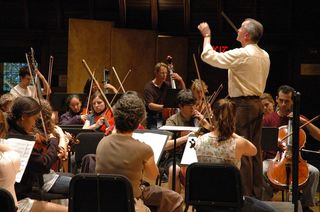
  •  One of the promises I made to myself several years ago was to embrace any new opportunities  Profile-shot-Symphony-c 
    that  might come along—to move beyond my comfort zone so I could relish new learning experiences and forge new friendships with the many unique and wonderful people I've yet to meet.

    For some of us, this is not always an easy thing to do because our hearts and minds are often entangled with an awful four letter word—fear.  Certainly, it is no stranger to me!

    For many years, fear prevented me from doing many things I wanted to do, but I learned that prayer is an antidote to fear. So, with prayer and new resolve, I forged ahead to find an ample supply of opportunities.

    One of the most challenging, to date, has been singing with a choir under the direction of Maestro Dimitrios M. Fousteris, music director and conductor of the Hellenic American Music Conservatory. Most of the music was written in Greek. For myself and four friends who joined in on this adventure, there was new meaning in the phrase, “It’s all Greek to me!”

    The choir was preparing for an impressive production celebrating Greek Independence Day, and included both a symphony orchestra and members of the Metropolitan Opera. Talk about anxiety!

    Being on the same stage with that many highly trained professionals could strike fear in the bravest of hearts. Fortunately, I discovered an endearing quality of Maestro Fousteris was his ability to dispel that fear. You could leave a grueling rehearsal actually believing that there is nothing strange about the fact that, as a simple parish choir member, you will be singing behind international stars, led by an orchestra conductor with 500 concerts throughout Europe and America to his credit.

    The key is clear, stressed the Maestro in his delightful Greek accent, “Focous!, focous!, focous!!” Waving his arms in pure conductor form, he was emphatic, “Do not take your eyes off me!”

    He gave us an exercise to sing, “A, E, I, O, U!” We were told to follow his hands and we began, “A, E….” His hands stopped. We didn’t—barreling along in full voice, “I, O, U!”

    The exercise was repeated four or five times and each time the choir missed the cue and forged ahead like a train unable to stop on the tracks.

    Finally, the Maestro reminded us loudly, “Focous!!! You must focous on me!!”

    The next time we got it right, and he smiled.

    I smiled, too, at the image of God that suddenly occurred to me—the Great Conductor, trying diligently to get us, his children, to “Focus!” while we race ahead with our own way of doing things.

    In the years since then, in addition to Maestro Fousteris, I have been privileged to sing with an incredibly talented and diverse group of music directors and conductors—Chris, Thom, Eliza and Tim. Though unique in their styles, they have all provided invaluable lessons, including the importance of being able to take your eyes off the musical score. It requires knowledge of the music and complete faith in the conductor—and focus!

    Their lessons remind me of the words of one of my favorite composers, Robert Schumann: “When you play {or sing!}, never mind who listens to you. Play always as if in the presence of a master.”
    For us, as Christians, that would be Master—with a capital M.

     “My eyes are upon you, O God, my Lord; in you I take refuge . . .” Psalm 141:8

    Photo is of Tim Keyes, conductor, composer and director of Tim Keyes Consort http://www.timkeyesconsort.org/

  • In a town near mine, there is a home unique in this area of sandy soil. It hosts a lovely English Cottagegardencottage garden. I noticed it when I stopped in a store nearby. An elderly gentleman was wielding pruning shears, preparing the garden for the full bloom of summer, when he caught me admiring his little plot of beauty.  He smiled, I smiled and, in a flash he was standing at the fence eager to talk about his creation, as new parents are eager to talk about their child.

    As he chatted, I noticed a weathered bronze sundial in the middle of the garden. It was something my father would have loved. On the top was a bronze dragonfly, a tribute to his wife, he said. She loved dragonflies. 

    There was also a saying about time, of course, molded into the top:

    Love makes time pass. Time makes love pass.

    The words were a reminder to him, he acknowledged, to use the gift of time as an investment in the things he loved, whether it was his garden, his children or his wife, who was now terminally ill. He pointed to the house down the street, once a delightful beach cottage, which had been reclaimed by time and a lack of attention. Unruly vines had strangled the unidentifiable shrubs and pulled down the gutters. Wooden windows stripped of paint were swollen with water and bulging from their frames.

    You’d think someone would at least sell it, rather than let it decay where it stood, he mused, but there’s no making sense of some people. Inevitably it will either fall down, or be torn down, and time will have won. A new house , or maybe some condos, will go up on the spot and time will have wiped the old house and its memories away.

    We chatted a little more, he invited me to visit sometime when the roses were all in bloom, and asked me where I was off to. I smiled and told him I was going home to trim the ivy that was strangling our little pines trees, and maybe plant another flat of pansies.

  • “Make yourself useful.”Georgische_Familie   

    That was my father’s favorite phrase for reminding me that being part of a family carried responsibilities. Child or not, I could, and should, certainly contribute by setting and cleaning off the table, dusting the furniture, putting away groceries, and keeping my room at least clean enough that the health department wouldn’t condemn it.

     I see it now that, as long as my father felt a need to use that phrase, it was evidence of my immaturity. A child needs to be told, a mature person should not. But even as a college student, still sadly self-focused at times, I needed to be reminded of the selective vision that looked past weeds, unfolded laundry or the almost daily need to shovel from December to March.

    Growing up and maturing do not always go hand in hand. One is a physical process, the other emotional, and I would add, spiritual. Children, we know, are all about “me,” the center of their own universe and full of needs and wants. Maturity nurtures gratitude, and a willingness to respond with the whole self, not just empty words.

     A truly grown-up person is also better able to balance their needs with the needs of others, and recognize that a family is a sacred trust, a covenant relationship of communion in which each person is recognized as a child of God—deserving of love and respect. When respect is divorced from love the family becomes a breeding ground for hurt, anger, and lots of drama. And who needs the drama??

     A happy family, even if not a perfect family, is a minor miracle and a reason to rejoice, as long as every member is committed to making themselves useful in planning the celebration!


  • For a number of years, I worked with a boss who encouraged us often to think outside the box, a Hamstertree phrase that has, today, become so commonplace as to be ordinary. Still, whenever I hear the phrase I think of him and his desire for us to engage in extraordinary thinking.

    While cleaning recently, I came across some remnants from a hamster cage, including the exercise wheel. As the image came to mind of our long-gone hamster running in the wheel within the cage, I thought again of the objective to “think outside the box.”

    Life for our hamster was one of routine, engaging in the same behaviors day after day, getting the same results, including running in a wheel that went no where. Hamsters, it would seem, are not able to consider life outside the box as a possibility and then take the necessary action to make it happen.

    If they were, our hamster might have piled up enough hamster litter around the wheel to make it stationary and then use the wheel to climb out of his cage. A simple wire mesh cover wouldn’t withstand for long the impassioned gnawing of hamster teeth, and voila, life outside the box!

    Of course, such a life is fraught with danger and challenges, not the least of which is the need to be self-sufficient, to secure sustenance and shelter, to learn to navigate a new environment full of other creatures who may either hurt you or help you build a new community of like-minded hamsters. It is easy to see why some hamsters might eventually go running back to the safety of their cage and their wheel, while others never even consider life outside four walls. 

    Obviously, hamsters, like other caged animals, are not endowed with the ability to consider the meaning of their lives. Reflective thinking is the domain of the human mind. Still, even with that gift, we are often unable to consider other options. We live in fear of the unknown and the uncertain, and retreat to the security of familiar behaviors even when the results make us miserable.

    Sometimes the most confining of boxes are not the circumstances of our lives, but, rather, our attitudes and our decisions, serving as self-constructed walls which ultimately restrict our growth. And surely, we were meant to grow.  God’s creation is our model. Within the living realm of nature, there is fluidity and movement, folding and unfolding. There are no squares, no boxes, except those we construct ourselves.

    All life is designed by God for growth and change, for becoming.  But growth is our choice. We can nurture it, or we can stop it dead in its tracks. God would tell us, as he directed Moses to tell the people of the Exodus, “Choose life!”


  • As I pulled my car into the parking lot of the beach along the bay, I noticed a single white swan, its800px-Black_swan_jan09    silhouette bright against the misty grayness of water, sky and land.  She had the bay to herself, no ducks, no geese, not even a seagull entered the scene. Even in the rolling waters, with a storm brewing to the north, the swan seemed to glide effortlessly across the surface, confident, self-directed, unperturbed by the ever widening expanse of water she had travelled away from the shore. Soon she was out of sight, and I turned back to my book, but the image of her alone and secure in deep water was meaningful for me as the place I wish I could be in my life.

    The next day, closer to sunset and parked in the same spot with the same book, my reading was  interrupted as I watched a lithe and strong young woman, dressed in a black wetsuit, carry a large white surfboard across the sand to the water. She was also carrying a long, slender oar.  She sat on the sand to stretch and struck a lotus pose for just a few minutes. Then she picked up the oar and slid the board into the water and stepped on to it. She dipped the oar into the water and began to glide across the dancing waves of an evening bay, confident, self-directed and seemingly unconcerned that the lavender hues of sunset warned of the quickly approaching darkness.

    She was the black swan, and the image of her standing on that board as if on solid ground, moving further and further away from shore, was remarkable. I was envious, but I shouldn’t have been. She had obviously wanted something enough to go beyond wishing.

  • It’s not often that I get a chance to be immersed in an abundance of creative expressions of faith Upliftedarms  meant to transform hearts and lives, but that’s exactly what will happen tomorrow at the Diocese of Trenton’s Re:Image Film Festival at the Algonquin Arts Theatre in Manasquan. Last year’s festival was a real testimony to the power of art and media to inspire a response in faith, so I’m really looking forward to tomorrow.

    One of the music video winners from last year was Laurie Collins, whose video “Choose Life” won the Mission Excellence Award. The music and images were powerful reminders of the gift of choice, not only when it comes to the unborn child but in the difficult and painful experiences of life.

    We read those same words, choose life, in the Book of Deuteronomy when Moses, who led a rebellious and complaining people through the desert for 40 years, reminds them of God’s commandment, saying, “I have set before you life and death, the blessing and the curse. Choose life, then, that you and your descendants may live …” (30:19).

    Moses makes it clear that life is comprised of both the blessing and the curse, “life and prosperity, death and doom.” We have the opportunity to choose between them. This is not to say our lives will be free of suffering or hardship, or that we will not experience death in its many forms, but that in choosing to remain aware of the blessing instead of losing ourselves in the curse, we are choosing God over the many gods that entice us. Our choices begin when we open our eyes in the morning, and affect, says Moses, not only us but our families as well.

    Today, Moses’ words in Deuteronomy 19, often ending with choose life, have become popular in motivational circles, but he has more to say about what choosing life really means:

    “I call heaven and earth today to witness against you: I have set before you life and death, the blessing and the curse. Choose life, then, that you and your descendants may live, by loving the LORD, your God, heeding his voice, and holding fast to him. For that will mean life for you, a long life for you to live on the land which the LORD swore he would give to your fathers Abraham, Isaac and Jacob” (Deuteronomy 30:19-20).

  • I love my occasional lunches with a writer friend of mine, Christina, who inevitably keeps me inGirllickingspoon  stitches  through the entire meal.  It's such a relief from the drama of life!

    We were talking recently about the demands of our present work situations when she quipped, “Don’t you just love it when you get that call saying, 'Uh, yeah, we need you to build the Eiffel Tower by tomorrow, and, by the way, we’ll be sending you a check for $3.' ”

    And since that, in a very funny nutshell, sums up the stress of writing for a living, I'm delighted that Christina now has her own blog, Prayaddhumorthenstir, through The Monitor, the newspaper of the Diocese of Trenton. Now I can retreat to her blog whenever I need an attitude adjustment, a good belly laugh or simply some good old-fashioned humor.

    Be sure to check her out. She is also the first link on my blog under Places I Like.


    Image link http://usa.stockfood.com/image-picture-Small-girl-licking-wooden-spoon-310257.html