• The past three weeks have been full of work and, finally, vacation without Internet access, all of which have been a factor in my falling behind with posts. I wondered what I might share that would be short but meaningful, as I try to catch up. Then I noticed, again, the small inspirational poster hanging near my computer and given to me by a friend who understands how important inspiration is to a writer. The words belong to Joan Chittister: "Our role in life is to bring the light of our own souls to the dark places around us."

    I think about her words a lot, especially when I am grappling with just what it is I am supposed to be doing with my life. I wonder how many of us are truly aware of the light of our souls, and the difference each one of us can make in the world if we let our light shine.

    Today, in one of my favorite books, The Artist’s Way by Julia Cameron, I read something related: "One of the chief barriers to accepting God’s generosity is our limited notion of what we are in fact able to accomplish. We may tune in to the voice of the creator within, hear a message—and then discount it as crazy or impossible. On the one hand, we take ourselves very seriously and don’t want to look like idiots pursuing some patently grandiose scheme. On the other hand, we don’t take ourselves—or God—seriously enough and so we define as grandiose many schemes that, with God’s help, may fall well within our grasp."

    Today, it seems, is the day to spend some time reflecting on possibilities.

  • Some years ago a friend asked why I didn’t write pieces that were more theological. Certainly, my education enabled me to undertake the task. I’m not quite sure he was satisfied with my explanation. Then I happened upon a wonderful book that I wish I had read before he asked the question. I just love the idea of theology as talking sensibly about God!


    “We need to dispel the notion that theology is the exclusive preserve of experts and academicians. Theology is something that we all do all the time, even without actually paying attention to it. I find no better illustration of this than the conversation between Mr. Brown and Chief Akunna. The former had probably spent a few years studying the Bible and theology in his native England to prepare for his missionary journey to the African village of Umuofia. He possessed an impressive mastery of the religious vocabulary and could reel off the theological terminologies with ease. Chief Akunna had not received any formal theological training in the knowledge of his religion. Notwithstanding, he possessed a native sense of religion that made him a theologian of no lesser statue and repute than Mr. Brown. He knew how to talk sensibly about God—the nature of God, the meaning of workshop, meditation and creation, divine providence, and divine retribution. In the course of this engaging conversation between Mr. Brown and Chief Akunna we get a clear idea of the meaning of theology: talking sensibly about God.”


    from Theology Brewed in an African Pot, Agbonkhianmeghe E. Orobator

  • And one of the scribes came and heard them arguing, and recognizing that He had answered them well, asked Him, "What commandment is the foremost of all?" Jesus answered, "The foremost is, 'Hear, O Israel! The Lord our God is one Lord; and you shall love the Lord your God with all your heart, and with all your soul, and with all your mind, and with all your strength.' "The second is this, 'You shall love your neighbor as yourself.' There is no other commandment greater than these." Mark 12:28-31

    When the second wedding in our family was approaching and a number of guests expected at my home, I began evaluating the poor state of our landscaping. In simple terms, it was a mess. Overgrown bushes, weeds encroaching on all our planted areas and one very dead oriental maple tree in our front lawn. It expired between summers but we had no idea why. I wanted to replace it but was afraid a new tree would succumb to the same fate.

    So, after work one day I decided to stop by our local nursery to ask some questions about replacing the tree and discuss some ideas for plantings in the rest of the yard. The owner suggested adding a small pond which would make a lovely spot for relaxing or reading. He showed me a display with a fountain of rippling water and lovely koi swimming back and forth.

    As I leaned over to get a closer look at the beautifully colored fish, I became aware of my reflection in the water. Suddenly, I remembered a Scripture quote that was sent to me as a daily reflection earlier in the day: "As water reflects a face back to a face, so one's heart is reflected back by another." Proverbs 27:19

    I had read it the first time and had a fleeting thought about the ancient myth of Narcissus, a young boy who also saw his face reflected in the water. But I was busy in the office and quickly turned back to the work at hand.

    But now that I had actually entered into the experience myself, I knew I had to go back to the reading and reflect on what both myth and Scripture had to teach me.

    I recalled reading the myth of Narcissus when I was young. He was a young man who had gone to the stream to drink, only to fall in love with his own reflection in the water. Every time he tried to drink, the image would be broken, as would be his heart at having lost the focus of his love. So Narcissus would not drink. Eventually he died of thirst – and self-love. Legend has it that the narcissus flower bloomed where he died.

    Any one who really studies our present day social environment would understand how narcissism could easily become a cultural pathology. Billions of dollars are spent annually to teach people how to love themselves, nurture themselves, fulfill all their dreams, reach their potential, be their own person, do their own thing,

    Of course, when we can keep things in balance, learning to love and value ourselves is important. Self-esteem and self-respect are crucial to an emotionally healthy life and strong viable relationships. This positive self-image also enables us to be successful in life. But when we lose the balance, and healthy self-respect is replaced with a heightened sense of self-importance, then what was good becomes damaging – to us and to others.

    Narcissistic behavior seems to be flourishing in this day and age. More than simple self-centeredness, it is often accompanied by an inability to experience empathy with the "other." The price for such behavior is alienation from the world, and on a more profound level, from God.

    Scripture, on the other hand, never loses sight of the "other." Here, God teaches us that to really be free, to fully actualize our potential as human beings, we must live in authentic relationship with others; a relationship that allows one heart to be reflected in the heart of the other "as water reflects a face back to a face."

    As for the pond, someday, when the expenses of weddings are done with, mine will definitely be filled with koi, not only because they are amazingly beautiful, but because I read that, in Japan, the koi symbolizes love and friendship.

    It never hurts to be reminded of what really makes us whole.


  • During the fourth century there developed a group of women and men who chose to live lives of simplicity and struggle in order to keep their minds focused solely on God. To do this they chose to live alone in the desolation of the Egyptian desert. These quiet, fourth century hermits laid the groundwork for centuries of monasticism. They chose to embrace the severity of solitude, endure the cold of desert nights and the hunger that was a part of their way of life, all to become more aware of their own sinfulness so they could grow in holiness and relationship with God. Their lives of voluntary poverty, austerity, abstinence and prayer have produced a treasure trove of wisdom for spiritual pilgrims of every generation. The Second Vatican Council taught that “Catholics therefore are earnestly recommended to avail themselves of the spiritual riches of the Eastern Fathers which lift up the whole man to the contemplation of the divine.”


    Those who have truly decided to serve the Lord God should practice the remembrance of God and uninterrupted prayer to Jesus Christ, mentally saying: Lord Jesus Christ, Son of God, have mercy on me, a sinner. St. Seraphim of Sarov

  • Summer is not my favorite time of year. It’s hot, and I don’t like hot. Being of Arabic descent, it would seem I should be comfortable in the heat, and the sand, too. When I make a rare appearance at the beach my husband will often quip, "Where’d you park the camel?"

    Funny. But truly, when I wonder what it was like for my ancestors, it causes me to reflect, also, on what it was like for Jesus living in so hot and dusty a climate, traveling everywhere he went by foot or maybe donkey;

    eating who knows what during the lengthy trips between cities, sleeping on the earth, and, likely, carrying a lot of the earth with him on his clothes and body, as well.

    Imagining how uncomfortable such a journey could be may cause us to wonder why Jesus would purposely seclude himself in the desert, not just for a day but for a month or more. But a careful look at his words and his behavior reveal a man who often felt the need to separate himself from the world to spend time with God. There, in the wilderness, without comfort or adequate nourishment it is easier for the soul to "be still and know" its God and to remember that God is the source and sustenance of its existence.

    It is likely that we will all have a desert experience in our lives, sometimes self-imposed once we realize its value for our spiritual growth, but just as often as a result of life’s challenges. No matter how we begin the journey, the discipline of the desert experience can deepen our relationship with God and heal our soul, and in the process allow us to discover the value of struggle. Then we will have truly entered into the life of Christ.

  • "Laugh at yourself and at life. Not in the spirit of derision or whining self-pity, but as a remedy, a miracle drug, that will ease your pain, cure your depression, and help you to put in perspective that seemingly terrible defeat and worry with laughter at your predicaments, thus freeing your mind to think clearly toward the solution that is certain to come. Never take yourself too seriously." Og Mandingo

    Working as part of a writing and editorial team means, of course, paying close attention to how things are worded. Our antennae are geared to catch mistakes. So, it is no surprise that we often find ourselves sharing the bloopers we’ve seen or heard during the week.

    Last week, a co-worker shared some commentary he had heard during a news story.

    The reporter, commenting on the scene of an accident, stated seriously, "The emergency crews have been here since they arrived."

    Wearing our editor’s hats, we had a good laugh at someone not only stating the obvious but getting paid for it, as well. It immediately brought to mind the now famous sayings of Yogi Berra, whose classics include, "It's like deja-vu, all over again," or "If you ask me anything I don't know, I'm not going to answer."

    Early the next morning, I had to drop some letters in the mail bin downstairs next to another co-worker’s desk. I asked her in all seriousness, "Do you think the post office will return this to me if I don’t put a return address on it?"

    My co-worker looked at me with a dead pan expression and after a few seconds of well-pointed silence asked, "How would they send it back to you if you don’t put a return address on it?"

    There it was, the big, "DUH!"; the dead quiet filled up with my own unspoken thought, "How could you say anything so stupid?!"

    Feeling duly chastised, I remembered yesterday’s laugh fest after hearing the reporter’s comments. "Who’s laughing now?" I chided myself. But when I was done feeling stupid, following yet another lesson in humility, I joined my co-worker in a hearty laugh at my expense.

    Laughter and a good sleep, said my Irish father, are the best cures for any ill. He was a wise man; one who taught me the value of laughter and the value of learning to laugh at one’s self when necessary. This skill, he said, encourages us to not take ourselves so seriously, which can result in our becoming so "full of ourselves" that there is little room for anything else.

    As a student of life, my father’s antenna was raised to the incongruities inherent in being human, and he was fond of pointing out that no amount of education, authority or power will prevent a person from making a fool of him or herself at some point in time. And while he admitted sometimes appreciating being there to see it happen, he was careful not to gloat too obviously because he knew his time was coming. And when it did, he was always ready with a laugh.

    When I think back on the most memorable times and people of my life there is always laughter involved. Sharing and making memories with family around the kitchen table, friends at work whose humor relieved stressful situations, laughter in a hospital room or even in a funeral parlor which, if even for a brief moment, eased the pain of loss and offered a glimmer of life’s hope, beauty and the promises of God. "A joyful heart is the health of the body," says the psalmist, and certainly that has been true in my own life.

    But on those days when even a smile seems hard to muster, I try to remember the words of another wise, but unknown, author: "Even if there is nothing to laugh about, laugh on credit."

    Copyright © 2010 by Mary Regina Morrell


  • My Aunt Evelyn made the best Syrian food—tabouli, kibbe, mahmool, pita bread and spinach pies. Her stuffed grape leaves were to die for! She had plots of mint growing on either side of the back door to her house, because fresh herbs, especially mint, were a staple of Arabic cooking. She made coffee by throwing the grinds in a pot of water, boiling and straining into a cup. Tea is made the same way, and when you add mint, it’s a whole body tonic, to say nothing of a delightful culinary experience!


    For each 8 oz. cup of tea you will need:

    1 healthy teaspoon tea (black, green or of your choosing)


    2-4 teaspoons of sugar (depending on preference)


    1 c. water


    A handful of fresh mint leaves (no measuring in her house, but 10 large leaves will suffice)


    Rub mint leaves between your hands. Drop them into the water with sugar and tea and bring to a boil. Let the mixture steep for 3-5 minutes depending on how strong you like the tea. For extra flavor, place a fresh piece of mint in the bottom of each cup and pour the hot tea through a strainer over it. Add milk, if you like, and enjoy!

  • Being caretaker for aging and ill parents is commonplace today, but the physical and emotional challenges it presents can over overwhelm the caretaker. I share this column in support of those who are in such a position. It was written about 14 years ago as I strove to be caretaker for my terminally ill mother, after the sudden death of my father, while raising six sons and working full time.


    "Bear one another's burdens, and so you will fulfill the law of Christ." (Gal. 6:2)

    Well, here I am once again, standing at the ocean's edge as another hurricane rapidly approaches. Choir members have taken to calling me Typhoon Mary, asking that I notify them of my scheduled vacations so they can make sure to stay home.

    There is something mystical and mesmerizing about the ocean. For me it has become a place of peace and tranquility in a life that daily seems to become increasingly complicated. In spite of the impending storm, I have no desire to leave here. Walking on the beach at 7 a.m., leaving my family asleep in the motel, I experience a solitude long missing from my life—a solitude we all need occasionally to maintain our mental health.

    Looking out over the churning waves and pounding surf, I would not be surprised to see mighty Neptune rising out of the foam, trident in hand, head thrown back in macabre laughter at the power he exerts over humankind. In the same instance, I am grateful to know only the one God who created all of this out of love for us. Sometimes, when I consider the things that brought me to this place, I marvel at his unending generosity to children who are so often inclined to be willful, disobedient, judgemental and hurtful.

    Though feelings of meloncholy sweep over me at the thought of returning home, I can not help but smile at the array of birds who seem to be performing for my pleasure. I am amazed at how each group Dancing gull has developed its own unique repertoire.
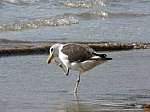
    Obviously secure in its aged wisdom, the grandaddy of seagulls undertakes an ornithological tapdance, churning up delicacies from beneath the watery sand, while delicate troupes of sand pipers, moving blithely across the shore like synchronized ice skaters, rely on speed to secure their morning meal. Nearby a staunch pelican sits squarely on the tilting post of the pier, eyeing his breakfast carefully before making a graceful swoop across the water.

    In a way I suppose we are like those birds, each of us tap dancing, skating or swooping our way through life, meeting the challenges put before us in our own unique style.

    The difference is that birds don't judge each other because they fail to dance the same dance.

    When I was 10 years old, my father gave me a beautiful dream catcher woven with colorful beads and silky feathers. In the center, burned into a piece of leather were the words "Don't judge another until you've walked a mile in their moccasins." I've seen similar sentiments expressed in a dozen ways and in as many languages since then, but for me, it's no less meaningful now. Maybe it's even more so as I struggle to meet the challenges of being a caretaker for a sick parent—a challenge more and more people seem to face with each year.

    I am fortunate, blessed really, with a family which supports my decision to keep my mother home with me— with a husband who never complains about fast food meals or a laundry room that seems to grow dirty clothes as fast as the mold on that mystery "food" in the refrigerator, with children who never complain about having to stay home with "Nanny" while I work and who give her snacks and call me if they think they should put her bed down a little, or young adult children (sons no less) who will take on the responsibility of caring for their grandmother overnight so I can have a much needed respite away, being careful to give her the medication she needs, prepare her meals or change her position.

    I will not apologize for letting my children share in the responsibility, or for needing time away from home, nor do I ever regret standing my ground when I disagree with the doctors or nurses. And if there should come a time when I must place my mother in someone else's care, I will do so free of heart because these decisions are part of how I meet the challenge put before me.

    For my wonderful fellow caretakers, who daily make difficult decisions about the care of a loved one, whether in home or in a nursing facility, I will share the advice my father gave me after he spent three long years caring for his wife: "As much as possible, live a normal life. Make time for yourself and your family and never feel guilty for the decisions you make. Trust in God and in your own wisdom."

    For outsiders who seem to find fault or feel the need to pass judgment, whether family members, friends or professionals, I will share another bit of wisdom. "The surest way down the road of understanding is in another person's shoes."

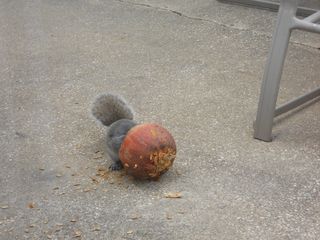
  • Each spring my backyard becomes home to a host of critters who are a continual source of delight to Pumpkinhead squirrel,  me. For the past two years my favorite has been the hyperactive squirrel who seemed to rejoice, in his own squirrel way, in being alive.

    He had a penchant for sliding across canvas awnings, swinging in the neighbor’s hanging planters, and jumping up on my patio table to join me for coffee when I was least expecting it. This season there is a different squirrel, one that doesn’t do much sliding or swinging. And when he does run, it’s with the characteristic of a crab, always stage right. Obviously, he is wounded.

    I noticed him one morning, picking up a peanut from under my lawn chair. He seemed to be listing, like he was drunk. Occasionally he would lose his balance and hit the frame of the chair. I thought he was just having a bad day.

    But later, as I watched him try to sit on his hind legs to eat another peanut, he fell over sideways, a tiny version of Arte Johnson on Laugh In when he used to fall over with that little tricycle. It was funny, but worrisome. I went outside to see if he was OK, and then I realized that, though he was lying on his side, he was still eating the peanut. When he was done, he got up, found another peanut and promptly fell over sideways again.

    Some mornings I would open the door and find him just lying on his side very still. I would worry that he had finally succumb to his wounds. But always on closer inspection I would see him nibbling away on a peanut, almost as if he had mastered the art of reclining at table.

    I looked at this little creature of God with admiration, considering how I have not always been able to adapt to my wounds and just get on with life, which in his case meant making sure he had enough nourishment every day.

    As human beings we are often sidetracked by any number of wounds. Our lives may come to a grinding halt. Our work and relationships suffer, our growth stops, our compass for self-nurturing no longer points north.

    Sometimes we deny the wound because we feel shame or anger. Sometimes we allow the wound to become who we are, identifying always with the pain rather than the possibilities. When this happens, fear of becoming someone new prevents us from simply becoming, and healing never happens.

    When I was suffering with depression, I eventually felt called to share my journey publicly because I had discovered how many people suffer needlessly in silence, without support or professional help because they are ashamed to acknowledge their disease.

    I was worried that my admission would jeopardize my job, and was letting fear make my decision for me. My spiritual director reminded me that no one had to experience more shame than Jesus, hanging naked on the cross, perceived by almost all who knew him as a failure. I should embrace this Jesus as my strength. So I did.

    Henri Nouwen wrote: "Nobody escapes being wounded. We all are wounded people, whether physically, emotionally, mentally, or spiritually. The main question is not ‘How can we hide our wounds?’ so we don’t have to be embarrassed, but ‘How can we put our woundedness in the service of others?’ When our wounds cease to be a source of shame, and become a source of healing, we have become wounded healers."

    Each day I am grateful for the lessons my Father provides, especially through the smallest of his creatures, who teach me not only what is, but what should be. In spending some time each morning with my wounded furry friend I am reminded that once our wounds have been healed, it is not enough for us to simply gather our own supply of peanuts each day. We are called to share the bounty; to love others as we love ourselves, wounds and all.

     Copyright © 2010 by Mary Regina Morrell

  • Today is my birthday. At 6 am, after a long night of trying to complete some assignments, I wasn’t feeling celebratory. The economy has hit us hard, and my head was spinning from the roller coaster of robbing Peter to pay Paul.

    On top of that, by 8 am this morning, I had received at least seven birthday greetings from a variety of website services, a phone call Happy Birthday! from the car dealership, and at least a half-dozen birthday postcards from my physical therapist, favorite restaurant, dentist, and a number of other companies that have somehow accessed my personal information. It seems the marketing power of birthdays has made new inroads. The significance of birthdays has been tainted! I was starting to feel like Eeyore: “After all, what are birthdays? Here today and gone tomorrow.”

    Then a volley of Facebook greetings from honest-to-goodness real friends, and family members, began to pop up in my email. These were sincere greetings. I could hear the smiles in their words. They changed my mood.

    But the best greeting, so far, came from my youngest son. He left a funny card on my keyboard. Inside was a $20 bill. You know things are bad when your sons start giving you spending money! But somehow, the gesture just made my day.

    I’m ready to take Peter and Paul out to celebrate, as long as they pick up the check.