• Working as part of a writing and editorial team means, of course, paying close attention to how things are worded. Our antennae are geared to catch mistakes. So, it is no surprise that we often find ourselves sharing the bloopers we’ve seen or heard during the week.


    One day, a co-worker shared some commentary he had heard during a news story.

    The reporter, commenting on the scene of an accident, stated seriously, “The emergency crews have been here since they arrived.”


    Wearing our editor’s hats, we had a good laugh at someone not only stating the obvious but getting paid for it, as well. It immediately brought to mind the now famous sayings of Yogi Berra, whose Laughing smiley classics include, “It's like deja-vu, all over again,” or “If you ask me anything I don't know, I'm not going to answer.”

     

    Early the next morning, I had to drop some letters in the mail bin downstairs next to another co-worker’s desk. I asked her in all seriousness, “Do you think the post office will return this to me if I don’t put a return address on it?”


    My co-worker looked at me with a dead pan expression and after a few seconds of well-pointed silence asked, “How would they send it back to you if you don’t put a return address on it?”

    There it was, the big, “DUH!”; the dead quiet filled up with my own unspoken thought, “How could you say anything so stupid?!”


    Feeling duly chastised, I remembered yesterday’s laugh fest after hearing the reporter’s comments. “Who’s laughing now?” I chided myself. But when I was done feeling stupid, following yet another lesson in humility, I joined my co-worker in a hearty laugh at my expense.


    Laughter and a good sleep, said my Irish father, are the best cures for any ill. He was a wise man; one who taught me the value of laughter and the value of learning to laugh at one’s self when necessary. This skill, he said, encourages us to not take ourselves so seriously, which can result in our becoming so “full of ourselves” that there is little room for anything else.


    As a student of life, my father’s antenna was raised to the incongruities inherent in being human, and he was fond of pointing out that no amount of education, authority or power will prevent a person from making a fool of him or herself at some point in time. And while he admitted sometimes appreciating being there to see it happen, he was careful not to gloat too obviously because he knew his time was coming. And when it did, he was always ready with a laugh.


    When I think back on the most memorable times and people of my life there is always laughter involved. Sharing and making memories with family around the kitchen table, friends at work whose humor relieved stressful situations, laughter in a hospital room or even in a funeral parlor which, if even for a brief moment, eased the pain of loss and offered a glimmer of life’s hope, beauty and the promises of God.  “A joyful heart is the health of the body,” says the psalmist, and certainly that has been true in my own life.


    But on those days when even a smile seems hard to muster, I try to remember the words of another wise, but unknown, author: “Even if there is nothing to laugh about, laugh on credit


  • I would assume that most people have an issue that really raises their blood pressure.

    For me, it's cell towers. For the past few years we have been fighting against a cell tower being built within Cell tower 200 ft. of our home in the middle of a densely populated residential area. There are three schools within 2 miles of us. We lost the fight. Now we are seeing company after company add their antennas to the pole, greatly increasing the levels of electromagnetic radiation emanating from a poor excuse of a "tree." In our research we discovered that health issues can not be presented as a reason to block towers from being built in a community. Industry leaders deny any connection between electromagnetic radiation and health risks, saying there are no definitive studies. One could say they have their head buried seriously in the sand, or, more appropriately, they are protecting their financial windfall at the expense of a nation's citizens, including those who cannot or choose not to use wireless technology. And what are our leaders doing about the situation?

    It is interesting to note that on April 2, 2009, in Brussels, the European Parliament passed a resolution on health concerns associated with electromagnetic fields. The text is too long to post here, but the significance is remarkable considering the European Parliament is the directly elected parliamentary institution of the European Union, and the European Union includes 27 states including: Austria, Belgium, Bulgaria, Cyprus, Czech Republic, Denmark, Estonia, Finland, France,Germany, Greece, Hungary, Ireland, Italy, Latvia, Lithuania, Luxembourg, Malta, Netherlands, Poland, Portugal, Romania, Slovakia, Slovenia, Spain, Sweden, and the United Kingdom.

    The research is there. If one of the most powerful legislatures in the world is suggesting transparency and real attention to the research, why are we lagging so far behind? And one small point of interest: European insurance companies are "tending to exclude coverage for the risks associated with EMFs from the scope of liability insurance policies, the implication clearly being that European insurers are already enforcing their version of the precautionary principle …"

  • One of the promises I made to myself several years ago was to embrace any new opportunities that might come along – to move beyond my comfort zone so I could relish new learning experiences and forge new friendships with the many unique and wonderful people I've yet to meet.

    For some of us, this is not always an easy thing to do because our hearts and minds are often entangled with an awful four letter word – fear. Certainly, it is no stranger to me!

    But my antidote to fear is prayer, so with lots of that and with great determination, I forged ahead to find an ample supply of opportunities.

    One of the most challenging, to date, has been singing with a choir under the direction of Maestro Thumbnail Dimitrios M. Fousteris, music director and conductor of the Hellenic American Music Conservatory. Most of the music was written in Greek. For myself and four friends who joined in on this adventure, there was new meaning in the phrase, "It’s all Greek to me!"

    The choir was preparing for an impressive production celebrating Greek Independence Day, and included both a symphony orchestra and members of the Metropolitan Opera. Talk about fear!

    Being on the same stage with that many highly trained professionals could strike fear in the bravest of hearts!

    Fortunately, I found that an endearing quality of Maestro Fousteris was his ability to dispel fear. You could leave a grueling rehearsal actually believing that there is nothing strange about the fact that, as a simple parish choir member, you will be singing behind international stars, led by an orchestra conductor with 500 concerts throughout Europe and America to his credit.

    The key is clear, stressed the Maestro in his delightful Greek accent, "Focus, focus, focus!!" Waving his arms in pure conductor form, he was emphatic, "Do not take your eyes off me!"

    He gave us an exercise to sing, "A, E, I, O, U!" We were told to follow his hands and we began, "A, E…." His hands stopped. We didn’t — barreling along in full voice, "I, O, U!"

    The exercise was repeated four or five times and each time the choir missed the cue and forged ahead like a train unable to stop on the tracks.

    Finally, the Maestro reminded us loudly, "Focus!!! You must focus on me!!"

    The next time we got it right, and he smiled.

    I smiled, too, at the image of God that suddenly occurred to me — the Great Conductor, trying diligently to get us to "Focus!" while we race ahead with our own way of doing things.

    In the years since then, in addition to Maestro Fousteris, I have been privileged to sing with an incredibly talented and diverse group of music directors and conductors – Chris, Thom, Eliza and Tim. Though unique in their styles, they have all provided invaluable lessons, including the importance of being able to take your eyes off the musical score. It requires knowledge of the music and complete faith in the conductor – and focus!

    Their lessons remind me of the words of one of my favorite composers, Robert Schumann. "When you play {or sing!}, never mind who listens to you. Play always as if in the presence of a master."
    For us, as Christians, that would be Master – with a capital M.

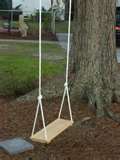
  • While taking a break from writing I decided to drive over to a lovely spot on the bay with parking and Swing benches, and most important for me, trees for shade. While I was sitting there decompressing, I noticed the children playing at the playground nearby. I found myself totally engaged in the joy of the children on the swings. Squealing, jumping, laughing, wanting to go higher and highter. I remembered days when the need for  a prayerful space and time would overtake me, and I would search out a swing at a nearby park. Then there were memories of joyful abandonment, freedom, trust and a glorious experience of space and time. I often wondered if that was the way a soul felt when lost in God. I guess I have misplaced a little bit of my child's heart. Today, I would feel conspicuous on a child's swing. That's sad, at least for me. It signifies that I need to do some soul work and regain the sense of joy in myself. Maybe the two-seater swing in the backyard would be a good place to start.

  • Today, on the way to a funeral Mass, a friend told me the story of an acquaintance who had been very ill, and very attached to her dog, and her dog devoted to her. She worried what would happen to her furry friend when she died and asked family members to please take care of him. Almost immediately after the woman died, her little friend had a freak accident and died also. It was easy for family members to believe that neither friend wanted to be without the other, that's how close they were.
     
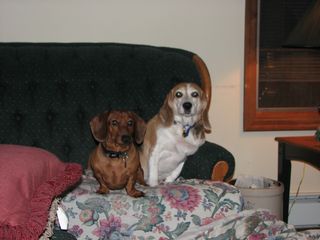
    There is no doubt that the bond between people and their pets is a strong one. And it's not surprising, Taffy sleepin given that they were created with the breath of God just as we were, though they are infinitely more patient and less judgemental than we are! We share our love with them, and they love us back, in the way they are able. My beautiful 14 year old beagle,Taffy, died in February,not long after my year and half old dachshund, Dickens, wiggled out of the backyard and was hit by a car. It hurts, but loving put us at risk.
     
    I often hear from friends who are grieving the loss of a beloved pet, but who are hesitant to ask for prayers to help them and their family with the grief they are experiencing. We hesitate because we feel that the death of an animal can in no way compare with the death, or sufferin, of a human being. But grief should not be quantified or categorized to judge the need for prayer. Certainly, some losses are more profound than others; some pain more unbearable, but all grief signifies a woundedness that needs healing. And Jesus never denied those who needed healing.
    Dickens2
     
    So, today I include in my prayers all those who have lost their pets, and share this prose written by Rudyard Kipling:


     A DOG FOR JESUS
    I wish someone had given Jesus a dog
    As loyal and loving as mine
    To sleep by His manger and gaze in His eyes
    And adore Him for being divine. 
    As our Lord grew to manhood His faithful dog
    Would have followed Him all through the day
    While He preached to the crowds and made the sick well
    And knelt in the garden to pray.
    It is sad to remember that Christ went away
    To face death alone and apart
    With no tender dog following close behind
    To comfort its Master's Heart.
    And when Jesus rose on that Easter morn     2 dogs
    How happy He would have been
    As His dog kissed His hands and barked its delight
    For The One who died for all men.
    Well, the Lord has a dog now, I just sent Him mine
    The old pal so dear to me
    And I smile through my tears on this first day alone
    Knowing they're in eternity.

    Day after day, the whole day through
    Wherever my road inclined
    Four feet said, "I am coming with you!"
    And trotted along behind.

  • Today, as I make plans to attend yet another wake for a friend, I do what most of us do in times like this—remember what was.

    The meeting of friends and family at the funeral parlor, the familiar routine of the wake service and Mass, the images and symbols of the cemetery are certain to evoke memories of loved ones lost and grief experienced.For me, at this moment, the prospect has brought to mind the burial of my very dear Uncle Stan so many years ago, someone much loved and cherished—and missed.

    That morning, as we stood silently by the grave side, waiting for the priest to begin the last prayers, I noticed a small child toying with the baskets of flowers that led to the canvas tent.The bright pink and purples of her dainty clothes were in stark contrast to the somber hues of the adults nearby. In a world of her own, as if unaware of the soft drizzle of fall rain or what was taking place around her, she hummed a quiet tune and touched the silken pedals of fresh cut roses.

    Though my heart ached at the painful thought of my dear Uncle Stan being laid to rest, I had to smile at the little girl who reminded me that life goes on. Then I was the grieving niece, the anguished daughter, having recently lost both parents. At some tomorrow I will be the deceased, as will we all.

    While death, for most of us, is a thought we try to push aside and a fate we try to avoid as long as possible, it is not a bad thing to live life with an awareness that our days are numbered. It is a powerful reminder to live and love fully.

    As the prayers concluded that morning, I followed the child’s lead and pulled several sweet-smelling flowers from the baskets, walking timidly around neighboring graves, trying to undo the familiar tightening in my throat as I came upon the graves of my parents.

    A heavy sigh escaped my lips as I placed the flowers across the dark, moist earth that seemed to resist the spreading grass. Behind me my cousins, after saying their final goodbyes to their devoted father, brought baskets of flowers to my parents’ graves. I was touched and thought about how much I loved my family.

    The smile that accompanied their gesture turned to laughter as someone remarked that, even after a year, there was no grass growing on my mother’s grave, remembering her oft quoted desire to rest in a mausoleum.

    Not your ordinary "drawer in a wall" mausoleum, mind you, where she would share space with other families’ loved ones, but a private mausoleum of grandiose proportions!

    "She’s not going to let the grass grow over HER!" someone quipped.

    "I hope my father doesn’t have to hear about it for all eternity," I had chuckled, remembering the good-natured darts that would often fly between them.

    Reflecting on the number of family members who were "resting" nearby, my cousins and I had considered the possibility of a family picnic.The remembering is so often painful, especially when we are alone. But shared with people who knew our loved ones or who love us in our pain, it can be powerfully healing.

    Now, as I remember times past with my parents, I continue to remember a favorite uncle who made me Dad1 laugh, who beat us to Lyons Lake on summer Saturdays to cook breakfast over an open grill, who served us Syrian bread and olives when we visited after church, whose nonchalant approach to driving evoked spontaneous prayer from anyone who drove with him, who opened his heart and his home to everyone and who loved his children and grandchildren with unabashed openness.

    Sitting here today, as my father’s birthday nears, another thought enters my mind. I remember vividly my cousin’s wedding when the D.J. played Sister Sledge’s song, "We Are Family!"

    "Get up everybody and sing!" blasted from the speakers. And we did, all of us, together.

    We sang together and danced together, as we laugh together, cry together and grieve together.

    There is a time to dance—and to remember.

    "There is an appointed time for everything … a time to weep and a time to laugh, a time to mourn and a time to dance."  Ecclesiastes 3:1,4

  • At this point in my life God has begun to remind me more and more of Columbo, the disheveled, trench coat wearing detective who didn't seem to have much on the ball. He would get hold of a suspect and wear him down with a barrage of questions and just when Columbo would walk away and the suspect would think, "Finally! He's done," Columbo would slow down, turn around with his finger resting pensively on his forehead and say, "Uh, just one more thing."  If that's not God I don't know what is! It seems he is never done with us, and it is easy to get weary with so much honing, and sculpting and molding going on, especially when we sometimes wonder if God really knows what God is doing. But I guess that's what faith is – trusting that God knows the plan even when we can't see it, and trusting, also, that it's not God who is wearing us away with trials but, rather, making us strong enough to bear them.

  • Recently some friends from the parish choir stopped by for a summer get together. At one point, we
    moved into the family room to gather around the piano and sing, because that's what we do. They have been here many times before, in a variety of seasons, and at every gathering someone Wall la muretcomments about how beautiful the room is, especially in winter with the fireplace burning and a 10-foot Christmas tree in front of the window.

    I am always grateful for the compliment but, personally, hide the sense of being a fraud because I am aware of all they can’t see – all of the cleaning that hasn't been done and all of the mess that is stored inconspicuously behind cabinets and closet doors.

    The truth is that when you are aware of what really lies beneath, or behind, surface beauty quickly loses its charm.

    Thoreau made the same discovery when he lived intimately with nature: "White Pond and Walden are great crystals on the surface of the earth, Lakes of Light…. They are too pure to have a market value; they contain no muck. How much more beautiful than our lives, how much more transparent than our characters are they! We never learned meanness of them."

    How good it would be to have the purity and transparency of a Lake of Light, but it is the truth of human existence that our character is formed not solely by the hand of God but within the realm of free choice and the decisions we make to live with or without integrity. And that reality makes integrity and authenticity an on-going challenge.

    Mother Teresa spoke wisely when she said, "Honesty and transparency make you vulnerable. Be honest and transparent anyway."

    It was the integrity of the man Nathanael that Jesus affirmed in saying, "Here is a true child of Israel. There is no duplicity in him" – and this in spite of the fact that Nathanael basically insulted Jesus by saying, "What good can come out of Nazareth?"

    But Jesus saw into Nathanael’s heart, as he sees into ours, and what he saw was not a man who smiled and bowed or offered his hand in friendship only to sling insults and barbs when Jesus turned his back, but, rather, a man who lived with integrity and honesty, who had "no guile in him."

    Nathanael was like the blessed servant of whom St. Francis spoke:

    "Blessed is the servant who loves his brother as much when he is sick and useless as when he is well and can be of service to him. And blessed is he who loves his brother as well when he is afar off as when he is by his side, and who would say nothing behind his back he might not, in love, say before his face."

    Personally, I often wonder what God sees when he looks into my heart because another painful truth is that the easiest person to fool about our lapses in integrity is ourselves.

    We seem to live in a world where deceit is the norm and honesty is rare. We are encouraged to be and to do whatever it takes to get our own way, to be successful, to be noticed, to be admired, to feel loved. These are shallow victories. As French author Andre Gide wrote, "It is better to be hated for what you are than to be loved for what you are not."

  • So, last week I locked my husband in the car.

    I didn’t mean to do it, mind you. It was an accident; one I didn’t even know had happened.

    We were meeting friends for dinner. When we arrived at the restaurant my husband told me to go ahead inside while he tried to find the directions to reset the car clock which was an hour slow.

    Through force of habit I must have locked the car with my remote on the way into the restaurant. Once inside, I was seated at a quiet table in the back and quickly met by the waiter.

    "Would you care for a drink?" he asked, seeing me eyeing up the wine and beverages list.

     "That would be great. I’ll have a berry martini."

    The minutes ticked by as I sipped my drink and began to relax. I had time to review the menu thoroughly, make a mental note of what I would like to order and just relish the opportunity to sit and let the stresses of the day melt away.

    As I neared the last of my martini, I began to wonder how much time had actually passed since I sat down and what had happened to my husband.

    "Just how long does it take to set a clock anyway?" I grumbled to myself, now perturbed at his insistence on fixing the problem right that minute. It was also strange that our friends had not yet arrived because they were always on time.

    I glanced over at the reception desk yet again and finally saw my friend coming toward me. He was laughing, so I smiled back, thinking how nice it was that he was already enjoying our evening together and it hadn’t even started. But for him it had – in the parking lot.

    Before reaching the table he said loudly, "Mary, you locked Frank in the car."

    Even after a few seconds that didn’t sink in.

    "What?" I replied, looking confused.

    "You locked your husband in the car. He can’t get out."

    Now the image of a frantic Frank trying to push every button in the car to open the doors was coming into focus. "You can’t be serious!" I tried to supress a laugh.

    But he was serious. The locks wouldn’t release from inside the car and my husband had been stuck there the whole time I was inside enjoying myself. He had tried calling me on my cell phone only to hear it ringing on the seat next to him. Then he called our friends, who, fortunately, had just pulled into the parking lot. My husband had to talk to them through closed windows and made it clear he was just seconds from putting his foot through one of those windows to get out. It’s amazing how hot a car can get when it’s a balmy 65 degrees outside.

    Before I could get my keys out of my pocket, my husband appeared in the restaurant, quite red and rumpled.

    "So, how did you escape?" I asked, trying not to laugh. The martini didn't help matters much.

    He wasn’t amused. "Didn’t you use the remote from in here? The locks just opened by themselves and I got out."

    I assured him I didn’t assist in his escape and most assuredly the remote would not work from inside the restaurant even if I had tried to use it. He decided to chalk it up to an electrical short. I preferred to think of it as a holy mystery.

    As I sat back and watched the moments unfold at our table amid laughter and listening; the sharing of food and of stories, the mystery became almost tangible; the reaching out from one to the other that began so obviously when locked in a car, continued in a more profound way across the table between friends and spouses; God in communion with us and us with each.

    Sometimes the mystery is not so mysterious if we let the day drop away and just pay attention to the moments.

    Of course, a berry martini doesn’t hurt.

  • "Do not seek from the Lord high office, or the seat of honor from the king … you may be partial to the powerful, and so mar your integrity." Sirach 7:4, 6b

    It’s amazing how many interesting stories you hear when you’re cloistered in a ladies room stall. It seems that some people still carry the notion of children, that if we can’t see someone, they can’t see, or hear, us. That leads to a lot of uninhibited prattle destined to become tomorrow’s latest gossip. I’ve often thought that if I were an investigative reporter instead of a Catholic columnist I could be making a lot more money.

    Just last week, while visiting my local book store, two young woman came barreling into the ladies room, the first one frantically texting on her cell phone, followed shortly thereafter by the other, responding to the text. They both seemed to be out of breath. I was to soon find out they had sprinted to the ladies room to escape the attentions of a young male friend who had unexpectedly shown up in the store.

    "Oh, my God, can you believe it?!" one girl squealed. "Is it possible to be stalked by a friend? He’s such a …" (add in a few hundred words spoken in a few seconds and you get the picture).

    Within the next two minutes I had enough information on them, their male friend/stalker, his former girlfriend, his new girlfriend and all their family situations to write a popular sitcom. Unfortunately I didn’t have a notebook.

    They then spent the next few minutes scheming. It became the typical clandestine conversation behind closed doors scenario; the plotting, the planning, the self-assurance that comes from believing that your plans are secure. Sadly, young people are not the only ones who engage in this stealth strategy; and adults, especially Christian adults, should know better.

    But James and John didn’t know better. There was a reason Jesus called them Sons of Thunder. They had plans. These two disciples, overconfident and ambitious, used this behind closed doors strategy in an attempt to wrest the finest seats in the house of Heaven from Jesus. And as if that alone weren’t enough, they brought their mother, Salome, in on the plan to ask for them. Maybe on some level they realized that their accomplishments or their faith really didn’t warrant a throne next to the Son of God so they hoped their mother’s influence, as one who supported Jesus’ ministry, might get it for them.

    Upon Salome’s request, Jesus basically responded, "Are you kidding? Do you know what you’re asking?" That’s paraphrased, of course, but he made it clear that to earn a place next to him in heaven they had to be willing to walk in his shoes. He asked them if they were willing to drink of the cup he would drink, and in their eagerness for honor and glory they replied, "No problem." Jesus promised them they would get their chance, but he didn’t make the promise they were hoping to hear—that they would be first in the Kingdom of Heaven, sitting at his right and left hand.

    James did, however, eventually earn the distinction of being first. He was the first apostle to be martyred, his powerful preaching having raised the ire of Herod Agrippa. It is said the man who was to lead James to his death was so moved by James’ passionate testimony as a Christian that the man acknowledged being a Christian himself and asked James to forgive him for his deception. James forgave him with a kiss and they were both martyred together.

    John, on the other hand, was the last Apostle to die and became known as the "beloved disciple," the "Apostle of Charity."

    What happened to change these brothers from the self-important, ambitious disciples they once were to the powerful, self-sacrificing Apostles they were at the time of their deaths? The Holy Spirit happened. And love happened, a love for Jesus so strong that both men allowed their hearts to be open to grace, to be humbled, to be used by God for God’s purposes, not personal ambition.

    When we end up behind closed doors, we need to remember one thing.

    The fastest way to make God laugh is to tell him our plans.