• Your work can be a force for great good or great evil. You yourselves know the dangers,
    Earthas well as the splendid opportunities open to you. Communication products can be works of great beauty, revealing what is noble and uplifting in humanity and promoting what is just and fair and true. On the other hand communications can appeal to and promote what is debased in people … All the media of popular culture which you represent can build or destroy, uplift or cast down. You have untold possibilities for good, ominous possibilities for destruction. It is the difference between death and life – the death or life of the spirit. And it is a matter of choice. The challenge of Moses to the people of Israel is applicable to all of us today: "I set before you life and death…. Choose life" (Dt 30:19).   Pope John Paul II

    via wellspringcommunications.typepad.com

    While Pope John Paul II was speaking to journalists and all those involved in some form of media, his words are applicable to any work in which we engage, and to the message of our lives.

  • Every year, as Christmas approaches, I find one of my most memorable lessons happens while
    Breadsinging with the parish choir. Each year the lesson is different, but always unforgettable.

    This year, as I looked across to the soprano section during our annual Christmas concert, I was struck by how much I miss my friend, Joan, who would always notice me waving and shoot me back a brilliant smile.

    Holidays with Joan were always something special, Her loving, generous spirit could only be outdone by her desire to feed her family, friends and guests. In truth, her bountiful table was an expression of her love, and there was always more than enough to go around. The thought that holidays will no longer bring me to Joan’s table, is a thought that continues to bring me to tears.

    Several years ago, I wrote a small story for a religious formation text that was inspired by Joan, and sadly, I never told her it was dedicated to her. Today I share it, and know that she I listening:

    Evelyn had a special gift. She loved to bake bread.

    Whenever someone would come to visit, Evelyn would treat her guest to a full pot of hot tea and warm homemade bread with cranberry butter. When the parish had a bake sale, Evelyn would arrive with her arms loaded with freshly bake loaves.

    When someone was sick at home, Evelyn would visit, always certain to bring a loaf to serve and a loaf to freeze. For some, this gift might seem inconsequential when compared to the gift of teaching or preaching or healing. But no gift is too small to put at the service of God. The preaching and healing that took place through the expression of love that was Evelyn’s bread would be remembered long past many a homily. It might be said that Evelyn’s bread making was a by-product of her true gift of a generous spirit.

     God has been generous with us, as he was with Evelyn, giving each of us our own unique gifts and talents, expecting that we would share those gifts with others for the purpose of building the Body of Christ. When we are tempted to consider that what we have to offer may not be significant enough to change lives, it’s good to think back to Evelyn’s bread, and the power of a crust of bread shared with love.

    This year, having resolved to be mindful of the many blessings in my life, I will thank God for the gift of Joan, a gift that will never be relegated to a shelf in a closet because she has been, and will remain, a forever part of my heart, helping to form who I am as a person and a Christian.

    “I do not cease giving thanks for you, remembering you in my prayers.” Ephesians 1:16


  • “A Good Man Is Hard to Find” – so wrote the renowned Southern author Flannery O’Connor some Good man2
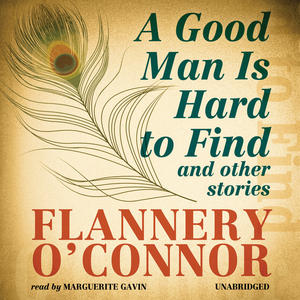
    60 years ago in what is today considered among the best American short stories ever written.

     When I was young, I found it macabre – a story of evil men gunning down an entire family because that’s what they enjoyed doing.

     Today, I still find it disturbing, but enlightening, with a new appreciation of O’Connor’s understanding of divine grace, and realizing, also, that O’Connor wasn’t referring to men, in particular, but people in general, and Christians especially.

     But over the years, the title, pregnant with meaning, has become a literal contemporary adage, often displayed on the front of a humorous “For Her” greeting card: “They say a good man is hard to find…” 

     Inside the card is some silly, often snarky sentiment about men. Generally, that’s a card that will sell because sometimes it is funny, and most people recognize that an occasional good-natured barb at the opposite sex doesn’t mark the demise of our moral standards. A problem arises, however, when the barbs become accepted perceptions; lessons we allow our children to learn.

    Growing up in the sixties, I was among those young women who applauded and supported the changing status of women in society, a status which was eventually reflected more and more in the rapidly expanding world of media advertising. For hundreds of years, women were relegated to the place of second class citizens with perceived limited potential, presented as devoid of enough intelligence or emotional stability to make the important decisions men make. It was frustrating, and unjust, but finally we seemed to be coming into our own, slowly gaining respect and stature in our communities, and media was helping convey the message.

     Having included “Leave it to Beaver” in my very limited TV viewing repertoire as a young girl, I often thought that the Beaver’s mom would have some real issues with the first “Charlie’s Angels,” who were just making their appearance as I was planning my wedding. Talk about a change.

     Sadly, however, it seems the pendulum in media and marketing has swung so far that, rather than simply promoting the strength, potential and inherent beauty of women, it has resorted to diminishing the status and character of men, particularly in family situations – much like an ugly political campaign highlighting one opponent’s shortcomings instead of providing an honest rendering of the other’s successes and failures.

     Sure, I’m biased, as a wife and mother of six sons, though I will confess to my fair share of sexist jokes and retorts, especially when frustration with the testosterone levels in my house have reached a pinnacle. But, frustration aside, it is obvious that what we are seeing in the media is the crafting of a stereotype portraying the ‘family man” as incompetent, self-absorbed, the helpless victim of children’s sarcasm and their wives’ disrespect – in a word, buffoons; certainly, not one among them the “good man” you’d want your daughter to bring home as a potential husband.

     It seems that the battle for equality that has raged throughout so much of history, not just between men and woman but among people of different ethnicities and faiths, has often left all sides bereft of a most important principle – honor.  In our respective jockeying for position, we have lost sight of the divine spark that resides in the “other.”  We often forget that being raised up does not require that we first knock down, or that the people we are knocking down are also children of God.

     When I think of the men in my family, especially my husband and my sons, and the wonderful male friends I am blessed to have, I see good men – unique certainly, like my female friends; imperfect, no doubt, like me – but good men just the same; men who want to love well, even if they, like we, still have a way to go. And they exist in every family, every community around the world.

     So, to Miss O’Connor I would say, a good man is not really so hard to find, as long as you look with the eyes of love.

    “Through the Thou a person becomes I.”   Martin Buber

  • For me, April has always been the herald of newness, recalling memories of childhood Easters when there was still a visual litany of delight present in the “Easter parade” at church; where young Stunning-Sunrise1girls wore crisp white gloves, patent leather shoes and the traditional flowered bonnet, and young boys squirmed under restrictive suit jackets with collars buttoned tight at the neck. Then there was always the tie, a sign of maturity for some and a convenient source of distraction, or disruption, for others.

    Buds just beginning on forsythia bushes, Easter lilies near the altar and tulips on the kitchen table were a sign of the season of life, and a reminder that we would soon be visiting the local nursery to buy our annuals for planting in flower beds and boxes, bringing color, and butterflies, to our family backyard.

    Dressed in my Easter finery I always felt a little like the butterfly just emerging from my cocoon, transformed from the ordinary to the extraordinary. Even after a long day of family visits and lengthy meals, I almost hated to change out of my new clothes and return to my pre-Easter self. Little did I know the experience would become a lesson of faith for me as I matured.

    Somehow it seems that Christ’s Resurrection could not have taken place at any other time of the year but spring, this time of new growth and promise, of miracles and transformations.

    During my life, this season of beginnings has often offered consolation and peace in those moments when, especially as a young woman, I was haunted by a great fear of death. To watch the mystery of spring unfold, to experience the beauty of life’s emergence from the cold ground of winter was to hear God’s assurance that ‘there is nothing to fear – all is life, all has its purpose, even death.”

    Our Catholic faith reaffirms that death is not the end, teaching that “just as Christ is truly risen from the dead and lives forever, so after death the righteous will live for-ever with the risen Christ and he will raise them up on the last day” (Catechism of the Catholic Church, 989).

    But what does it mean to be raised up?

    Again, our faith says, “In death, the separation of the soul from the body, the human body decays and the soul goes to meet God, while awaiting its reunion with its glorified body. God, in his almighty power, will definitively grant incorruptible life to our bodies by reuniting them with our souls, through the power of Jesus’ Resurrection” (CCC, 997).

    This is the resurrection of the “last day,” an event not bound by time or space and certainly beyond our full human comprehension, but God gives us glimpses of this mystery in the little resurrections of daily life. We only need watch for them, in the same way that we watch for the crocus, the robin, the early morning light which follows the dark of night.

    Our Holy Father, Blessed John Paul II, wrote in Novo Millennio Ineunte, “The truth of Christ’s Resurrection is the original fact upon which Christian faith is based, an event set at the center of the mystery of time, prefiguring the last day when Christ will return in glory. We do not know what the new millennium has in store for us, but we are certain that it is safe in the hands of Christ, the ‘King of kings and Lord of lords’” (no. 35).

    Safe in the hands of Christ – can any thought be more comforting as we face our uncertain futures, and ultimately, our deaths? Certainly, this is reason enough to celebrate Christ’s Passover, not only on Easter, but on every Sunday, with gratitude and the reassurance of what it means to emerge from the cocoon of human existence to the freedom of resurrected life.

    One day my Lord said to me: “Believe me, my daughter, trials are the heaviest for those my father loves the best. It is difficult to accept whatever suffering comes our way … but this is the cost of going where God leads us … into the Garden of Gethsemane and on to Calvary. And only then to Easter morning.”        “That You May Have Life,” excerpt based on writings of St. Teresa of Avila


  • Saturdays were my favorite day as a child. It meant time spent with my mom, or dad, or both, Jonahusually shopping for groceries, buying the latest Nancy Drew volume and, eventually, grabbing a bite to eat at the local diner.

    Looking back, I realize how much of my time with them was filled with lessons, not only taught on-purpose, but caught from listening to their spirited conversations.

    As with most couples, there were lots of stories about people they knew – relatives, friends and co-workers. Sentences often began with “Did you know….” or “Can you believe…” or “It’s a shame …,” especially when the topic was a lost job or a failed marriage. My father rarely said anything that smacked of passing judgment, but occasionally, and not unexpectedly for an Irishman, he was known to make one of two pronouncements – he’s “a good man” or he’s “an old fool.”

    For the good man, the bottom line was always a heart that meant well, in spite of shortcomings and mistakes. The old fool, on the other hand, took his missteps on the road of life by failing to see the good, and in the omission, leaving the gift of gratitude unopened. The good man, in most moments, was focused on others; the old fool, on himself.

    Undoubtedly, we have all been, or will be, the old fool at one point or another, differing only by degrees.  The danger lies in foolishness that becomes a habit, a way of life that destroys our willingness to seek forgiveness for what we have done, or, what we have failed to do – or even admit to ourselves that we have fallen short of our responsibilities and promises to God.

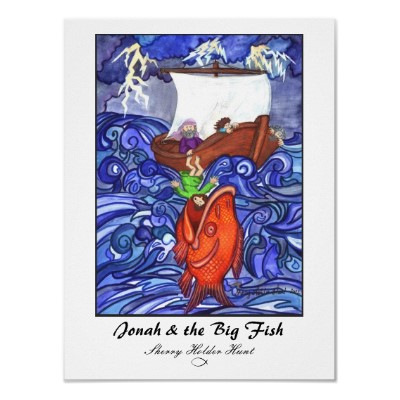
    Perhaps no one in Scripture was more a fool than Jonah, who found out the hard way the folly of running from God. Not only did Jonah attempt to flee from God’s request, he was confident enough in his decision to sleep soundly in the hold of the ship while the waters raged around him.  Even his Phoenician shipmates had insight enough to know that running from God has consequences, so, to protect themselves, they threw a once cocky Jonah overboard and then prayed for mercy.

    God was merciful, not only to them but to Jonah as well, giving him a place to reflect and recollect his senses for a few days – in the belly of a big fish. This was a well-timed crisis for Jonah, the reluctant prophet, one with the potential of a turning point; an experience common to us all, but not always so fruitful.

    Interestingly, the Hebrew word for crisis, mashber, means the moment of birth. It is both a promising and challenging perspective to see new life in the most frightening or painful of experiences, but Jonah’s prayer from inside the fish shows his heart moving in the right direction. He recounts his descent to the deep, the teeming, swirling waters pushing him down to the ocean floor, his head wrapped in seaweed, his soul fainting in fear, until the God of mercy rescues him in a wondrous way. He acknowledges, “Those who worship vain idols forsake their source of mercy. But I, with resounding praise, will sacrifice to you: What I have vowed I will pay: deliverance is from the Lord.”

    And the fish spat Jonah up on the shore … where he would soon forget his earlier predicament, confront God in anger and be afflicted with yet another lesson, this one on selfishness.

    It seems foolishness is a hard habit to break.

  • Every writer needs a favorite place where they can scribble notes on napkins or complete Paris-la-closerie-des-lilas-6478
    manuscripts while the noise of living plays in the background.

    Hemingway had La Closerie des Lilas, his favorite restaurant in Montparnasse, Paris.

    I have the Terrace Café in JFK Hospital, Edison, New Jersey.

    Certainly, a smoke-filled café on the left bank of Paris, where such artistic geniuses as Pablo Picasso, William Faulkner, Salvador Dali and Dorothy Parker gathered to create and exchange ideas, cannot be compared to my little hospital café.

    But for me, spending close to two months in the hospital within a year while doctors and nurses worked to heal my son and then my husband, this flourescent and formica restaurant overlooking the hospital parking lot has provided a much appreciated place of respite with plenty of coffee, the daily newspaper and really great soup.

    Simple blessings are often the most meaningful.

    My fellow patrons may not have included the literary or artistic giants of our time, but their conversations—their tears, their frustration, their laughter, their resiliency—revealed the stuff of inspirational writing.

    One afternoon, when I was too tired to even write a word, I took a table near the window with my back to most of the room. Even a smile would have been too much to muster. But the noise of living crept in behind me where a very elderly dad sat eating at a small table across from his senior son.

    While they ate their voices rose in anger and accusation.

    “You’re a useless son!”

    “You’re a terrible father!”

    “You’re a drunk!”

    “You’re selfish!!

    It went on for 30 minutes before the son stormed out and left the father holding his head in his hands. What became clear to me, in his face and beneath all the anger, was an unspoken fear—of pain and dying or, maybe, of being alone or unloved. Certainly these two men loved each other, but for some reason had just not learned how to do it well.

    Theirs was a story of the human condition, taking one step toward love and two steps back in our weakness and frailty. Jesus understood this condition and shared the secret, “Love one another as I have loved you.” But dying to self is not a challenge easily met.

    Any stay in the hospital, as a patient or a loved one, will confirm a basic truth—being human is not easy. We suffer physically because we are mortal, but we suffer more deeply because we love. It was these stories of love’s suffering and giving and rising above fear that filled my brown stenographer’s notebook every day when I visited the Terrace Café, drank my coffee and was warmed by my soup. Every visit brought new opportunities to consider what was really important in life and how I could do it all better.

    Someday I may have the chance to create something meaningful with the notes I scribbled, but for now I’m just grateful for the lessons and the not so simple blessings of health for my family, good doctors, caring nurses and the unfailing support of my friends.

    Above all I am grateful for the glimpses of God caught through the human stories encountered each day and the light of hope that shines through the indomitable human spirit.

  • When my second son began preschool, an experience relished by his five brothers, his reaction was
    Ark2 less than enthusiastic. As we approached the brightly painted door that led to his classroom, I felt myself being pulled backward by the pressure of his tiny hand tugging on mine.

    Looking down I saw the big brown eyes welling up with tears, a look of fear crossing his flushed face. A kindly, gray-haired lady came out and wrapped her arm around his shoulder, ushering him in to join the other children. As he turned to look at me with wide doe-eyes, I was sure the lump in my throat would choke me. I waited for the inevitable with baited breath.

    “MOMEEE!” came the blood-curdling scream. It wasn’t so much the word as the impassioned, gut-wrenching way in which it was delivered that pierced my guilty-mother heart as I tore myself away, leaving him there in the obviously adequate care of his new teacher.

    New beginnings were not his cup of tea.

    And so it is for many of us, even as adults. New beginnings, while often exciting and challenging, also signify endings. With each new beginning we are called to give up the security and comfortableness of old ways to move forward into the unknown. Even routine, boring or painful daily experiences may be difficult to relinquish because they have become an anchor holding us in place.

    New beginnings require a trust in the Lord and acknowledgement that he is the author of both beginnings and endings. Moving forward is sure to be difficult without the hand of the Lord to lead us.

    Talking to a young man who wished to follow Jesus, but only after he had returned home to say good-bye to his family, Jesus explained the importance of letting go of the past: “No one who sets a hand to the plow and looks to what was left behind is fit for the kingdom of God.”

    Jesus was not saying, as many believe, that the past is something that should be forgotten or ignored, but rather, that when the time comes for a decision to be made for the future, the past must take its place as the port from which one sails.

    To continue to look back may prevent us from making what one Bible commentary refers to as an “instant decision of purpose” – the kind we must make when God calls us to something new and, often, something frightening.

    My experience with decisions of “purpose” has taught me a lesson I try hard to remember—when the challenges of any new beginning bring cries for help, recall the words of Jesus as he rebuked the storm, saying, “Quiet! Be still!” and his remonstration of the Apostles, of whom he asked, “Why are you terrified? Do you not yet have faith?”

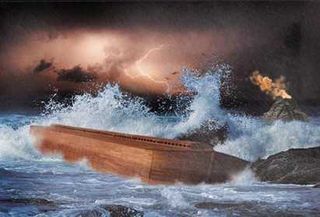
    I want to answer assuredly, “You know I do!” But sometimes, my behavior belies my shaky faith, and I wonder, almost hopefully, if Noah’s first response to God – not recorded in Scripture – might have been along the lines of a muffled, “Seriously?”

    I would feel so much better knowing someone who navigated so well the stormy sea of change through faith in God, also had his moments of doubt.

     “Then David said to his son, Solomon. ‘Be firm and steadfast. Go to work without fear or discouragement, for the Lord, my God, is with you. He will not fail you or abandon you before you have completed all the work for the service of the house of the Lord.’”  1 Chronicles 28:20

  • I was first introduced to Harry Emerson Fosdick through a quote: “… real Christians do not carry their religion; their religion carries them. It is not weight, it is wings. It lifts them up, it sees them over hard places. It makes the universe seem friendly, life Dan-kiefer-uPl8fJ5Ce2M-unsplash (2) NATIVITY purposeful, hope real, sacrifice worthwhile. It sets them free from fear, futility, discouragement, and sin — the great enslaver of men's souls. You can know a real Christian when you see him, by his bouyancy.”

    What a powerful description of our faith, I thought, and what an amazing image, as I remembered looking down over the rail at a mall full of Christmas shoppers to see a large number of them walking with a spring in their step, propelled upward and forward like Neil Armstrong walking on the moon.

    I wanted to know more about this man, who I would discover was an American clergyman, a Baptist minister who often preached in the Presbyterian Church. He was a proponent of liberal Protestantism, and felt the Christian faith had room for people of many opinions regarding Christian doctrine.

    While surely, Harry and I would have disagreed about many things, I was certain I would have enjoyed the conversations and the opportunity to gain his insights on what weighs a Christian down, taking the spring out of his step.

    I think we would have been in agreement that one of the greatest impediments to being lifted up by faith is a lack of humility and our tendency toward self-absorption.

    In fact, in his influential book in the emerging field of pastoral counseling, “On Being a Real Person,” Fosdick wrote, “At very best, a person wrapped up in himself makes a small package.”

    How different is such a person – swaddled in pride and enamored only of his own opinion and enjoyment – from our Lord, a babe swaddled in the simple clothes of humble birth, whose life was a sacrificial offering of love for each one of us.

    The power of Christmas is the humility of the Nativity; God, the creator of all things, born a vulnerable infant into a stable full of animals and the care of a young, inexperienced mother chosen by God.

    It was this paradoxical love of our Creator that Paul tried to explain to the Corinthians: ‘God chose the foolish of the world to shame the wise, and God chose the weak of the world to shame the strong, and God chose the lowly and despised of the world, those who count for nothing, to reduce to nothing those who are something, so that no human being might boast before God” (1 Corinthians 1:27-29).

    Paul’s words remain a gift to us today, and not only at Christmas, reminding us to wrap ourselves in humility, and remember whose children we are.

    Photo by Dan Kiefer on Unsplash

  • MM_LessonOnLove_Cov4ISBN

     This small but powerful book of stories is the perfect read for you when you want to reward yourself with some well-deserved quiet time! Rabbi Irwin Kula, author of “Yearnings: Embracing the Sacred Messiness of Life” wrote, “If you want to find God, know love, and truly understand these are the same, read this beautiful book. But be prepared to have your heart opened up, to laugh and to cry, to take many deep breaths of awe and wonder, and to shout out to the Heavens and to the people in your life, Thank You! Hallelujah! What a perfect dose of grace this book is for people of all backgrounds!"  

    You can deliver this book now to your e-reader by visiting Things My Father Taught Me About Love, Kindle edition.


  • As a Catholic, I have a confession to make. I sometimes watch televangelists. 437784-Black-And-White-Outline-Design-Of-A-Televangelist-Man-Preaching-At-A-Podium-Poster-Art-Print

    While there are many things that make me uncomfortable about this style of evangelizing, I have always felt it would be arrogant, and foolish, of me to suggest that God limits the wisdom of the Holy Spirit to only those of one particular faith tradition. And very often I am edified by a particular insight.

    Today’s bit of wisdom centered on our tendency, as human beings, to allow the miracles in our lives to become ordinary.

    God fills our lives with miracles every day; someone to love us, the birth of a child, a new job, a promotion, a return to health, or good friends.  At first, our hearts are full of gratitude and love for God’s gift, but too often, when love demands something of us, or work becomes a challenge, the miracle becomes ordinary, routine, not worth the effort or fullness of heart with which we once embraced the gift.

    This preacher used the example of the birth of a child, a miracle that fills us with love so profound it’s hard to even describe. And then, the child becomes a teenager and we ask, “God, why did you do this to me??”

    I laughed, having had to deal with six teenagers during my lifetime.

    The preacher followed this analogy with a Scripture passage, and that’s when I really started paying attention, because it was the same passage that had come across my desk three times in the past three days, and one I had never read before.

    “But I have this against you, that you have turned away from your first love. So keep in mind where you were at first, and be changed in heart and do the first works; or I will come to you, and will take away your light from its place, if your heart is not changed.”  Revelations 2:4-5

    Today would be a good day to remember the miracles, so “ordinary” doesn’t become a way of life and we find ourselves grieving the loss of God's gifts to us.