• Imagine a scene in the labor and delivery floor of the local hospital. A young wife and her husband Potter2have just delivered their first child. They look down with love at the tiny infant wrapped in a small pink blanket. Beaming, the mother says, “Isn’t she just the most mediocre baby you have ever seen?”
     Imagine if the creation story in Genesis read in similar fashion:

     On the third day, God created every kind of plant and fruit and he looked at what he had created and said, “Ehh … so, so.”

     And on the fourth day God created the sun and moon and all the lights in the sky, and he looked at what he had created and said, “Well, this is pretty mediocre.”

    Then God saw every thing he had made and said, “Hmmm, I could probably do better, but who’s going to know?” 

    Somehow the story would just lose something.

     But, as we should keep in mind, God’s reaction to creation was considerably different. With every new day and every new creation God saw that “it was good.”

     And if we were to give God a 21st century vocabulary and demeanor, he would cross some very large arms over a similarly large chest, look around with a big grin on his radiant face and pronounce, “This is good! This is DAMN good!”

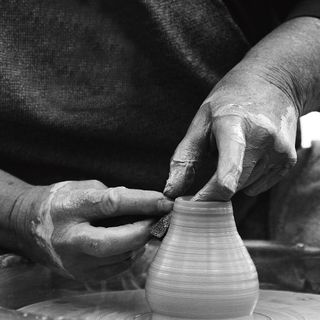
     Each of us has been endowed by God with the ability to create; to bring something into existence that wasn’t there before through the inspiration of the Holy Spirit working in our hearts, our bodies and our minds. Whether we create an environment of love or hospitality in our homes, build friendships or meaningful moments for others; whether we create with words or music, our voices or our hands, when the work is for God and God's people, we can take our cue from our God, stand back and exclaim, “This is damn good!”

  • What’s in a word?                                                                                                                                        Putz-9

    A lot, as I was reminded during my first holiday trip to Bethlehem, Pa., last year.

    A day in historic Bethlehem during the Christmas season is an experience that bears repeating. The shops, the lights, the horse drawn carriage rides around the 240 year old city while Christmas music fills the air were all steps back in time. While wandering in and out of book stores and gift shops, we were treated to marvelous decorations, wonderful smells and shop keepers dressed in the period costumes of Bethlehem’s original founders, the Moravians.

    I also discovered a tradition unique to the Moravian culture—putz. Signs for ‘putz’ were everywhere, both in the stores and outside along the streets. Unfortunately, I had no idea what ‘putz’ meant.

    So, in one particular Christmas shop which seemed to have an overabundance of ‘putz’ signs, I leaned over the counter where a slender, silver-haired lady with shaky hands stood next to a tall, dashing gray-haired gentleman and rang up the purchases of a line of shoppers.

    “May I help you?” the lady asked with a bright smile.

    “I was just wondering if you could tell me what a putz is,” I asked, pronouncing putz with an ‘uh’ sound.

    She hesitated, “I think you mean ‘pootz.’ ”

    Always happy to be corrected in front of a dozen people, I forced a smile. Suddenly, the dashing gentleman chimed in matter-of-factly, “Yes, it’s pronounced pootz, because putz is a Yiddish word for a certain part of the male anatomy.”

    Unfortunately for the silver-haired lady, he then punctuated the sentence with ‘the word’—penis!  She quickly turned a stunning shade of red. The chortles from customers around me seemed much louder than they probably were and my traveling companion could barely keep her composure.

    The distorted look on my face took hold as an image of a street poster flashed through my mind: This year’s tour also features an extraordinary display of 150 putzes in the Sisters house on Church Street.

    “Yes, that would certainly be extraordinary,” I thought, pursing my lips to maintain control.

    I wasn’t asking any more questions. I thanked the gentlemen for the explanation and we left the store with a memory that keeps us laughing even today. Later that evening I did some research and discovered that Moravian Putz was actually the building of miniature scenes to retell the nativity story, and that the word putz comes from the German word putzen which means to decorate.

    Interesting certainly, but, for me, the whole experience was more than a language lesson. It was a reminder of something I was always told as a child: watch your words.

    Words are like my friend Ruthie—always pregnant; always full of life and potential, including the potential to hurt or heal.

    What we do with them is up to us.

    “Words, once they are printed, have a life of their own.”  Carol Burnett


  • Whenever a major change in life catches me off-guard and I focus too much on loss, I try to re-Sankeyframe it within the words of Isaiah who reminds us of God’s promise of rebirth. While I am not always successful, it is always encouraging to read the words of the Lord who said, “Remember not the events of the past, the things of long ago consider not; see, I am doing something new!”

    Through Isaiah, God reminds us, “It is I, I, who wipe out for my own sake, your offenses; your sins I remember no more.”

    Whenever I read this Scripture passage, I think of that beautiful hymn, Blessed Assurance, for certainly, assured is what I feel when I hear God say, “Your sins I remember no more.”

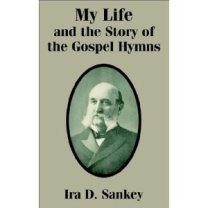
    There is an interesting story relayed in Ira David Sankey’s book, “My Life and the Story of the Gospel Hymns.” He writes, “‘During the recent war in the Transvaal,’ said a gentleman at my meeting in Exeter Hall, London, in 1900, ‘when the soldiers going to the front were passing another body of soldiers whom they recognized, their greetings used to be, ‘Four-nine-four, boys; four-nine-four,’ and the salute would invariably be answered with ‘six further on, boys; six further on.’

    The significance of this was that in ‘Sacred Songs and Solos,’ a number of copies of the small edition of which had been sent to the front, number 494 was ‘God be with you until we meet again,’ and six further on that 494, or number 500, was ‘Blessed Assurance, Jesus is mine.’”

     We can always find assurance in the truth that Jesus is ours and will find his way to us by whatever means possible, even through coded messages and in spite of the bonds of death.


  • There is a story of a pastor who decided to hire a gardener for the parish grounds. From spring toGarden summer the man worked diligently until one fine day the pastor strolled out into the flower garden with a neighboring priest, anxious to show off the new creation.

    Gesturing toward the many different plants and flowers, the pastor said, "I praise God for all of his handiwork!" Stepping out from behind a bush with clippers in his hand, the gardener chastised the pastor, saying, "Don't you go giving all the credit to God. Just remember what this place looked like before I got here and God had it all to himself!"

    There is much to be said about the teaching that we are co-creators with God, working in communion with the God who made us to create all that is good and beautiful, or working without God or in spite of God, to create all that is not of God.

    When we stroll through the gardens of our lives and take a hard look at what is growing there it will become obvious whether or not we are partnering with God.

  • Parents of young children know the experience of trying to leave them alone to play while the Elephantsparent tries to get some work done in another room. Without fail, even if a child is playing happily, the child will leave their toys and follow the parent from place to place, often without saying a word, simply desiring to be where they are.

    Sometimes there is nothing more wonderful or comforting than to simply rest in the presence of the one you love. At those times, only silence is adequate to communicate the great love that burns in the heart.

    "There come times when I have nothing more to tell God. If I were to continue to pray in words, I would have to repeat what I have already said. At such times it is wonderful to say to God, 'May I be in Thy presence, Lord? I have nothing more to say to Thee, but I do love to be in Thy presence."  ~O. Hallesby


  • I have always loved the writings of St. Francis de Sales because I have always found Flying dogencouragement in his admonitions to be gentle with ourselves. He wrote, "Patience is the one virtue which gives greatest assurance of our reaching perfection, and while we must have patience with others, we must also have it with ourselves."

    Of course, that is a tall order, but St. Francis was well aware that the person each of us is hardest on is often ourselves. We can accept the shortcomings and idosyncrasies of others, especially our friends, but we beat up on ourselves for the slightest imperfection.

    Warts of "not good enough" seem to pop out all over the place when we look in the mirror each morning. I can't image God feels really good about that.

    Rather, he must feel like the little child who has just created a crayon masterpiece only to be told by the teacher that maple trees are not purple and dogs do not have wings.

    Well, maybe not in her world, but in the eyes of the Artist, the work is perfect.

  • Pope St. Pius X wrote, “Hope has been the sole companion of my life, the greatest aid in doubts, the Irisstrongest assistance in my weakness; hope, but not the hope in men, such as is thought to bring greater happiness and instead brings greater disaster, but hope in Christ, supported by the celestial promise that he will strengthen the weakest of men with a greatness of soul and divine help.” 

    Experience taught this pope, as it teaches many of us, that there is a certain faith we may put in others, that they will try their best to be loving, just, honest and loyal. But to expect that they will never falter would be to put our hearts under the knives of their frailties and endure an avoidable wound. Love others, but put your hope in God. It is an assurance that your heart will remain whole.

  • Having lived in a home with multiple teenagers, I can say unequivocally that they have a unique Regretway of enlightening parents to their own version of the truth. In my house, I very often got the “quote.”

    A favorite among them, especially when asked to explain some errant behavior, was, “What can I say, I ‘walk to the beat of a different drummer.’”

    I often wondered if Thoreau would give them a high-five or chastise them for using the quote out of context. There is, after all, something to be said for learning the whole lesson.

    But I suppose I am as guilty of inspiring the quotation response as anyone, because, as many writers would acknowledge of themselves, I have a fondness for quotations, too.

    Whether those little gems of wisdom that often give some direction to our day, or those uniquely beautiful ways of expressing a thought that I wish I had written myself, I find I am drawn to these mini-lessons.

    Often someone else’s words can provoke us to memories, both painful and sweet, and remind us of things we should have learned, but sometimes forget.

    That was my experience on the day I signed the contract to sell the home in which I grew up.

    The house had been on the market for more than a year, overdue taxes had been accumulating for nearly three years and the stress was mounting as I faced another winter worrying about who would shovel the snow or make sure the heat stayed on in this house located in a snow belt of upstate New York.

    Still, as I signed my name to the last of three copies of the contract for which I had fervently prayed, tears welled up in my eyes as I thought of all I had lost with the death of my parents.

    In that moment I recalled the words of a favorite quotation:

    “Looking back, I have this to regret, that too often when I loved, I did not say so.”

    I remembered once again the image of my father, waving goodbye from his driveway as my family drove away that winter day. It was the last time I would see him alive, and the last opportunity I would have to tell him that I loved him – and I let it slip away as I let so many other opportunities slip away before then.

    I don’t remember who wrote that quote, but the words increased my resolve to let those I love know how I feel. But sometimes there are no words harder to say than the very three that everyone wants so much to hear. And so I have often faltered, letting days and weeks go by without saying, “I love you,” to the very people who mean the most to me.

    It remains a mystery that what we want so much for ourselves is often the hardest to give to someone else – love, tenderness, time, forgiveness – those things that make the words a reality.

    I believe that is why God gave us Jesus – to show us how to love – and why he inspires some to write the beautiful words that may move others to love fully and freely; words like those of William Childs: “Do not keep alabaster boxes of your love and tenderness sealed up until your friends are dead. Fill their lives with sweetness, speak cheering words while their ears can hear, and while their hearts can be thrilled and made happier by them.”

    Amen to that, William. Amen.

    “May the Lord make your love increase and overflow for each other.” 1 Thessalonians 3:12

     Image at https://www.pxleyes.com/blog

  • Yesterday, when I was searching the closet for something to wear to work, I spied the hem of the Bicone_blue_zircon_6mm_thumbdress I wore to one of my son’s weddings. A lovely shade of turquoise, the entire skirt and jacket were embroidered with small iridescent turquoise crystals in an intricate pattern of swirls and starbursts.

    On the day before the wedding, as I was moving the dress from one closet to another, a string caught on a nail head protruding from the closet molding.

    Unaware, I continued walking and in a few seconds hundreds of turquoise crystals were lying on the floor. I stood in disbelief, as wedding stress took over and I gave in to sobs.

    It took hours, in the middle of the night, to re-sew most, of the crystals back in place and while no one mentioned the distinct difference in the swirls of my mending, I was upset, none-the-less, that the dress I was to wear for such a special occasion was now marred.

    Today, rolling one more stray crystal between my fingers, I consider how intimately trust and love are bound together.

    Like thread, trust is capable of weaving love in intricate patterns throughout our lives, but when broken can, in an instant, unravel the beauty that has taken a life-time to create.

     “To be trusted is a greater compliment than being loved.”   George Macdonald


  • Recently, I made the familiar 160 mile drive to Albany, where I was born and raised, and where Th_meatloaf
    family memories play hide and seek behind low rock walls along the New York State Thruway, and yell “home free!” most often, it seems, when I pull in to the parking lot of Keenan’s Funeral Parlor.

    Here, the bodies of a generation of deceased loved ones have laid in repose, allowing those of us left behind to have a few more brief hours of their presence before the casket closes and we face the reality that they are gone, at least from this earthly life.

    This was one of those days, but the service, though not Catholic, was one of the most moving I have experienced.

    A reformed minister led us in prayer and song in the funeral parlor, before inviting family members and friends of Wayne, my cousin’s husband, to share their thoughts and memories.

    A steady stream of guests took the microphone at this good-bye celebration of Wayne’s life, and brought us to tears of laughter and sorrow as they shared their experiences.

    I will never forget the story shared by Wayne’s sister when she matter-of-factly suggested that Wayne would now know the answer to one of his frequent questions as a child: Will there be meatloaf in heaven?

    As a young child, Wayne wasn’t just asking if he would have the pleasure of eating a favorite food after death. He was asking for assurance.

    We do the same thing as adults.

    We need to be assured through words and behavior that we are loved, that we are secure, that there is no boogey man under our bed, or in our relationships.

    We want insight into the unknown, the dark, the mysterious – including the mind of our teenager, or our spouse!

    We desire truth, and that assurance our fears are allayed.

    Perhaps that is why blind Christian hymnist Francis Crosby wrote, in 1873, the comforting and memorable words, “Blessed assurance, Jesus is mine!”

    Composing more than 8,000 hymns, Fanny, as she was well-known, said of her blindness, "The first face ever to gladden my sight will be when I get to heaven and behold the face of the One who died for me. . . .  I verily believe that God intended that I should live my days in physical darkness so that I might be better prepared to sing His praise and lead others from spiritual darkness into eternal light.  With sight I would have been too distracted to have written thousands of hymns."

    Fanny’s faith, a gift from God which she freely embraced, was the source of her confidence in the promises of God. Jesus invites us to do the same, strengthened by the Word of God: “Now faith is the assurance of things hoped for, the conviction of things not seen.”

    Certainly, with faith, there is no boogeyman that cannot be dispelled by the light of Christ.

     “Blessed assurance, Jesus is mine! Oh, what a foretaste of glory divine! Heir of salvation, purchase of God, born of His Spirit, washed in His blood. Perfect submission, all is at rest, I in my Savior am happy and blest, watching and waiting, looking above, filled with His goodness, lost in His love.”  Fanny Crosby