• Getting a kite up in the air can be a real challenge, especially when you stand on the tail.Kite

    This was today’s lesson by the bay, as I watched a young father try with persistence to get his kite, stamped with a spaceship, to lift-off.

    After numerous adjustments to his backward gait, the line length, arm placement and evaluating whether the kite was put together properly in the first place, this frustrated father was close to chucking the kite, streamers and all, into the sand and calling it quits when he happened to look down and realize he was standing on the kite’s tail.

    I think I saw a relieved smile creep up the corners of his mouth, as if he were glad to discover he was not kite-challenged after all.

    Like this kite-flyer, when it comes to achieving something, we are often our own worst enemies, standing on the tail of our dreams and our growth.

    Our plans, our relationships, and our spiritual lives may be stunted as much by our own failure to pay attention as by our sometimes misguided decisions and tendency for blaming others, especially God.

    On more than one occasion, when I’ve complained about things not going as I’d like, I’m certain I’ve heard God say, “Well, if you would just pick up your foot and get out of my way, we might make some progress!”

    A good first step is when I can get in line with Jimmy Buffet and admit, “I know it’s my own damn fault!”


    Image URL  www.tias.com/stores/fuzzyizzy/pictures/7401a.jpg

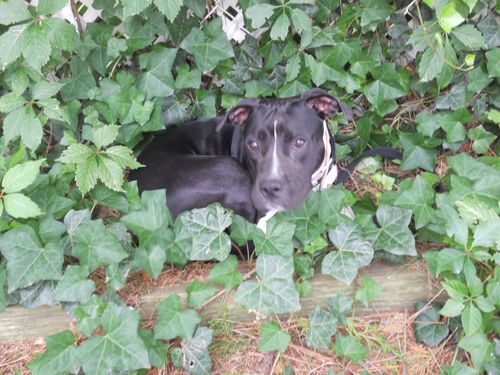
  • For the past week I have been dog-sitting for my son’s newest addition, Sadie.DSCN0445 

    Rescued several weeks ago from a kennel, we know very little about Sadie’s background, but her many fears, especially of enclosed spaces, like houses, rooms, or cars, provides a challenge, since she often has to be pushed or lifted to get her from one place to another – that is unless we are going outside.

    Once she has the sense of space and the thousand scents that fill the air, Sadie’s body begins to relax, her tail raises from between her legs and she moves with less hesitation. If we stay out long enough she sometimes regains her puppy behavior, snatching at sticks, throwing pine-cones in the air, and lunging like she’s ready for a game of catch-me-if-you can.

    But when it’s time to go in, her powerful hind legs put on the breaks at the door, making the emphatic statement that inside is not a good place to be.

    While Sadie’s young life may have been compromised at some point and her memories of “inside” raise fear in her canine heart, her preference for nesting in a bed of ivy, or lounging under the pine bushes, comes, for me, as a reinforcement of the Nature Principal – a wonderful book I finished reading just weeks before Sadie’s visit. The book’s message is still fresh in my mind, as is its sub-title, “Human restoration and the end of nature-deficit disorder.”

    Says the book’s author, Richard Louv, “Primarily a statement of philosophy, the Nature Principle is supported by a growing body of theoretical, anecdotal, and empirical research that describes the restorative power of nature—its impact on our sense and intelligence; on our physical,  psychological, and spiritual health; and on the bonds of family, friendship and the multi-species community. Illuminated by ideas and stories from good people I have met, this book asks: what would our lives be like if our days and nights were as immersed in nature as they ware in technology? How can each of us help create that life-enhancing world, not only in a hypothetical future, but right now, for our families and for ourselves?”

    The questions Louv poses, no matter our religious traditions or spiritual leanings, are essential to our wholeness as a human community; a community that can still benefit from the lessons of our non-human companions on the journey that is life.

    Sadie has also reminded me of one other thing — I don't have to stand at the door and whine, waiting for someone to let me out. I just have to turn the knob.

  • My mother-in-law was a feisty woman, who was always up for a rousing debate, especially about Stones her faith. Still, given that she was a cradle Catholic who spent several years in a convent boarding school as a child, her decision to join the Jewish Community Center in her 70s, after her husband died, was a surprise to all of us.
    Sure, they had a great pool, which was her primary reason for joining, so she said, but it became obvious that she also took great pleasure in being the lone Catholic wolf in what would soon become her small community of Jewish women. I’m sure there was more than a little fire in their conversations, and her name was Muriel.

    So, when her funeral procession pulled in to the cemetery last week, and I realized that the veteran’s section, where my mother-in-law would be buried with her husband, was adjacent to the Jewish section of the cemetery, I had to laugh.

    There would certainly be no dearth of spirited dialogue for this special lady of blessed memory.

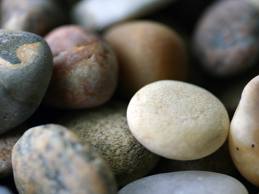
    While we waited along the narrow path in our cars, my husband noticed that most of the tombstones on Jewish graves had small rocks of various sizes resting on top of them, and he wondered at the significance. Stones, after all, are ordinary, cold and lifeless, certainly lacking the color and beauty of flowers.

    But, as with so many things, the beauty of meaning often lies beyond sight.

    The Jewish people find great significance in stones – ancient altars were often formed with piles of rocks, and graves were marked with them in the form of cairns. One of the most sacred sites of the Jewish faith, the Western Wall of the Temple Mount, is comprised of stones that have tasted the tears and heard the prayers of the Jewish people for centuries.

    And then there is God, who King David calls “the Rock of my salvation,” and who is known as the Rock of Israel.

    And didn’t Jesus, the “corner stone,” change Simon’s name to Peter, saying, “Upon this rock I will build my church.”?

    In Jewish tradition, when a visitor places a rock or pebble on a headstone, it symbolizes the presence of God, whose love and covenant is enduring. By engaging in this meaning ritual, a person is also participating in the mitzvah, or commandment, of making a marker at the grave to honor the deceased.

    As one rabbi has written, “We are taught that it is an act of ultimate kindness and respect to bury someone and place a marker at the site.”

    Looking out across the wide expanse of the memorial garden where Muriel was to be buried, I looked in wonder at the sight of hundreds of tombstones, and almost everyone had stones of varying shapes and sizes sitting on top; stones of remembrance.

    I thought a lot about remembering, about love and kindness, and was grateful for the Spirit of God which propels us to toward holiness even when we really don’t fully understand how, or why. Like the Jewish people, we trust that God’s commandments and God’s whisperings are leading us into wholeness and communion, with God and each other.

    And I like to think that God, like so many visitors to a Jewish grave, leaves markers in our lives as a sign of his presence and a reminder that we are loved and never forgotten.


  • I have come to believe that anyone who has paid the exorbitant price of higher education should 901-free-paper-airplane-instructions be  rewarded with something similar to frequent flier miles so that when age, wisdom and relevance kick in former students could re-take, at no charge, those courses which they had blown off in youthful ignorance the first time around.

    If that were the case I would run back to my class on economics which focused on the work of John Kenneth Galbraith, a brilliant man with a caustic wit who made economics accessible and meaningful to the ordinary person – something I would only learn by accident years later when re-entering the work force after spending the better part of 19 years at home raising my six children (the hardest and most rewarding of all jobs).

    Since I do not have frequent flier miles for classes, I resort to the next best thing and re-read the college texts that still reside in my library at home. Galbraith’s The Affluent Society is among my favorites. It was in these pages that Galbriath illuminated for me a tendency in the workplace that, as my father often said, “gets my goat.”  It is “the art of genteel and elaborately concealed idleness…”

    Galbraith draws back the curtain on a practice that many truly believe they have perfected: “Indeed, it is possible that the ancient art of evading work has been carried in our time to its highest level of sophistication, not to say elegance. One should not suppose that it is an accomplishment of any particular class, occupation, or profession. Apart from the universities where its practice has the standing of a scholarly rite, the art of genteel and elaborately concealed idleness may well reach its highest development in the upper executive reaches of the modern corporation.”

    Slackers, my mother would call them, observing them herself from her always busy desk in a local high school. They can be found at every level of the work force, but it seems most distasteful when they have a position of responsibility, ignoring the truth that “much will be required of the person entrusted with much, and still more will be demanded of the person entrusted with more.”

    A human resource director once pointed out to me, “Increased salary comes with increased responsibility.”  Maybe that should have a codicil:

    Increased salary comes with increased responsibility that is accepted and fulfilled.

  • My son and daughter-in-law are animal lovers, and even before they moved in to their new house, Remmy with lots of space and a great yard, they were fostering the biggest Great Dane I have ever seen, the Snuffleupagus of Great Danes, Pluto. They made room for him in their apartment, along with Evie, an adorable and feisty miniature schnauzer, and two ferrets. Pluto, who was abandoned and had pony-length legs about as thin as his ribs, has since become a well-loved, well-fed part of the family, and has taken a paternal interest in the two bunnies also recently added to the herd.

    But love has welcoming arms and a big heart so I was not surprised when, last week,  they  rescued another young Great Dane just hours from her being euthanized and took her home to get her healthy before putting her up for adoption through a Great Dane rescue organization.

    Remmy, in the photo, is young, and small for a Great Dane, and could easily walk underneath the behemoth Pluto, except that she is so weak and emaciated from not eating or being cared for, she has trouble walking at all. This is complicated by not having the use of one of her paws, which she drags when she does walk. So she has gratefully taken to the couch where she is showered with attention and affection, plied with high quality food, and is learning to play, something she seems to know little about.

    Looking at her photo, I am reminded of the dogs in Scripture who scavenge for scraps under the table, dropped by the children who were fed first, and best. Fortunately, Remmy’s circumstances have changed. She is now one of the children at the table, and I am confident she will thrive under the care of my kids who have learned that real love provides more than leftovers.

  • On the shore at the bay there is a jungle gym area where my daily visits usually include a lesson 800px-ConeQueenOperator learned in observing children at play. Yesterday’s lesson was fit for America’s Funniest Home Videos.

    A group of seven young children between the ages of two and eight were having a great time climbing the plastic rock stairs, chasing each other up and down the slide, and hiding in the nooks and crannies of an artificial mountain. Squeals of delight echoed loudly, even against the lapping waves and the chatter of parents nearby.

    Then, in an instant, chaos reigned. The Ice Cream Man arrived. Like a dog whistle to dogs, the distinctive teeth-grinding chimes of the ice cream truck set this once pleasant, collaborating group of little people into a frenzy. Squeals of delight became pterodactyl–like screeches of desire.

    “ICE CREAM!!!!!!!!!”

    Pushing and shoving ensued as 14 crazed feet jockeyed for a head start to the truck. Parents sprang into action to halt the stampede but not before one limber five year old bolted toward the street well ahead of frantic adults who screamed for him to cease and desist – to no avail. Thank God for parent panic which propelled his father across the sand before tiny feet hit the pavement.

    When it was over, and the Ice Cream Man drove away without a sale, several children had collapsed into quivering, sobbing mounds of disappointment. “I want ice cream!! Give me ice cream!!” Parents cajoled, promised, and resorted to dragging limp bodies across the sand to restore order.

    Young children are notoriously self-focused. They want what they want when they want it. They have to learn to share, to defer desire, to put others’ needs before their own.  Sometimes, we, as adults, are not much different. We may not throw ourselves on the ground and scream when we don’t get what we want (though a few TV shows give evidence to the contrary), but we often go to great lengths to satisfy our wants, sometimes at the expense of others, even those we love.

    Famed British poet, Lord Byron, wrote, “We are all selfish and I no more trust myself than others with a good motive.”

    Acknowledging our propensity for selfishness, and mustering up the courage to examine our motivations, is a powerful step toward understanding that while “have it your way” may be a great advertising slogan for building sales, it is a poor philosophy for life. For as much as we can be the center of our own universe, we also share in God’s nature, which is love. Where we place our attention and our energy is our choice.

    Ultimately, the degree to which we can balance our selfishness with our magnanimity is the degree to which our lives will have meaning and our relationships will be truly loving.  That doesn’t mean we can’t run to the ice cream truck once in a while, it just means we shouldn’t push people off the slide to get there.

  • My mother was a wonderful mom, a beautiful and compassionate person, but, honestly, she was not the best of cooks. It Bread2 jordane-mathieu-540264-unsplashwasn't for a want of trying. There was never a night or a Sunday afternoon when she didn’t put a home cooked meal on the table in spite of working every day.

    Granted, she could have taken lessons from her sister, my Aunt Ginny, when it came to making meatballs. My mother’s were small and hard and made a loud thud if they fell on the floor. Aunt Ginny’s were robust and tender, full of spices and home made bread crumbs.

    I chose to model my meatballs after my aunt’s. But I learned from my mom how to make some of my favorite Syrian food: riz and lubee (rice and green beans), mamool (dough stuffed with chopped nuts and sugar), and pita bread.

    I loved the days when she made bread. The anticipation of warm round loaves coming out of the oven, of pulling off a piece and spreading the inside with real butter and then having a good strong cup of tea was heavenly. But I didn’t realize how much work went into the bread making until I went through the whole process by myself as a young married woman — the kneading, the rolling, the waiting.

    But the experience was a lesson that helped me see the truth in a lovely quote by writer Ursula K. Le Guin: "Love doesn't sit there like a stone, it has to be made, like bread; remade all of the time, made new." 


  • It seems an unlikely marriage, beauty and despair, but creations of the human spirit in crisis are Variety 189 among the most meaningful and beautiful in existence. Art, music, literature, even prayer, flowing from a heart of pain, resonate with creatures who must face their mortality with every passing moment. What are we to do with this life which is ours for such a short time? How do we give it meaning? Where do we find our joy? How best can we navigate an existence fraught with paradox and insecurities?

    Vincent Van Gogh painted.  In the grip of mental illness and a soul-searing loneliness, this Dutch painter gave the world hundreds of paintings, haunting, filled with light and beauty and depth. During the year preceding his suicide, from an asylum in Saint Remy, France, Van Gogh painted more than 100 works, including two of his most famous – Starry Night and Irises, a painting that sold for $54 million dollars in 1987 and remains on the list of the most expensive paintings ever sold.

    Irises have great meaning for me. As my father’s favorite flower, my childhood was filled with their rainbow of color. The image of their graceful sway sat at the periphery of long summer conversations with my dad on the mysteries of life. I miss him, and so I fill my space with irises, paintings of all sizes and shapes, among them some of Van Gogh’s brilliant still-lifes. 

    These images hold memories of presence, of sharing, of love, the experiences that give life true meaning. They also remind me of the fluidness of time, slipping through our fingers and gone before our limited brains can process its going.  As I grow older, and wiser, my father’s lesson to live with awareness transforms the slip of time into an opportunity, into a graced experience of the potential within each of us.

    And so I stand each night at the edge of the bay, watching in wonder as the sun seemingly slips beneath the horizon in a haunting display of color, a moment breathtakingly beautiful, yet painfully marking the passing of another day of our earthly journey – God’s painting, reminding us to live, and love, well.

    Photo of the bay at Lavalette at sundown.

  • Surely, if God has given us any amazing gifts, the gift of friends is one of the best, especially the Taxi-central-park_~L64-296222 kind of friend who lasts a lifetime; the kind that is genuine and allows you to be the person you really are. My friend Rich is a friend like that. Our families have been friends since our children began kindergarten 25 years ago. He and his wife, Liz, and our friend, Joan, have shared all of life’s best and most difficult moments.

    Yesterday, at a small family barbecue to honor a milestone birthday for my husband, I was reminded of the time we joined Rich and Liz at a wonderful little restaurant to celebrate her birthday. Since I was not driving, I decided to indulge with the guest of honor in an unusually named drink—the Dented Yellow Cab.

    It looked delicious, fruity and cool, and the weather had been uncomfortably warm, so I drank the first one quickly. When the waitress returned to refill our drinks my husband shouted after her, “Make it a double!” I thought she knew he was kidding. She didn’t.

    So, as we began eating and the waitress appeared for our third drink order, asking me if I was ready for another, Rich looked at me and laughed, “What she really needs is a Big Red Tow Truck!”

    What a friend! Needless to say, though I drank only water the rest of the evening, we laughed our way through dinner as friends are apt to do when they get together.

    It seems friends always help us find the laughter; at least it has always been so in my life. My friends like to adhere to the maxim, “A true friend is someone who thinks you are a good egg even though they know you are slightly cracked.”

    So I raise my Dented Yellow Cab to scrambled eggs, laughter, and all the friends who make life a gift: “May God grant you always…A sunbeam to warm you, a moonbeam to charm you, a sheltering Angel so nothing can harm you. Laughter to cheer you. Faithful friends near you. And whenever you pray, Heaven to hear you.”   


  • Walking in the woods where I came from was not an unusual pastime for a child. Even today the  Grapevine_in_flower  
    sound of twigs cracking underfoot and the smell of mulching leaves brings back memories of afternoons walking the trails of the Heldebergs with my father. Maybe it was the simplicity and beauty of the experience or perhaps it was just sharing time with someone I loved, but even today being in the words is comforting for me. Just as being at the ocean, it is easy to experience God’s presence there.

    Some time ago, when the departure of a dear friend caused me great sorrow, I found comfort once again walking along the small strip of woods behind my house. As the tears streamed down my face and I cried to God about the pain of loss, I noticed the singing of the birds seemed to have changed and grown even sweeter. A small brown rabbit ran out from the underbrush and, startled by my presence, came to a screeching halt in front of me like a child being pushed out on stage during a recital. Even with my tears, I laughed out loud.

    I began to feel the presence of God as I would have felt the arms of my father around my shoulders, and so I allowed all the sorrow to spill out of my heart to the breast of God. “Will you leave me, too?” I sobbed like a fearful child.

    The answer came as I looked again at the woods around me and became very much aware of the broken trees and fallen branches that had been reclaimed by nature. Vines had wrapped themselves around every inch of their brokenness, often forming canopies and sheltering thickets for the animals and birds. It was difficult to see anything but the vines. It seemed as though God were saying, “Why do you worry child? You know I am the vine, you are the branches.”

    Of course, I had read it and heard it a hundred times before. There had been many interpretations of its meaning, but now the words truly meant something to me. Like the vine, God holds all things together, transforming the brokenness into the life giving image of Christ.

    How simple, how profound, how like God.

    Christ is all that others will see if we allow him to wrap himself around our hearts and souls. But he will not do it without our invitation, without our desire to offer our hearts and souls completely to God.

    “I am the true vine and my Father is the vinedresser. Every branch in Me that does not bear fruit he takes away, and every branch that bears fruit He prunes, that it may bear more fruit.”

    Sometimes it seems God prunes us most with experiences of pain, cutting back unwanted growth with shears of suffering. When pain is most difficult, we need to remember that the most delectable fruit, the fruit of greatest nourishment, came forth from the dead and broken wood of a cross, transformed by the Vine of Love.

    God will do no less with the broken pieces of our lives and our hearts – if we ask.


    “Yet, over and over I find people who are living witnesses of this mystery—that by opening their heart to pain, they also opened it to love, and so, found incredible peace.” Antoinette Bosco