• When my mother was first diagnosed with cancer she swore me to secrecy. She said she didn’t wantYellowbud  people looking at her funny, or avoiding her because they didn’t know what to say. “You become the disease,” she said.

    My mother’s insight was on the mark, not only for cancer, but depression, as well. At some point in my recovery (actually, discovery is a better word for it), I realized  I had identified with my illness. Not only did others see me as the person with depression, but I saw myself that way, to the point of forgetting what life was like before the illness or considering there could even be an “after” the illness.

    I don’t remember the circumstances of that realization, but I do remember it was a catalyst for me to gain control of my thoughts, my attitudes and my decisions. Depression has a way of forcing you to surrender, but that moment of realization made me determined to tear up the white flag. I had to fight, because I was determined that I was not going to spend the rest of my life being that depressed person.

    I was depressed. Now I’m not.

    It took a lot of work, and faith, to get from one point to the other, which is one of the reasons I’ve hesitated in sharing the journey. I am happy to be where I am, and, on some level, have been afraid of being identified, once again, with the illness. But depression taught me, among other things, that fear is an obstacle to growth.

  • Ten years ago, I was diagnosed with serious clinic depression. I was in crisis. For some reason I felt Deepwater compelled, from the first day of my realization that something was wrong, to keep a journal of the journey that would take place during the next four years.  It seemed strange, since, though I am a writer, I have never really kept a journal, other than spiritual reflections and my rambling attempts at poetry. 

    At some point in the process of recovery, the journal began to morph into a manuscript, but it wasn't until several weeks ago, more than 10 years later, that I was able to send some sample chapters to my publisher. I suppose my counselor could help me uncover the reasons for my reticence, but I haven't seen her professionally in years now. Actually, after four years of intensive therapy, I've learned to identify my motivation for things, that is when I'm willing to really look at myself honestly.  Sometimes, that's really hard. Sometimes, I wish I could just call her up on the phone to chat, and maybe throw in a few therapy issues off the cuff, but she'd see right through me. She's probably the most amazing person I've ever met.

    Anyway, after some recent admissions of friends and acquaintances, that they are struggling with depression, I thought I would share a little of my journey, in bits and pieces, as I wait for a response from the publisher. Could be that there's a lot more work to do on the manuscript before it will be accepted, but in the meantime maybe someone else will find some solace in knowing they are not alone.

    The manuscript is titled (at least for now) Deep Water. Any posts with those words in the title will be excerpts from the book. I will continue to pray, as one who understands, for all those suffering from a very challenging illness. Recovery is hard and humbling work, and worth every drop of blood, sweat and tears that goes into it.  There is joy when we get to the place of remembering that God has a purpose for every life.

  • In my many years of catechetical work, I have often been asked what difference Mass makes. I have Moses reflected on that many times in my life, especially when the celebrant announces, "The Mass is ended. Go in peace to love and serve the world."

    It seems to me that, when we leave Mass nourished by the Eucharist, we are called to go out the way Moses descended Mount Sinai, with his face shining, with his heart brave and strong, to face the challenges of a world that often forgets God.


                                                                                                                                                                                Image by Steve Nethercroft

  • Several nights ago my son decided to order hot wings for dinner. He asked the girl on the phone ifWings1  the wings were breaded, explaining that he only wanted the plain ones, no breading, with hot sauce on the side.

    "I’ll ask the cook," she said.

    After a few moments of silence she assured him, "No, they are not breaded."

    "Great, I’ll take an order," responded my son.

    About 25 minutes later the order arrived and my son flipped open the box to see, you guessed it, 10 pieces of darkly fried and heavily breaded wings. Now he was annoyed. "Can you believe this?? I specifically asked her if they were breaded and she said no."

    He promptly went upstairs to call and complain, and came down minutes later with an incredulous look on his face. The girl on the phone had explained to my son that the wings were not breaded. "They are covered with flour, not bread."

    What do you say to an answer like that?

    My husband then relayed the story that, while on the job last week, he had called the same restaurant to place an order for lunch. After a curt, "Hello," a young woman on the other end promptly told him that he had called on a fax line and that he wasn’t allowed to call that line to order. It was for faxes only.

    "Then why did you answer??" asked my husband.

    Ignoring the question, she continued to insist that he had called on a line for faxes only and he had to call back on the regular line to place an order.

    "But you are already talking to me," my husband pointed out.

    "I know that," she admitted, "but this number is for faxes only."

    Growing more irritated by the second, he also pointed out that she could have taken his order twice-over in the time they had spent having this conversation, but to no avail.

    "Sir, you will have to call on the other line."

    My husband slammed down the receiver and immediately called the other number.

    The same young woman answered, "Hi, may I take your order?"

    It was like something out of a Seinfeld comedy, a parody on literalism; a spoof on surface living. But sadly, it was not a caricature but an example of the reality in which many people live, unaware or ignoring, the fullness of ideas, of people, or of circumstances.

    Such a world view is similar to riding on the waves of the ocean, or traveling over the earth, and insisting there is nothing below the surface.

    Wisdom is never the fruit of literal living; rather it is the fruit of plumbing the depths of life. And who better to offer us insight than Job, who was plummeted to the depths of life and loss but retained his faith in God.

    Wisdom, said Job, "is hidden from the eyes of all living, and concealed from the birds of the air … God understands the way to it, and he knows its place. For he looks to the ends of the earth, and sees everything under the heavens."

    We may better understand the work of wisdom by considering Job’s analogy of the miner who puts an end to darkness by turning over mountains and cutting through rock, who hangs in darkness, away from human habitation, to mine the precious things of the earth—stones that reveal sapphires and dust which contains gold.

    Of miners, Job says, "The sources of the rivers they probe; hidden things they bring to light."

    We, too, must be miners of our spiritual lives, moving past the easy answers of surface living to the uncovering of wisdom at every level of human existence.

    Then we, like Job, may discover that love of God is true Wisdom and the greatest of all treasures.

     

  • There is an Arab proverb that says, "Prayer is the pillow of religion."Fleurpillow  

    For most people, the image of a pillow will conjure up the idea of rest, and certainly prayer is a powerful source of rest for our spirit. But there is also the primitive root for the Hebrew word for pillow which means "to fill hollows." How comforting it is to think of prayer as that which fills the hollows of our souls.

  •  

    I recently realized that this has been the fifteenth year that I have been writing my syndicated column, Things My
      Father Taught Me.
    It doesn’t seem possible that so many years have passed since my dad died, or that I have written more than 500 columns as a tribute to him. During those 15 years, my family, including six sons, hasDoglife lessons been a part of two Catholic elementary schools, four Catholic high schools, three institutions of higher learning, and a conservatory in New York City where my youngest is studying theatre, a healthy dose of Shakespeare, poetry and prose. To my sons I might say, "How do I love thee? Let me count the dollars invested in education!"

    We’ve had two weddings, another engagement and were delighted to be part of the birth of our first grandson just one month ago. We’ve lost a business, started a new one, and changed parishes twice. We grieved the loss of parents, friends and family members who died. I recovered from a four-year battle with depression, only to suffer through the suicide of a high school sweetheart who didn’t recover from the same disease. Somewhere in there I earned my master’s degree.

    My son and my husband were both hospitalized; my husband three times, each time critically ill, each time rebounding. To celebrate, we became Arthur Murray students and three years later my husband, the carpenter, is a novice dance instructor aide. Who would have thought! This year we celebrate 36 years of marriage, a good reason not to hang up our dancing shoes.

    This is just a snippet of our lives, a whirlwind of blessings and losses, joys and sorrows, frustrations and accomplishments. It’s easy to see why I titled my first book, published during the depression years, as Through the Strength of Heaven! The publisher changed it to something catchier, of course, but the first title still reflects how we get through life each day. As popular author Leo Buscaglia wrote, "A life lived in love will never be dull."

    There are, of course, other tools that have helped me navigate the always-full-of-surprises journey that is life. They are the lessons of my father. For those who prefer bulleted lists to paragraphs of text, I have attempted to boil down a life-time of learning and 500 columns to a bakers’ dozen of lessons. Each lesson could be a book unto itself, each one has a depth and breadth of stories attached, each one has hidden sub-bullets that may serve as fodder for new columns at another time and place.

    Taking stock of our lives can be an enlightening undertaking, if we can get past the fear of acknowledging the ceaseless march of time that has brought us to this place; the unrecoverable moments through we which have passed, awake and aware or sleepwalking.

    But, as my father liked to say, tomorrow is another day. What we do with it is up to us.

    MY FATHER'S LESSONS

    Do good ~ Love well ~ Take walks ~ Wear a hat ~ Be grateful ~ Tell stories ~ Listen to life ~ Laugh often ~

    Plant flowers ~ Eat ice cream ~ Walk with God ~ Embrace mystery ~ Whistle while you work

        Heigh ho

    "It's only when we truly know and understand that we have a limited time on earth—and that we have no way of knowing when our time is up—that we will begin to live each day to the fullest, as if it was the only one we had." Elisabeth Kubler-Ross


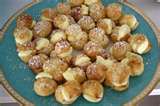
  • Last year I started a Morrell Family Cookbook. I gave each son a binder into which I slipped a cover page Cream puffs of my own design. I included a few family recipes that they all loved, with a promise to email one or more every few months which they could print out and add to the binder. One of their favorite desserts has been cream puffs. One of my sons changed up the recipe for the fall months by adding pumpkin spice to the cream, or by using pumpkin flavored non-dairy creamer in place of some of the milk.


    Enjoy!


    Cream Puffs


    1 cup water


    1/2 cup butter


    1 cup all-purpose flour


    4 eggs


    Pudding Cream Filling (below)


    Heat oven to 400. Heat water and butter to rolling boil. Stir in flour. Stir vigorously over low heat about 1 minute or until mixture forms a ball. Remove from heat. Beat in eggs, all at one time; continue beating until smooth. Drop dough by scant ¼ cupfuls 3 inches apart onto ungreased baking sheet.


    Bake 35-40 minutes or until puffed and golden. Cool away from draft. Cut off tops. Pull out any filaments of soft dough. Carefully fill puffs with Pudding Cream Filling. Replace tops; dust with confectioners’ sugar. Refrigerate until serving time.  12 cream puffs.


    Or Midget Puffs: Drop dough by slightly rounded teaspoonfuls onto ungreased baking sheet. Bake 25-30 minutes. About 5 dozen puffs.


    Pudding Cream Filling:


    In small mixer bowl, blend 1 package (about 3 ½ ounces) vanilla instant pudding and 1 cup milk on low speed. Add 2 cups chilled whipping cream (in a carton, not an aerosol can); beat about 2 minutes medium speed or until soft peaks form. 


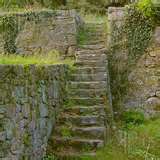
  • One morning many years ago, when my towering youngest son was about a foot shorter and still beingStone stairs driven to elementary school, he asked me an interesting question: "When you were a kid, what did you want to be when you grew up?"

    When I thought about it, I realized that, while I always wanted to write, there was one other thing that captivated my imagination—being an archeologist. I was entranced with things of the past, the older the better. I still am. My father nurtured in my soul a love of the mysterious and of things ancient—the statues of Easter Island, the Cahokia Mounds in Illinois, the ruins of Machu Picchu in Peru, Stonehenge in England. The list is endless.

    More realistically, my romance with things old includes furniture, houses, books, stone walls, and most especially stone stairs that end as mysteriously as they begin; steps to nowhere. We may have seen them on the grounds of some historic site or among the renovated buildings of a spiritual retreat center. Perhaps they are stumbled across while walking through the woods or along the banks of a river, remnants of a life that once was and a history that somehow now connects with our own.

    It is easy to be enamored of the past, to live in the fantasy of it; the memories lend themselves to crafting by the workings of our minds. Sometimes it’s a creative endeavor, sometimes it’s a coping mechanism for processing our experiences and emotions. But when we become mired in memories, we are prevented from recognizing the gift of the present moment.

    The past should not be forgotten. Past moments, past loves, past losses and accomplishments have all shaped us into who we are. They have formed our perspective and our behaviors. But to come to a stand-still in our past is to surrender the potential of the present.

    Sadly, there are also those who give up the present to focus solely on the future. My parents, like many, lost much in planning so great a part of their enjoyment for the day when they retired. Ultimately, my mother retired when cancer got the best of her; my father spent his retirement caring for her, rarely leaving the house, and then he died before she did. Neither got to do the things they planned their whole lives to do.

    Most sorely missed were those opportunities when we, as a family, could have spent time together and didn’t because we allowed some seemingly pressing concern to interfere with the "now" of our relationship. My sons, especially, suffered the loss of time spent wrapped in the love of grandparents.

    I once received a prayer card with a simple piece of prose that recalled God as "I am." Not "I was" or "I will be." I kept it as a reminder of the holiness and preciousness of now. Learning to live in the present was a hard lesson for me; one that came about through a variety of painful losses. Now I try to stay aware of the gift of this moment so I am not filled regret at missed blessings or opportunities, especially the opportunity to spend time with loved ones before all the moments are a memory.

    "Lost, yesterday, somewhere between sunrise and sunset, two golden hours, each set with sixty diamond minutes. No reward is offered, for they are gone forever. " Horace Mann

  • My cousin Debbie is a baker. It’s in her blood, and in her wisdom she pronounces, “Not everyone can say they look forward to getting up every morning and going to work. I LOVE my job.”  Smell-flowers  

    My son, Shaun, is a teacher. He lives and breathes teaching. Every moment is seen through the lens of educator and everyday his work is rewarding, even when it’s difficult.

    Venerable Pierre Toussaint, a Catholic slave, was a hair dresser. His gift for this work not only earned him considerable wealth but enabled him to touch the lives of a arge number of people as he lived the Gospel teachings of charity and love.

    I am a writer. But until recently, at the ripe old age of (sorry, the signal’s breaking up) and having written for the better part of my life, the most I would say is that I love to write. Months ago, if you asked me what I do, I would have said, “I work as an editor for an international faith based organization.” A few years ago, I would have answered as an administrator and religious educator for a Catholic diocese.

    But today, having broken out of the cocoon, I can admit what I have known on some level since I was four. I am a writer.

    Being a writer – or a baker or a teacher or hair dresser – is not all we are, but it is the unique work through which the eternal self blossoms to fullness and lives as a child of God. What an amazing garden of gifts God has cultivated in the human spirit!


    (The image used is at www.inspirationline.com/EZINE/31MAR2008.htm)

  • In honor of my mom, Georgette, who loved her Syrian Orthodox church, this blog is dedicated to 200px-Stgeorge-dragon


    St. George.