• With Earth Day fresh in our memories, serving as a reminder of our intimate connection with God’s creation, I recalled an Samuel-pagel-2oFfyvY9Iyc-unsplash experience which served as an unlikely lesson in divine mystery.

    As my husband and I pulled into a diner for lunch, I noticed a large black bird with a wide wingspan swooping overhead. Exiting my car and walking toward the building, I realized the bird, a black vulture, had alighted on the roof edge along the gutter, now perched wing-to-wing with a second vulture. As we got closer, we could see them both looking intently at us with beady eyes, their heads moving ever so slightly lower as we got closer.

    “Keep moving,” my husband chuckled, “so they don’t think we’re their next meal.”

    I laughed, though I was taught that vultures do not attack people. Still, it was eerie, knowing how intently they were watching us. I imagined there would be something to learn from the experience.

    As scavengers, vultures have a tarnished image. They live off dead and rotting carcasses, something abhorrent to people. They are equated with death and destruction and things foul.  But without vultures, and similar members of the avian clean-up and sanitation crew, humanity would suffer.

    After all, God created every living creature, vultures, and humans, alike, with a purpose.  Vultures play a significant role in the cycle of life, providing opportunities for regeneration, purification, and new beginnings. They get rid of the old, not only what’s not needed but what can be detrimental to humans, like bacteria that can lead to contagious diseases.

    Now, when I see a vulture being a vulture on the side of the road or flying overhead, I consider what it is that needs purification and renewal in my life.  What is happening in my life that is detrimental to my mental, physical or spiritual life, or that of my family? What resources are available to me to help me make that change?

    Most importantly, I remember that the vulture is living its God-given purpose, which causes me to reflect on whether I am living my purpose, as well.

    One of my favorite quotes about creation comes from famed Russian novelist, and Orthodox Christian, Fyodor Dostoyevsky, who wrote, “Love all God's creation, the whole and every grain of sand of it. Love every leaf, every ray of God's light. Love the animals, love the plants, love everything. If you love everything, you will perceive the divine mystery in things. Once you perceive it, you will begin to comprehend it better every day. And you will come at last to love the whole world with an all-embracing love.”

    Vultures may not be the most loveable of birds, but they have been part of my lesson that God’s creation has the power to teach us about God, about ourselves and the relationships that bind us.

    Earth Day has passed but for us, every day is a day to embrace our role as protectors of creation, a term used often by Pope Francis. During his homily for his inauguration in 2013, Pope Francis said, “The vocation of being a ‘protector,’ however, is not just something involving us Christians alone; it also has a prior dimension which is simply human, involving everyone. It means protecting all creation, the beauty of the created world, as the Book of Genesis tells us and as Saint Francis of Assisi showed us. It means respecting each of God’s creatures and respecting the environment in which we live.”


    Samuel Pagel photo on UnSplash.

  • During a recent visit to the drug store, a young child, maybe 5 years old, followed his mom up and down the greeting card aisle. She was looking for a Johannes-plenio-Fem4uCQ7VEg-unsplash card and gift bag for a baby’ gift, asking for the little boy’s thoughts on her choices.

    Mom showed him a bag and a card and said, “What about these for the baby?”

    His forehead crinkled and his words spilled out, rapidly and very matter of factly, “Mom the baby is not going to fit in there. And that card – does it have music? It has to have music you know, because a baby needs a lullaby like he needs his bottle.”

    His bits of wisdom continued to flow as his mother attempted to at least clarify that “the baby’s not going in the bag, honey.” But pauses in his chatter were non-existent. And there I stayed, pretending to be looking for something but really just wanting to soak up everything he was saying. But I didn’t have to go home with him.

    His mother seemed unflappable, but I wondered if she ever went to her car, put her head on the steering wheel, and muttered under her breath, “Pleeeaase, stop talking!”

    Years ago, I wrote a small book entitled, “Through the Strength of Heaven,” a collection of columns written to encourage parents and others who were struggling for one reason or another.

    I borrowed the title from the Lorica of St. Patrick, a prayer attributed to the well-known saint who faced kidnapping, enslavement, hunger, and brutality but never gave up his God-given mission to the Irish people. He wrote that he was able to accomplish what he did “through the strength of Heaven.”

    I always thought those words were the perfect motto for parents. It speaks so deeply to how we get through so many rough patches in our parenting life.

    Certainly, it was prayer and a reliance on God’s strength that got me through when my own strength was waning, and believe me, there were times when waning meant running on empty. What I began to realize is that it wasn’t just strength I found in prayer, but guidance in making decisions, insight when I needed it, wisdom in relationships and being led to the right people and right resources to lighten my load and help me for the good of my family.

    And let’s not forget patience for when a child feels compelled to regale us with their profound wisdom, sometimes known as, “I may not be right, but I’m never wrong.”

    A lorica is known as a prayer of protection but it is also a prayer of gratitude, recognizing that God is behind our strength. Today, when I read the Lorica of St. Patrick, also known as the Breastplate of St. Patrick, I remember the sometimes overwhelming experience of parenting, and feel the truth in praying, “I arise today thought the strength of Heaven.”   

                                                                                                                                           
    St patrick's breastplate


    Johannes Plenio photo 1 on Unsplash

  • Seeking a really special recipe to top off Easter dinner for loved ones and friends this year? Pilgrims, your search is ended!

    Look no further than the carefully crafted recipe for the mildly sweet rice pie below. Known as Pastiera di Riso, this lovely version originated in the LT grandmother
    kitchen of Carmela (Millie) Martucci and has been faithfully recreated and adapted over the years by her granddaughter, Lisa Martucci Thibault, a friend of mine in real life and on Facebook.

    Known to many as the Director of Marketing Communications & Fund Development at the Children’s Home Society of New Jersey, her many Facebook friends look forward to photos she shares of her creative culinary creations.

    In fact, a real highlight of this Christmas season was the pictorial stop-by-stop tour of the food, landscapes, landmarks and marvelous faces she and her husband Rob, a corporate communicator for Bristol Myers, and their daughter, Emily, shared daily on their 12 days in France.

    When Lisa agreed to share one of her Easter recipes with “What are you cooking for dinner?” I couldn’t wait to see what she’d come up with. The result exceeded all expectations.

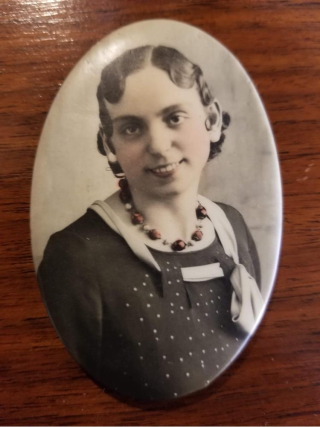
    Like so many of us who have fond memories of the dishes cooked by our immigrant grandmas, Lisa shared how she didn’t have a cookbook to work from.

    “Sadly,” she said, her grandmother “did not commit a single recipe to writing, despite repeated requests from relatives. I later deduced this was because she was embarrassed that she could not write capably in English, the language she reluctantly adopted when her parents brought her to the U.S. from Naples in 1920 at the age of 12.”

    “So, over the years, I have recreated, adapted and made many iterations of her recipes, including this Easter pie as well as my family’s staples – pasta fagioli, steamed artichokes, pumpkin and beans, pasta and lentils and basic marinara sauce (and no, we never called it gravy). I think that she would be happy knowing that her grandchildren and great-grandchildren are keeping her culinary legacy very much alive.”

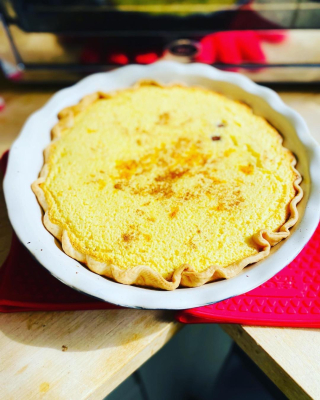
    As Lisa described it, Pastiera di Riso is similar to the more widely known Pastiera Napoletana which can be found on the Internet and in at least one area pie shop – Emery’s Farm Country Bakery on Long Swamp Road in New Egypt – but it uses rice in place of wheat berries.

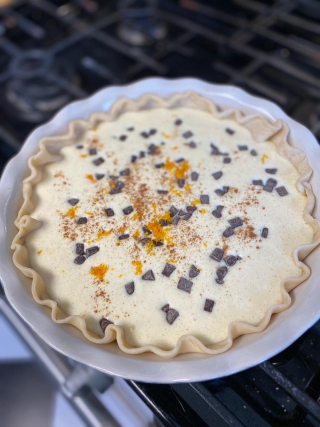
    “Filled with cooked rice and ricotta, ours includes orange zest and cinnamon. The dense little Arborio (rice) nuggets give it a toothsome texture that pairs well with the creamy ricotta custard,” she said. “Over the years, I have done away with the crust entirely to give full attention to the rich filling enhanced with orange, cinnamon and dark chocolate chunks instead of the hard, gummy bits of candied citron that my Grandmother added.”

    Lisa advises those who “believe all pie requires a crust,” to follow King Arthur Flour’s single pie crust recipe or buy a prepared crust noting “this is a judgment-free recipe.”

    On a closing note, I’m hoping this isn’t the last recipe Lisa will share with “What are you cooking for dinner” and looking forward to perhaps hearing from daughter Emily, a senior archaeology major at Bryn Mawr College with an area interest in culinary rituals and diets of our ancestors!            LT pie 1

    Emily will be the first in the family to go back to Italy. This summer she’ll be participating in a field research program in Turin. I hear the food there is worth writing about!                                                                                                                                                                            

    GRANDMA MARTUCCI’S EASTER PIE                                                                                                         

    Ingredients for the Filling:

    -1 ½ cups of cooked arborio rice

    -1 cup heavy cream

    -1 cup sugar

    -1 tsp cinnamon

    -the zest of one orange

    -15-16 ounces whole milk ricotta cheese (Lisa prefers Galbani or Sorrento but says any low-moisture types are fine)

    -1 tbsp fior d’arancio (orange blossom water) optional

    -4 eggs

    -1/2 cup dark chocolate chunks

    -powdered sugar for dusting

    Directions for filling:

    Bring 2 cups of water (unsalted) to a boil. Add 1 cup of Arborio rice, return to a boil, cover and lower the heat, slightly simmering for 20 minutes. Butter an empty (crustless) pie pan or make and place a pie crust into a pan.                                                                                                                              LT pie 2

    Then, in a large bowl, combine: 5-16 oz. container of whole milk ricotta; 4 slightly beaten eggs;1 cup heavy cream;1-cup sugar (can also reduce to ¾ cup); 1 tsp. cinnamon; 1 tsp. orange blossom water (optional); zest of one orange and dark chocolate chunks.

    Once cooked rice has cooled, stir in roughly 1 ½ cups to the ricotta mixture and scrape it into the pie crust/pan. Sometimes, Lisa sprinkles some extra chocolate chunks on top before baking.

    Bake at 350F for about 50-60 minutes. Check doneness by inserting a toothpick in the center. Once cooled, dust with powdered sugar. It is delicious warm or cold but Lisa recommends storing the pie in the refrigerator.

    Lois Rogers has been writing about faith, family and food (most notably in her award-winning blog, "Keeping the Feast" which has appeared in The Trenton Monitor) for most of her professional career. She may be reached at loisrogers66@gmail.com.

  • With food prices rising astronomically this Lenten season, I can’t help but envision my mother during similar financial squeezes. Every Sunday before Mass, she’d go through the food pages in the newspaper, clipping coupons with a manic glow on her face. Rationing 1024px-RationingBoardNOLAVachonC

    She’d come of age late in the Depression and made it through rationing as a new bride during the Second World War. Under the watchful eye of her own mother, a Slovakian immigrant who’d come through hard times of her own, Mom learned how to be thrifty to the utmost.

    Lucky for us, she was also a good cook who knew how to make the most of sale items, be they fresh ingredients or the boxed and canned non-perishable goods with which she lined the shelves of the large pantry she always referred to as “the closet.”

    Her culinary talent for turning sale staples into memorable meals lent itself particularly to sauces, stews and soups. And each year as Lent approaches, I think of the meatless soups and, most especially, the chowders she was so good at composing, often starting with a base of clams and their broth,

    These Lenten soups – Manhattan and New England clam chowder, her own “vegetarian vegetable” and mixed seafood soup – were, as I recall, wonderful for warming up Friday nights in March. Years ago, I tinkered with recreating her corn and potato chowder.

    Inspired by combinations on the internet, I added canned salmon as the seafood, mixing it with vegetable broth (so available these days), diced carrots and potatoes, sweet onion and light cream.

    The result is a Salmon, Corn and Potato Chowder that, I hope, will warm the cockles of your heart. This is a good recipe to play with. I chose canned salmon as the key ingredient as it’s reasonable now, but the pricier clams, shrimp or scallops would work as well. I’ve used a pound of bay scallops when they are on sale or a half pound of medium shrimp which are often discounted in supermarkets during Lent.

    Other vegetables – I’m thinking, sweet peas, mushrooms, and of course, chopped celery – would be good additions. Lois chowder

    I often serve the chowder with a mixed green salad and crusty bread.                                                                                                                                                  

    Salmon, Corn and Potato Chowder – serves four

    Ingredients

    – 6 tablespoons butter

    – 2 large carrots, diced

    – two large baking potatoes, diced

    – 1/3 sweet onion, diced

    – 3 tablespoons all-purpose flour

    – 2 cups vegetable broth

    – 2 cups light cream

    – 1 can corn kernels

    – two 6 ounce cans of good quality, skinned and boned salmon

    Directions: In a large, heavy saucepan, melt the butter. Then add the potatoes, carrots and onions and cook over medium heat stirring frequently for about 10 minutes until they are tender but not brown. Stir in the flour, salt and pepper. Gradually add the broth and light cream. Cook until it thickens a bit and gets bubbly but don’t boil. Add the corn and canned salmon, stir for a minute or two and then serve.

    Tip: Flaked baked or broiled salmon filet leftovers are fine to use in this chowder and adding a few ounces of clam broth to the mix wouldn't hurt.  From chopping the vegetables to serving the soup, it took less than 40 minutes to prepare.

    Lois Rogers has been writing about faith, family and food (most notably in her award-winning blog, "Keeping the Feast" which has appeared in The Trenton Monitor) for most of her professional career. She may be reached at loisrogers66@gmail.com.

    Photo by John Vachon – Public Domain, https://commons.wikimedia.org/w/index.php?curid=3444701

  • Headlines recognized it as a miracle.

    An earthquake let loose an avalanche from a nearby mountain, nearly wiping out the homes and businesses of a small

    Ukrainian_rescuers_check_the_remains_of_a_street_in_Chernigiv

    Ukrainian rescuers check the remains of a street in Chernigiv.

    community and killing thousands. But somehow, the boulders stopped within feet of the local church. It was deemed an act of God.

    The anger and frustration rose within me. “The real miracle,” I blurted out, “would have been if You had spared the thousands who died and not an empty building.”

    Honesty with God comes from a lifetime of believing in, of praying and being faithful to God, but I would be lying if I said I never questioned the justice and mercy of God. I would be dishonest before God if I didn’t share my frustration with what often seems like God’s lack of interest in his children.

    I’ve never questioned the existence of God, but I certainly do not pretend to understand God’s ways. I know I am not alone in this. We are only human, after all. Coming to terms with this kind of conflict is part of the process of faith, and it is put to the test during the worst of times, as when war or atrocity becomes a reality.

    While the fighting is not yet at our doorsteps, the media now brings war into our homes daily. We see and hear the pain of those who are in death’s path. We watch bombs fall and homes go up in flames. We are appalled and heart broken and when we hear the number of civilian deaths we wonder if our prayers will ever be answered. We may even ask, “Where are you, God? Why are you allowing your innocent children to suffer such inhumanity?”

    And perhaps there, in that word “inhumanity,” is an answer.  War is a human action, a choice, an evil that is a blot on human history throughout the ages, and yet it persists. Perhaps the real miracles are those we are now seeing on the television. The human miracles, the often-hidden stories of sacrifices people, once strangers, are making on behalf of others, the children of God being children of God. Beautiful stories, but not enough to make sense of so much death and horror.

    Holocaust survivor and Nobel Peace Laureate Elie Wiesel experienced unspeakable atrocities which put a seemingly insurmountable distance between him and God. In his renowned book, “Night,” Wiesel writes honestly, “For the first time, I felt anger rising within me. Why should I sanctify His name? The Almighty, the eternal and terrible Master of the Universe, chose to be silent. What was there to thank Him for?”

    Many years later, Wiesel would also share his reconciliation with God in a New York Times column, writing of what he once called his “wounded faith,” saying, “I now realize I never lost it, not even over there, during the darkest hours of my life. I don’t know why I kept on whispering my daily prayers, and those one reserved for the Sabbath, and for the holidays, but I did recite them, often with my father and, on Rosh ha-Shanah eve, with hundreds of inmates at Auschwitz.”

    He admitted being haunted for a lifetime with the question, “Where were you, God of kindness, in Auschwitz?” Yet, he entreated God: “Let us make up: for the child in me, it is unbearable to be divorced from you so long.”

    As I watch the horror unfold in the Ukraine, and see the innocent, worried faces of Ukrainian children, their voices raised to God and their hands clasped in prayer, I question my God of love. Yet, I continue to pray that God will see and hear the children, and that Elie Wiesel has God’s ear.

    Photo attributed to mvs.gov.ua – Ministry of Internal Affairs of Ukraine

  • Headlines recognized it as a miracle.

    An earthquake let loose an avalanche from a nearby mountain, nearly wiping out the homes and businesses of a small

    Ukrainian_rescuers_check_the_remains_of_a_street_in_Chernigiv

    Ukrainian rescuers check the remains of a street in Chernigiv.

    community and killing thousands. But somehow, the boulders stopped within feet of the local church. It was deemed an act of God.

    The anger and frustration rose within me. “The real miracle,” I blurted out, “would have been if You had spared the thousands who died and not an empty building.”

    Honesty with God comes from a lifetime of believing in, of praying and being faithful to God, but I would be lying if I said I never questioned the justice and mercy of God. I would be dishonest before God if I didn’t share my frustration with what often seems like God’s lack of interest in his children.

    I’ve never questioned the existence of God, but I certainly do not pretend to understand God’s ways. I know I am not alone in this. We are only human, after all. Coming to terms with this kind of conflict is part of the process of faith, and it is put to the test during the worst of times, as when war or atrocity becomes a reality.

    While the fighting is not yet at our doorsteps, the media now brings war into our homes daily. We see and hear the pain of those who are in death’s path. We watch bombs fall and homes go up in flames. We are appalled and heart broken and when we hear the number of civilian deaths we wonder if our prayers will ever be answered. We may even ask, “Where are you, God? Why are you allowing your innocent children to suffer such inhumanity?”

    And perhaps there, in that word “inhumanity,” is an answer.  War is a human action, a choice, an evil that is a blot on human history throughout the ages, and yet it persists. Perhaps the real miracles are those we are now seeing on the television. The human miracles, the often-hidden stories of sacrifices people, once strangers, are making on behalf of others, the children of God being children of God. Beautiful stories, but not enough to make sense of so much death and horror.

    Holocaust survivor and Nobel Peace Laureate Elie Wiesel experienced unspeakable atrocities which put a seemingly insurmountable distance between him and God. In his renowned book, “Night,” Wiesel writes honestly, “For the first time, I felt anger rising within me. Why should I sanctify His name? The Almighty, the eternal and terrible Master of the Universe, chose to be silent. What was there to thank Him for?”

    Many years later, Wiesel would also share his reconciliation with God in a New York Times column, writing of what he once called his “wounded faith,” saying, “I now realize I never lost it, not even over there, during the darkest hours of my life. I don’t know why I kept on whispering my daily prayers, and those one reserved for the Sabbath, and for the holidays, but I did recite them, often with my father and, on Rosh ha-Shanah eve, with hundreds of inmates at Auschwitz.”

    He admitted being haunted for a lifetime with the question, “Where were you, God of kindness, in Auschwitz?” Yet, he entreated God: “Let us make up: for the child in me, it is unbearable to be divorced from you so long.”

    As I watch the horror unfold in the Ukraine, and see the innocent, worried faces of Ukrainian children, their voices raised to God and their hands clasped in prayer, I question my God of love. Yet, I continue to pray that God will see and hear the children, and that Elie Wiesel has God’s ear.

    Photo attributed to mvs.gov.ua – Ministry of Internal Affairs of Ukraine

  • I was seeking a simple, inexpensive and tasty dinner recipe to serve friends before heading off to the “Treasures of the Milanese 1 Church” exposition at the Co-Cathedral of St. Robert Bellarmine in Freehold Feb. 16, and was blessed, yes, blessed, when I mentioned it to the rector, Msgr. Sam Sirianni during a phone interview about the program.

    “I have a good recipe for Crispy Chicken Milanese that I can send you,” was the Monsignor’s immediate response. Monsignor hails from a Long Branch family well known for their culinary abilities.

    Having collaborated with him before over the years on Lenten food traditions and offerings for Keeping the Feast – the blog I developed for The Monitor – I immediately asked him to email it so I could give it a try.

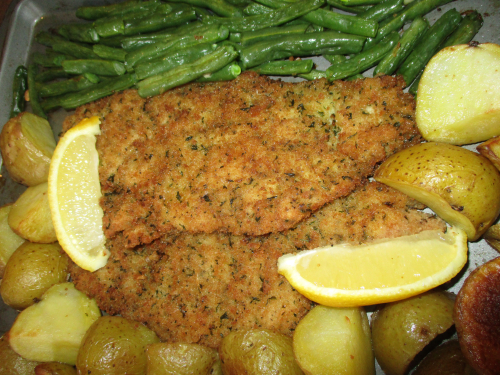
    Preparing a sheet pan dinner was a new experience for me and I was a little concerned about getting the timing right on all the ingredients and what the results would taste like. But the recipe, which Father Sam acknowledged was prepared for dinner in the rectory by Father Brian Butch, the parochial vicar, proved to be a delicious mix of tastes and textures and it was very well received by my guests.

    Light enough to take the edge off the appetite but not heavy enough to weigh you down, it proved an excellent meal to have before the exposition which began with an hour-long presentation by Companions of The Cross Father Carlos Martins about Relic event the relics he brought with him.

    It was followed by what he referred to as a “walk with the saints” in Dentici Hall where those in attendance were able to come
    into close contact with 165 relics, from the many he has collected over the years which could be venerated by the faithful.

    Among its treasures were relics of St. Therese of Lisieux, St. Francis of Assisi, St. Anthony of Padua, St. Thomas Aquinas and St. Faustina Kowalska. Highlights of the exposition included one of the largest relics in existence of what is believed by the Church to be the True Cross, along with a portion of the veil believed to have been worn by the Virgin Mary.


    In answer to the question “What did you have for dinner,” here’s the recipe for

    Crispy Chicken Milanese and Vegetables baked in a sheet pan

    Ingredients for the Milanese

    – 1 large egg

    – 2 tsp. Minced garlic

    – ½ tablespoon fresh chopped parsley

    – ½ tsp. Each salt and pepper

    – ½ cup breadcrumbs

    – 1/3 cup fresh grated Parmesan and Romano cheese

    – 2 tablespoons of fresh squeezed lemon juice

    -4 skinless, boneless chicken breasts or thighs

    Ingredients for the vegetables

    – 8-10 (1 pound) baby potatoes, quartered

    – ½ cup butter, melted

    – 2 tsp. Minced garlic

    – salt to taste

    – 1 pound green beans cut into thirds

    Instructions:

    • Preheat oven to 400°F. Lightly grease a baking tray / sheet with cooking oil spray, or a light coating of oil. Set aside.
    • In a large bowl, whisk together the egg, lemon juice, 2 teaspoons garlic, parsley, salt and pepper.
    • Dip chicken into egg mixture, cover and allow to marinade in the refrigerator for 30 minutes to an hour (if time allows).
    • In another bowl, combine the breadcrumbs with the blend of Parmesan and Romano cheese.
    • Dredge the egg coated chicken in the breadcrumb/cheese mixture, lightly pressing to evenly coat.
    • Place chicken onto the baking sheet/tray and lightly spray or brush with cooking oil. I brushed on safflower oil. Arrange the potatoes around the chicken in a single layer. Mix together the butter, 2 teaspoons garlic and salt and pour half the mixture over the potatoes. Toss to evenly coat.

    Bake in preheated oven for 15 minutes.

    • Remove baking tray from the oven and carefully flip each chicken breast. Move the potatoes to one side and place the green beans around the chicken on the other side of the baking sheet. Pour over the remaining garlic butter over the green beans and return the sheet pan to the oven to broil (or grill) on medium-high heat for a further 10 minutes, or until chicken is golden and crisp, and potatoes are cooked through.

    Sprinkle with fresh chopped parsley (optional) and serve immediately


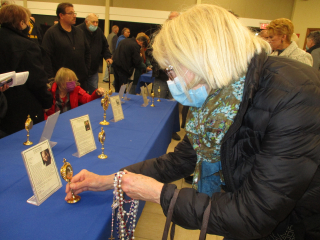
    Photo caption –St. Robert Parishioner Kristina Mueller venerates relics at Treasures of the Church presentation.

    Lois Rogers has been writing about faith, family and food (most notably in her award-winning blog, "Keeping the Feast" which has appeared in The Trenton Monitor) for most of her professional career. She may be reached at loisrogers66@gmail.com.

  • This month's "What Are You Cooking for Dinner?" by Lois Rogers is due to arrive at God Talk and Tea on or around Feb. 18 and will feature a recipe for Parmesan Baked Chicken Milanese and vegetables, a favorite from the rectory kitchen of St. Robert Bellarmine Co-Cathedral in Freehold.

    Lois plans to cook the recipe for friends before they head out for a special event at the Co-Cathedral.                                                 

    “Treasures of the Church,” a spectacular collection of Vatican relics will be hosted at the Co-Cathedral on Feb. 16 at 6:30 p.m. If you can’t be there in St Francis of Assisi person to see it, “What Are You Cooking for Dinner,” will also include some insight about this rare opportunity to view, venerate and come close to some 150 relics of beloved saints.

    Presented by Companions of the Cross Father Carlos Martins, a Vatican-appointed expert on relics, the exposition includes relics from the dawn of Christianity through the Middle Ages and Renaissance down to modern times.

    Among its treasures will be relics of St. Joseph, St. Maria Goretti, St. Therese of Lisieux, St. Francis of Assisi, St. Anthony of Padua, St. Thomas Aquinas and St. Faustina Kowalska. A highlight of the exposition is one of the largest relics in existence of what is believed by the Church to be the True Cross, along with a portion of the veil believed to have been worn by the Virgin Mary.

    “Treasures of the Church” has been touring widely for some time and has been hosted in almost 200 Catholic dioceses in various countries according to the website, treasuresofthechurch.com. Each exposition begins with a multi-media presentation on the Church’s use of relics that is scriptural, catechetical and devotional, according to the website.

    Father Martins opens each presentation with a talk that prepares those in attendance with what they are about to behold on what he calls the “walk with the saints” where the relics will be lined up along one of the long church corridors.

    Those who attend can expect to come in close contact with objects that have a direct association with the saints or with Jesus. All are encouraged to bring articles of devotion – Rosaries, holy cards and medals, as well as pictures of ill friends or family members in need of prayer that can be touched to the relics when praying for intercession.

    St. Robert Bellarmine Co-Cathedral is located at 61 Georgia Road, Freehold. For more information call 732-462-7429.

    Lois Rogers has been writing about faith, family and food (most notably in her award-winning blog, "Keeping the Feast" which has appeared in The Trenton Monitor) for most of her professional career. She may be reached at loisrogers66@gmail.com.

  • As I watched my three-year-old grandson 
    sitting at the kitchen table, creating a Get Well/Valentine card for his great-uncle, it brought back memories of my own sons doing the same thing for their grandfather many years ago. Jon-tyson-UK61KZPnpyY-unsplash (2)

    It was Valentine’s Day, so on my way home from the hospital, I stopped to buy the small red heart boxes of Valentine’s
    Day candy my dad would have given them. As they sat around the table, I gave them each a box. They didn’t smile. My youngest pushed his away and said, “Can we bring Poppy home tonight?”

    I had to tell him no and answer his difficult question of why. Their poppy died the next day.

    My dad had suffered an unexpected heart attack and I was told he would not recover. He could not breathe on his own and there was little brain activity. As an only child, with my husband and sons in another state at that time, I was alone in making decisions. After a few days, doctors suggested I remove him from life support. I refused. At his age, I felt he had earned some time to recover.

    Out of respect for my mom, who was a Hospice patient on the next floor, I called the Syrian Orthodox Catholic Church to ask for the Sacrament of Anointing the Sick. Though the new pastor did not yet know my mom or my dad, he was at the hospital within the hour. He anointed my father with blessed oil and prayed over him with an unexpected tenderness.

    Then he sat with me, prayed with me, stayed with me. Through tears, I shared my inability to make the decision to remove my dad from life support. He took my hands and assured me I had done the most important thing that could be done … I made sure he received the Sacrament. The decision about life support could be made when I was ready knowing he was in God’s hands.

    Within that experience was a powerful encounter of Jesus. The love and compassion of this priest made it possible for me to make that very difficult decision, and to sit alone with my dad when he died. It gave me the courage and strength to take care of all that needed to be done from that point on, including caring for my mom. It strengthened my faith at a time of great loss, then and a year later when my mom died.

    Encounters with Jesus such as this are agape encounters, transformational encounters with God’s love, the love St. Paul talks about in his Letter to the Corinthians, a love that is greater than faith and hope, a love that never fails.

    That is why our encounters with Christ are so very important to the well-being of the world, and why we are called to be these encounters for others. Our daily decisions to love, unconditionally and with a willingness for self-sacrifice, are the one thing that can transform what is into what should be.

    “One day everything will be made of agape.”

    I wish I had written those words, but I didn’t. Still, the thought is something to hold on to during this very challenging moment in time when it is so easy to become discouraged, to lose hope and faith.

    Jesus reminds us to become like little children. Perhaps because they give so freely of themselves and their simple, humble, handmade expressions of love.

    Little bundles of agape.


    © Mary Clifford Morrell

    Jon Tyson photo on Unsplash

  • As the pandemic grinds on in its so-far relentless pace, this is the question that has been opening up most conversations around here for quite a Stuffed pumpkin3 while.

    At first, I found it annoying – especially when one of my friends, who was cooking for her household, would routinely toss it out at me after describing
    her family menu for the night, pointing up my solitary status and making me feel terribly sorry for myself.

    The answer on my part was usually, “I haven’t thought about it yet,” or, even worse, “maybe some cheerios.” Blah!

    Cooking for one during a plague didn’t strike me as much fun.                                                                                                                                                        
    But as time went on, it became crystal clear from visions of food shortages around the country and people in critical states of need, that if you could access the ingredients, had transportation, had friends kind enough to shop for you if needed, and the means to actually bring home enough of what was available to meet the requirements of your heart healthy diet, you just better snap out of it.

    Thus began cooking dinner fever in the little blue house on the lake and a lot of thinking about how folks around me were making do.

    Putting together an interesting combination of ingredients that managed to make it through the supply chain became a challenge and sometimes a triumph – when asparagus went down to $1.29 a pound after Thanksgiving, sweet potatoes were pretty inexpensive, too, and a good brand of veggies cost a mere .40 cents a can were just some examples.

    Sharing those commodities with neighbors when a really good sale came along became a part of the “what’s for dinner” program around here. It’s not much in the face of things, but as my late brother Pete used to say, “It’s better than nothing.”

    As the Christmas season of 2021 dwindles down to a few days in the New Year of 2022, here’s hoping that before too long, this pandemic will just be a memory, something to point to when better times arrive – like my grandmother’s blackout curtains after World War II or my grandfather, forgoing heat so that he could keep the sugar bowl full during the gas crisis of the 1970s.

    And I plan to hold on to “what’s cooking for dinner” with thought, care and prayer. I hope to spend some of 2022 asking friends, relatives and colleagues – secular, ordained and religious – what’s cooking for dinner and reporting back.

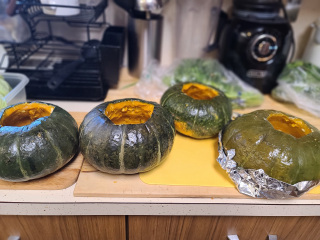
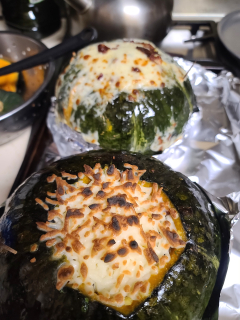
    This very festive recipe for Camarão na Moranga – Brazilian Shrimp Stuffed Pumpkin was shared by Divine Word Father Guilherme Andrino, pastor of Lakewood’s Our Lady of Guadalupe. He prepared it for a number of the volunteers who organized the annual procession of torches in honor of Our Lady of Guadalupe which was held for the first time in Lakewood on Dec. 4.

    A traditional Brazilian dish from the Southeastern part of Brazil, Father Andrino described it as a “cheese and creamy shrimp stew” often served inside a large pumpkin. The best pumpkin to use, he said, is called Kabocha (or Japanese squash) but Cinderella pumpkins can be used too, he said.

    “This recipe is fun to prepare because it is not only delicious, but it is very impressive,” said Father Andrino. “The dish is very creamy, comfy and rich in flavor.”

    One thing I really enjoyed about this dish was the adventure of finding some of the ingredients. Because of the constraints of the pandemic, I shop Stuffed pumpkin1 jan early in the morning or rather late in the afternoon when the area stores are apt to be less crowded.

    I’d long noticed that Lakewood is dotted with international markets but, except for a farmer’s market on Route 9 on the border of Lakewood and Howell, I never seriously explored them.

    The need to find a pumpkin, or big squash, changed my perspective when Father Andrino told me where they could be found. His advice led me not
    only to the pumpkins, but also opened up a veritable wonderland of culinary options for recipes to come after seeing shelves lined with Mexican, South American, Asian and Central and Eastern European goods.

    It was a fun adventure and very informative.

    Camarão na Moranga – Brazilian Shrimp Stuffed Pumpkin  

    • 1 large pumpkin                                                                                                                                                              
    • 3 garlic cloves, minced
    • 1 ½ onions, minced
    • Pepper to taste
    • Salt to taste    
    • 3 tablespoons olive oil
    • 1 pound shrimp, cleaned and fresh
    • 2 tomatoes, minced
    • ½ cup tomato purée
    • 1 tablespoon fresh cilantro, chopped
    • 2 seedless chili peppers, hand-chopped
    • 1 cup heavy cream (cream cheese or Brazilian Requeijao)
    • 1 cup Oaxaca cheese, melted
    • 1 cup mozzarella cheese, grated
    • 1 lemon, for seasoning
    • Olive oil, for cooking


    DIRECTIONS

    1. Preheat oven to 350 degrees.
    2. Cut off the top of the pumpkin, around 2 to 4-inch opening depending on the size of the pumpkin. Scoop out the seeds and stringy pulp. Set aside.
    3. grind the 2 garlic cloves with half the onion, pepper, salt, and oil.
    4. Rub this mixture on the inside of the pumpkin, and cover.
    5. Place in the oven for 30 minutes.
    6. Next, season the shrimp with salt, pepper, and lemon juice.
    7. In a hot frying pan with oil, sautée the shrimp until browned. Add more salt and pepper for taste if needed. Set aside.
    8. In the same frying pan, add the remaining onion and garlic, and then add the tomatoes. Cook for 10 minutes. Add in half cup of tomato purée. Mix together, and then add in the cilantro and chili peppers. Next, add in the heavy cream (cream cheese or Brazilian Requeijao), melted cheese, shrimp, and mixed altogether. Season with pepper.
    9. Pour the shrimp mixture inside the pumpkin.
    10. Cover with grated mozzarella cheese.
    11. Place in the oven for 20 minutes, or until golden brown on top. Allow to cool before serving. Enjoy!

    Lois Rogers has been writing about faith, family and food (most notably in her award-winning blog, "Keeping the Feast" which has appeared in The Trenton Monitor) for most of her professional career. She may be reached at loisrogers66@gmail.com.

    Photos courtesy Father Guilherme Andrino