• As a blogger for a Catholic publisher, my task is to write on topics of concern for today’s parents. This sometimes proves to be a Jonny-gios-sRzgBkhwPi8-unsplash challenge because I am no longer raising children in today’s culture and am sometimes at odds with my own children about how to raise grandchildren.

    But I have found there are some issues that are “evergreen” and continue to be issues of concern even for grown-ups. One of these, which stands in stark relationship to our ability for gratitude, is the concept of “enough” – an experience that lives somewhere between deprivation and abundance.

    “Enough” is a place of satisfaction, happiness, and peace of mind. It doesn’t mean we are at a place of no struggle; it just means we have what we need if not everything we want. The challenge for parents is to help children move into adulthood knowing the difference.

    Whether it is how much money we make, things we buy, time we waste or time we work, how much we consume or how much of our lives are spent in anger, complaints or judging others, we need to develop our internal voice to say, “That’s enough.”

    Having parents who grew up during the Great Depression was a blessing for me. As adults, they were satisfied with their modest means and belongings, and loved the humble home I grew up in. The values I learned from them, to be happy with a simple life, to be grateful for what I had, to learn to make do, and to hold on to my faith, were essential for me as my husband and I raised six children and often did not have everything we needed, particularly enough money to pay all the bills.

    When one of my young sons, at the dinner table where there was more than enough to go around, asked if we were poor, it opened a door for a conversation on what it means to know poverty.

    Within the week, some generous parishioners left a box of Thanksgiving fixings, including the turkey, on our front porch. They obviously knew a family with so many children would appreciate the help, which we did, but I knew there were families who needed it more.

    I called around until I found a church unable to help all the families on their Thanksgiving list. With an address in hand, and my youngest sons in the car, we pulled up in front of the house after dusk.

    The porch where we were supposed to leave the box was barely visible from overgrown shrubs. There were holes in the roof and several windows were boarded up with plywood. It’s a house we saw weekly on our trip to the supermarket but never imagined anyone actually lived there. It didn’t look safe.

    I walked in front of my sons, who carried the box and a few bags of extras we had filled ourselves, and tried to quietly open the porch screen door. Thankfully, we were able to make the delivery clandestinely so as not to embarrass the receivers.

    When we got back to the car, the boys were silent. Even the youngest of us need time to process a new understanding of something.  As we drove home, I asked my son if he thought we were poor. He didn’t answer; he just shook his head no. The youngest was crying. I asked why. “There were no toys in the box. They need toys,” he said.

    While we may sometimes envision the poor as being desperately unhappy, those who suffer material poverty are often those who are most joyful, grateful, generous and faithful, and cannot be counted among those of us who suffer from the many other forms of poverty – poverty of hope, of faith, of joy, of compassion, of generosity, of understanding, of gratitude.

    In his message for the Fifth World Day of the Poor, Pope Francis stresses, “Christian discipleship entails deciding not to accumulate earthly treasures, which give the illusion of a security that is actually fragile and fleeting. It requires a willingness to be set free from all that holds us back from achieving true happiness and bliss, in order to recognize what is lasting, what cannot be destroyed by anyone or anything.”

    The Holy Father reminds us that the poor, “may be people who lack some things, often many things, including the bare necessities, yet they do not lack everything, for they retain the dignity of God's children that nothing and no one can take away from them.”


    Jonny Gios photo on Unsplash.

  • Something happened today at a funeral that reminded me of a question God posed to me years ago, and it has to do with Joanna-nix-walkup-o_7HYmtE2Y8-unsplash (1)
    wisteria.

    For more than 50 years, our house has been graced with an aged, gnarled wisteria vine growing along a fence on the side of our property. Wisterias are vigorous vines which grow large, extraordinarily beautiful clusters of purple, blue, pink or white flowers that hang like grapes off the vine.

    Wisteria, with it’s deep and wide root system, is known for its hardiness and longevity, but I was convinced our particular plant could have withstood the 10 plagues of Moses and the biblical flood.

    In my time, it has been repeatedly trampled by dozens of little feet, run over with the lawn mower, suffocated by a dumpster when we remodeled our house and been struck by lightning, going up in a flash fire and leaving just a smoldering piece of vine sticking out of the ground.

    I was upset, of course, believing that was the end of my beloved wisteria, but under the cold October ground that little vine was whispering, “Oh, ye of little faith.” By spring, its wispy green leaves were pushing through the earth, around its petrified former self and creeping up the nearby fence and light pole.

    Its growth upward has taken it over, around and through a variety of obstacles, but none were sufficient to halt its progress. With every walk around my house, I would notice some new green here, another inch there, and I would be in awe of its strength and persistence.

    One day, as I marveled at its tenacity, God asked me again a question I have been asked before: “What is your root?” I sighed, wondering if God ever gets tired of holding our feet to the fire when we need to learn something.

    Certainly, wisteria has a physical root that grows deep and wide, securely entrenched in the earth from which it can absorb all the nutrients it needs to stay healthy. On another level, this is a plant that seems to know its ‘self,’ determined to come back again and again despite the obstacles because it has one goal – to give life to its essence.

    Humans are not always so single-minded. Our progress is often interrupted or impeded or brought to a grinding halt by wounds, by doubt or by fear. It is the nature of humanity to stumble over our human limitations and, sometimes, allow them to curtail our growth.

    When we are fortunate enough to be reminded by our resolute God that our root is divine, not simply human, then obstacles become challenges on our journey of becoming: challenges that will take us over, around and through, just like the wisteria.

    Today, I was reminded, when I unexpectedly saw a friend, a deacon, I haven’t seen in several years because he has been incapacitated by pain and facing myriad, serious health issues that could have undone the strongest of us.

    Yet today, there he was, serving as deacon at the funeral of a mutual friend, walking down the aisle with a cane to accompany the casket, standing at the altar to assist the priest, reading the Gospel through heartfelt tears, and preaching a homily that will stay with me always.

    Today, I saw a friend, so often near death, who came back to life, persisting through prayer, faith and divine tenacity.

    Today I was reminded what it means to be rooted in God and I cried in gratitude.

    Joanna Nix Walkout photo on Unsplash.

  • Today I learned that my long-time companion, a sweet and gentle beagle named Taffy, is going to die. This loving animal, a gift from my husband after James barker photo-2 my mom died, has a very large tumor in her chest, pressing against her lungs and heart.

    The vet gave me some medication to help open her bronchial tubes and cortisone to reduce some of the swelling, in the hopes that it would make her more comfortable. Then he sent us both home and told me to talk to my family.

    There were questions I wanted to ask, and though I struggled to maintain my composure, as I opened my mouth to speak my face began to twist in the familiar contortion of grief. Instinctively I raised my hand to cover my distorted image and choked out the words, “I wanted to ask a question before I …”

    I heard him say, “It’s alright.”

    Certainly, he’s accustomed to the scene after so many years as a vet, so why should I be embarrassed? A few minutes later, sitting isolated in my car with Taffy resting her head in my lap, it is safe to allow my emotions free reign and I begin to sob. I realize it’s not so much embarrassment that caused me to hold back the tears, but the intimate nature of my pain. It is not for sharing with just anyone.

    Once home, I take small comfort in familiar rituals. This time it is St. Francis who is moved from his normal place high on a bookshelf to the kitchen counter. I pull out candles from closets and drawers and create a little shrine. I look frantically for the St. Francis prayer card I just took from a church where I had attended the funeral of someone I didn’t even know. Still, I cried.

    With tiny flames and smoke rising as new wicks burn I plead with everyone I can think of—God, Jesus, Mary, St. Joseph, my mom and my Aunt Virginia, who was an animal lover like me, and of course, St. Francis. I remind them of the many animals I have rescued and cared for over the years. That must count for something, I demand, as if I’ve earned bonus points that can be redeemed.

    What about the blind baby bird, the pregnant mole or the baby possum? What about the cockatiel abducted and abandoned during a family custody fight; the dove with a broken wing, the pigeon with a broken foot, or the stranded baby blue jay whose mother was so protective I had to wear a football helmet to walk across my backyard? Or the steady stream of dogs that managed to escape at least once a month from the nearby kennel?

    It was like word was out in the pet underground. Morrell’s is a safe house. And it was, because if I didn’t keep them, I found them all homes or cared for them until they could be set free. Cats, kittens, squirrels and even a fat, long-eared rabbit smuggled home on the train by my son because he thought the monks at his school were raising him to be eaten. They all became mine for a time.

    Finally exhausted from my emotional litany, I turn to sit down and realize Taffy has been sitting next to me all along, intently watching my every move, and even now, hoping for some food.

    I slip her pills into a big wad of cream cheese and let her wash it down with a graham cracker or two. Her tail wags, and we move into the den together, sitting in silence. She lifts her paw so I can rub her chest and she moans, but now I don’t know if it’s pain or contentment. But she doesn’t move away. I find myself praying that, just for a few seconds, God would allow the healing power of the Holy Spirit to move through my hands as it did for the Apostles, and I wonder if Jesus, the Good Shepherd, ever healed animals.

    Sometimes I think God created animals to stretch our love beyond ourselves and those like us. But there are times, like now, when the stretching brings you close to breaking, and you are reminded again of the cost of loving — even an animal.

    As the night wears on, calm settles in and I notice Taffy’s breathing is easier than before. The medication is helping, though I am very much aware that this time, however long it may be, is a respite, and an opportunity to live more in the gift than the grief.

    Prayer does work in mysterious ways.

    “In his hand is the soul of every living thing.”
    Job 12:10

    James Barker photo on Unsplash.

    This column was originally written and published in November of 2009.

  • By Lois Rogers, Guest Blogger

    When the Oct. 4 Feast of St. Francis of Assisi approaches every year, I take a Franciscan inventory of the yard. Happily Boo IMG_1877[1] (1)

    this year the survey once again revealed that all five – count ‘em five – statues of the saint, including two with bunnies nestling by his side – survived this summer’s nasty weather with its storms and floods, and even a scary microburst.

    The statues are treasured presents given by friends over the years in token of my family’s devotion to Francis and his love of creation over at least a couple of generations. I regard them as a concrete welcoming committee for the birds, squirrels, butterflies, bees and other of God’s creatures who venture over here from the Green Acres Park across the street.

    And, whenever I have concerns for the health of one of my own rescued critters or that of a poor straggler that appears to be abandoned, alone and at risk– as with a fluffy, large white and black rabbit this summer carelessly tossed out of a car at the park – I call animal rescue first and go outside and pray to St. Francis to intercede for a safe recovery.

    This habit dates back well over a decade to when the word got out that a tiny, battered white rabbit had been spotted running loose and frantic on the grounds where I worked. As it turns out, I wasn’t the only one praying that Francis would intercede for this little guy. Quite a few people who worked on the campus of Notre Dame High School shares with the Diocese of Trenton’s Chancery in Lawrenceville were praying to him for the same thing.

    In fact, a whole crew of determined folks made it their mission to rescue this contemporary iteration of the “runaway bunny” made famous in the beloved children’s story by Margaret Wise Brown. Custodians and crew from the high school equipped themselves with a have-a-heart trap and monitored his appearances. I got regular updates from a co-worker whose son was a Notre Dame student and kept the bunny in prayer to Francis.

    If I recall, it took well over a week, but they were determined to bring this rescue attempt to a happy end and, finally, he was captured. He turned up one morning in the office of The Monitor, the diocesan newspaper where I worked, at the behest of the co-worker when her original plan for her son to take him didn’t work out.

    Tucked under my desk in the have-a-heart trap, he was a pathetic sight with scratches and bruises across his mid-section. The newspaper crew decided he had a narrow escape from a predator and were supportive when I decided to take him home that night, get him to a vet and “foster” him ‘til a permanent home could be found.

    He was so beaten up that when I got him to the veterinarian, people in the waiting room started to grumble and gave me angry looks thinking I was the culprit. They backed off when the vet – Dr. Laurie A. Pearlman – who would care for him over all the years that followed, came out into the waiting room and interceded, telling them, “No, No! She rescued him.”

    That was 13 years ago and the little bunny, who we named “Boo” because of his skittery behavior, has been a permanent resident of the little blue house by the lake ever since.

    My late brother Pete, who shared the house during a particularly happy period here, made sure that Boo was entertained and well fed while I was at work and that the little guy got to interact with other rescues who bunked in here over the years.

    Now, at age 13, the equivalent of about 91 for a human, Boo is holding his own. He has regular visits with Dr. Pearlman who announces his arrival to one and all in earshot with, “Here’s the world’s oldest bunny!” to let everyone know his venerable status.

    He has lost his sight so he can no longer sit by the patio door and muse over the statue of St. Francis by the bird bath and all of the creatures who like to sip from the waters and bathe in it and rest on the saint’s head.

    Nor does he pay any attention to pirate movies and other action films as he once did, though he stretches out in sheer bliss on his blanket when classical music is playing. And he gets around very well, knowing every inch of the large gated area of the dining room where he still goes on midnight rambles and runs.

    He always appreciates the gift of fresh parsley and dandelion greens and gobbles them down as fast as he can. And, most wonderful of all, is the way he snuggles in my arms when he gets a “bunny burrito” wrap in a comfy towel after grooming.

    So that he doesn’t suffer stress while traveling, this will be the second year in a row that the trip to church for the Blessing of the Animals will be replaced by a livestream service and a sprinkle of holy water on his forehead. I’ll savor every moment while holding him in front of the television set and then carry him outside for a brief walk around the yard by the statues, thanking St. Francis once again for answering the prayers for Boo.

    Lois Rogers has been writing about faith, family and food (most notably in her award winning blog, "Keeping the Feast" which appeared in The Monitor) since the late ‘90s. She may be reached at loisrogers66@gmail.com.

    Courtesy photo.

  • As a child, my parents gave me two very oversized, illustrated books of Scripture – one of Old Testaments stories and the Mads-schmidt-rasmussen-v0PWN7Z38ag-unsplash other of New Testament stories. I loved those books and while their pages are worn and broken away from the binding, I'm happy to still have them for my grandchildren to read.

    The hand-painted, vibrant, illustrations were, no doubt, the reason I remember so many Bible happenings. My favorite was always the story of Shadrach, Meshach and Abednego walking in the fiery furnace with an angel of God behind them.

    But it was probably a less exciting vignette that had greater impact on my faith and my life over the years. It was the image of two disciples, walking together toward Jesus. One disciple, Philip, tells another soon-to-be disciple, Nathanael, “We have found the one Moses wrote about in the Law, and about whom the prophets also wrote—Jesus of Nazareth, the son of Joseph.”

    Nathanael scoffs, “Nazareth! Can anything good come from there?”

    As a student still in C.C.D. classes, my first thought was, “Oh, boy, he just put down Jesus. Sister Mary Catherine wouldn’t be happy about that!” Plus, I thought for sure he was going to be in big trouble with Jesus. I mean, you just don’t say that kind of stuff about the Son of God.

    As I read on, I saw that Jesus was aware of Nathanael’s cynical, stereotyped comment but instead of being angry Jesus responded, “Here truly is an Israelite in whom there is no deceit.”

    I was both confused and in awe of what transpired between the two of them, and probably got myself in to a few bits of trouble by following Nathanael’s outspoken example before I had grown enough to better understand the story.

    There was more Scripture to read, more time needed for prayer, before I understood that Jesus didn’t just hear Nathanael’s words, he knew Nathanael’s heart. He knew Nathanael was a man looking for the truth, but Nathanael’s prejudice regarding Nazareth was clouding his vision. That would change.

    The transformation happened when Nathanael finally encountered Jesus and asked, “How do you know me?” He was astounded at Jesus’ reply, “Before Philip called you, I saw you under the fig tree,” and declared Jesus the Son of God. This new and inspired disciple went on to evangelize and minister to Samaritans, Jews, Romans, Greeks and even those Pharisees who were willing to listen.

    “How do you know me?” is a question I find myself asking God often, usually when I am running headlong down the wrong path until God shoves me on to the runaway ramp so I don’t crash and burn. Sometimes, like Nathanael, I overcome an obstacle and move forward as a disciple. At other times, it is not so easy to let go of what skews my judgment.

    Prejudice and division, often dependent upon each other, are obstacles, not only to Christian life but to the good of humanity. Often, they are thrust upon us; sometimes we participate in their creation and nurturing. It is important to be aware of our complicity.

    To truly be disciples, anxious to live a life of trusting relationship with God, we must strive to let go of prejudice and, instead, strive for unity, not only for the Church but for the sake of all God’s children.

    On the night before he died, Jesus prayed to his Father five times “that they may be one” as Jesus and his Father were one. Theologians may point out that Jesus was praying for his disciples, or for those who believed in Jesus, but I understood his prayer to cover all who were in the world then, and all who would come to be.

    It makes sense to me because “oneness” is an act of love, and since God’s love knows no bounds, it is not up to us to set limits on it.

    Rads Schmidt Rasmussen photo on Unsplash.

  • If the pandemic has taught me anything, it’s how adept we are at creating “the other.”                                                            Harli-marten-M9jrKDXOQoU-unsplash

    With more time to read, research and actually pay attention, I began to recognize more fully the need we have for the “other,” that fluid group, or class, against whom we define ourselves as better, or right, or more intelligent, or more worthy, and the list goes on.

    Author and philosopher Simone de Beauvoir observed, “Otherness is a fundamental category of human thought. Thus it is that no group ever sets itself up as the One without at once setting up the Other over against itself.”

    What is otherness based on? It depends on the wants and needs of the established culture at the time. Others may be identified by their race, gender, religion, politics, ideology, income, residence, education, age, citizenship status, or anything that makes them distinct from who we believe we are.

    Sociology, psychology and philosophy all have their nuanced explanations of otherness, all defining the pitting of one group of people against another, usually in complex terms that make your head spin.

    Often, at the foundation of otherness stands fear, a powerful catalyst for self-protection. Power and position plays a part, too.

    Jesus had another mindset. He reminds us that within those groups of “others” are individuals, people with whom we are called into relationship. The Samaritan woman at the well was such a person.

    In their encounter, Jesus ignored the cultural and religious expectations of the day, and made a radical choice – personal presence and dialogue.

    The Samaritan woman was the “other,” not only from a religious perspective but from an ethnic and gender perspective, as well, She was well aware of it, and expressed her surprise when Jesus asked for a cup of water from her, replying, “The Jews have nothing to do with the Samaritans.”

    Her people were considered half-breeds, of mixed ancestry and ethnicity, which made them “less than” in the estimation of those Jews who had returned from Babylonian captivity to rebuild Jerusalem, even though the Samaritans were comprised, in part, of members of the northern Kingdom of Israel.

    There was a shared patriarchy – Jacob, who gave the land that was to become Samaria to his youngest son, Joseph. But the lineage was not enough to prevent otherness from creeping in. It just goes to show how badly families can end up treating each other, even the family of God.

    Jesus knew and understood all of this, but dealt with it by recognizing the Samaritan woman’s humanity, by respecting who she was as person, by sharing who he was and, something so often missing in today’s culture, by listening to what she said.

    When I read and re-read the encounter in the Gospel of John I recall a quote from a popular Bible study: “It is not the person from the radically different culture on the other side of the world that is hardest to love, but the nearby neighbor whose skin color, language, rituals, values, ancestry, history, and customs are different from one’s own.” 

    There is much more of importance for us in the story of the Samaritan woman, but suffice it to point out, for now, that her encounter with our radical Lord led to a transformation, and today she is known as St. Photina, a name that means “luminous.”

    As we move into a new tomorrow, constructed in great part by a human crisis, it may help us to get to know ourselves better if we reflect on who we consider as “other,” so we can be part of building unity, not division.

    Harli Marten photo on Unsplash.

  • After the death of my dad, I wanted to do something special to honor him. It was then that I was given the chance to write a weekly column entitled Fatherhood “Things My Father Taught Me.” 

    About a year after the column was first published, a workshop participant came to me at the end of the day to tell me how much she loved the column. “Sadly,” she said, “not everyone has a father like yours.”

    She shared that her father was an angry man and sometimes abusive. She loved him but she was often afraid of him. She suggested that, perhaps, I could consider that when writing my column. I thanked her for her honesty and for her suggestion.

    After that, every time I wrote a column I thought about what she said and tried to be sensitive with how and what I wrote, but the truth is it’s difficult to write from someone else’s experiences. The best I could do was try to help both moms and dads understand the beauty and value of their vocations, and how much they mean to the children who love them.

    After all, there are no perfect parents. Remembering back to the first of our six children, and what it was like for my husband, I think of the quote from author Frank Pittman: “Fathering is not something perfect men do, but something that perfects the man.”

    I am blessed to have watched the process with my sons and their children, as well. It is a wondrous thing to see how the love of a child transforms a new father in baby steps, in some cases, and, in leaps and bounds in others, especially when there is a crisis.

    This has been the case for my oldest son, whose youngest child is medically compromised and spent the first six months of his life in a children’s hospital, with multiple surgical procedures before his first birthday. His homecare includes intravenous nutrition, day and night nurses, and constant monitoring for health issues that can send him back to the hospital at a moment’s notice.

    This past week has been one of those times.  My daughter-in-law took a photo of my grandson, all of 19 months old, standing in his bed in his child’s hospital gown with my son sitting next to him, waiting to be taken to surgery. He is reaching out to his dad, touching his chest, a look of worry and apprehension on his little face. My son is looking into his eyes, arm around his waist, undoubtedly assuring him without words that everything will be fine. The exchange was priceless, and I bawled my eyes out.

    What stood out in that single image was the most important virtue of fatherhood—presence.

    A father’s presence is the blessed assurance we sing about in Mass. Presence is what we need when we say to our Father, “Hold my hand, lest I fall.”  When a child grows up with this presence, there is a greater likelihood the child will eventually grow to understand what it means to live in the Presence of God.

    Divine Presence is the love that allows a father to grow into the courageous protector, the mentor, the example that all children need. There is no more important example than modeling for a child what it means to love and enabling them to feel safe.

    In his Apostolic Letter, Patris Corde, With a Father’s Heart, Pope Francis observes, “Fathers are not born, but made. A man does not become a father simply by bringing a child into the world, but by taking up the responsibility to care for that child. Whenever a man accepts responsibility for the life of another, in some way he becomes a father to that person.”

    And so it was with St. Joseph, the father to whom God entrusted his only son. Pope Francis describes Joseph as a father who “found happiness not in mere self-sacrifice but in self-gift. In him, we never see frustration but only trust. His patient silence was the prelude to concrete expressions of trust.”

    St. Joseph lived confidently in the presence of God, knowing the love that makes every vocation, especially fatherhood, possible.

    Mohamed Awwam photo on Unsplash.

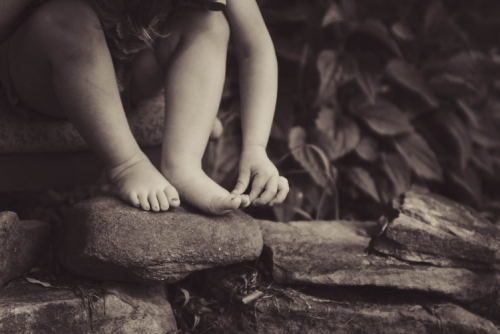
  • One of my favorite places to visit when we vacationed on the Outer Banks of North Carolina was a small book store in the town of Buxton. Set in a Barefeet Gabby Orcutt
    charming old house whose property stretched back to the placid waters of the Pamlico Sound, the ambiance of the place was captured in a small hand-painted sign that hung near the front door:  Welcome – bathing suits, wet suits, waders, barefoot children of all ages and small dragons.

    It was customary to enter barefoot, or with a towel wrapped around a damp bathing suit. Ledger sheets were maintained by hand and guests were likely to sense the pride the island took in its local authors, photographers and cooks, whose books held a prominent spot in the front of the store.

    There was a magic about the place that stemmed from nothing more than pure simplicity, and it wasn’t hard to imagine that a quick turn in to the children’s corner would uncover a tousled-haired five year old flipping through “How Droofus the Dragon Lost His Head,” with his own chubby-cheeked, fire-sputtering best friend leaning against his leg looking at the pictures.

    Still, no matter how I tried to bring the magic home with me, it disappeared the moment I got in the door and faced the mountains of paperwork that needed to be uncovered. Once home, it wasn’t long before the serenity of vacation began to be replaced with an invasive sense of urgency that seemed to pervade every aspect of our daily lives.

    It reappeared in the guise of payment due dates, the flashing light of the answering machine and the deadlines that define work and home.

    And then there’s the commute.

    There is no doubt that modern advances in engineering are, for the most part, a blessing, but sometimes I feel more suited to a job at NASA than a Catholic newspaper.

    Just getting in my car in the morning to drive to work seems like a clip from a modern space saga.

    Seatbelts? Check. Car phone? Check. Charger? Check. Coffee? Check. GPS in case traffic is detoured? Check. Location of all the clean restrooms between home and the office? Check.

    By the time I’m ready to put the car in drive I expect to hear a voice say, “Houston, we have lift-off.” And as I join in the morning marathon, I am convinced that some drivers really believe their cars are driven by rocket fuel.

    More and more I wonder, “What’s happened to the simplicity of life?”

    Yes, every century had its drawbacks. Who wouldn’t agree that indoor plumbing is a boon to humanity. But now it’s not enough to have a privy in the house; now it has to be an oasis of luxury, a vacation retreat where a weary soul can close the door and escape from the stresses of modern life.

    My grandparents would have had a great laugh at the idea. I can just hear my grandmother: “A bathroom is a bathroom. You can’t dress up what goes on in there.”

    Luxury for them would have been new cushions for front porch sitting at the end of the day. That was their idea of stress relief … and it was a good thing, something that built community and strengthened ties between family and neighbors.

    While we are, hopefully, grateful for the many creature comforts of this day and age, I also believe, as a society, we have sacrificed a lot to maintain our standard of living. Serenity, simplicity and basic good humor seem to be in short stead today, replaced, proudly it often seems, with anger and attitude.

    If picking up and moving to some Brigadoon in the mist isn’t an option, there is one way to bring a measure of serenity to life – prayer.

    My experience has been that many adults express doubt in their ability to pray well, but I would encourage them to consider the words of author Paul Wilke: “By seeking God in prayer, [the pray-er] has already made the connection. God is always there first, waiting. God asks no more than an open heart; and that is what prayer is – an opening of our being to that Being, however and wherever it occurs.”

    At the ocean, so mindful of the glory of God, prayer seems effortless, with each breath, each thought an offering of thanks. Once home, at least for me, prayer often requires more conscious effort, is squeezed into a time slot or filled with petitions for help.

    But no matter how we pray, the moment of prayer is the supreme moment of simplicity when we untie our earthly tethers and incline our hearts toward God. Prayer refreshes. It nurtures joy and keeps us focused on the really important things of life.

    Prayer is a much needed respite for the 21st century soul – especially for those of us more accustomed to seeing store signs that read: No shoes, no shirt, no service!

    Give me small dragons any day.


    Gabby Orcutt photo on Unsplash.

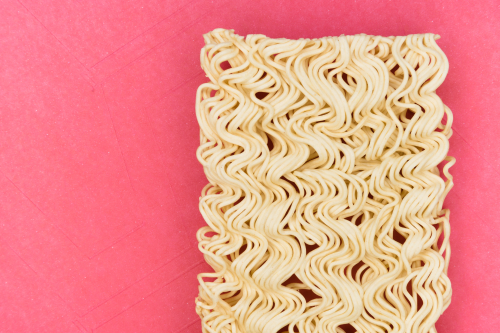
  • Ramen noodles. Ramen markus-winkler-qRpmKufw6Co-unsplashBy some, they’re considered a blessing. By others, a curse on good nutrition, but I never thought they would be fodder for a profound moment of insight from a three-year old.

    During lunch, I asked my grandson to tell me about his favorite foods. We ended up talking about noodles, his favorite, and what actually could be considered a noodle. Soon, we were talking about Ramen noodles, a rarity in their home, but which his older brother would happily make for everyone at lunchtime.

    “You know what happens with Ramen noodles?” he asked, with eyes lit up like he was sharing a magical experience. “They are a square and when you cook them, poof, they become noodles with their own sauce!”

    “Wow,” I replied, “That’s amazing! But I think there is a package of seasoning that has to be added to the water to make the sauce.”

    His brow began to furrow. “No, there isn’t!”

    “Um, I’m pretty sure there is.”

    “No …. There isn’t!”

    He was becoming more irritated as the exchange continued, so I encouraged him to watch his brother the next time he made the noodles so he could see him add the seasoning package.

    He went silent for a minute and hung his head, before saying, “I don’t want to.”

    “Ok,” I replied, “that’s fine. You don’t have to. But can you tell me why you don’t want to?”

    He didn’t hesitate. “Because I don’t want to know.”

    Wow, I thought. Just wow.

    “Well, that is a very honest answer,” I said. “Thank you for sharing that. I like it.”

    “Well, I don’t.”

    Curious to know if he understood why he didn’t want to know, I asked one more question. “Do you not want to know because it might mean you are wrong about the sauce?”

    Again, he didn’t hesitate. “Yes.”

    I smiled at him and assured him I understood how he was feeling. Adults are faced with that dilemma on a regular basis. Sometimes it's easier to not know the truth.

    I asked him if would like another pickle with his grilled cheese sandwich and he said, “Sure.”

    All was well.


    Marcus Winkler photo on Unsplash

  • As we pulled into the diner for lunch, I noticed a large black bird with a wide wing span swooping overhead. As I exited my car and walked toward Vulture trac-vu-B0uQWCc8KlE-unsplash the building, I realized the bird, a black vulture, had alighted on the roof edge along the gutter, now perched wing-to-wing with a second vulture. As we got closer we could see them both looking intently at us with beady eyes, their heads moving ever so slightly lower as we got closer.

    “Keep moving,” said my husband with a chuckle, “so they don’t think we’re their next meal.”

    I laughed, but it was eerie, knowing how intently they were watching us. I wondered if there was something to learn from the experience.

    As scavengers, vultures have a tarnished image. They live off dead and rotting carcasses, something abhorrent to people. They are equated with death and destruction and things foul.  But without vultures, and similar members of the avian clean-up and sanitation crew, humanity would suffer.

    After all, God created every living creature, vultures and humans, alike, with a purpose.  Vultures play a significant role in the cycle of life, providing opportunities for regeneration, purification, and new beginnings. They get rid of the old, not only what’s not needed but what can be detrimental to humans.

    Now, when I see a vulture being a vulture on the side of the road or flying overhead, I consider what it is that needs purification and renewal in my life.  What is happening in my life that is detrimental to my mental, physical or spiritual life, or that of my family? What resources are available to me to help me make that change?

    Most importantly, I remember that the vulture is living its God-given purpose, which causes me to reflect on whether I am living my purpose, as well.

    One of my favorite quotes about creation comes from famed Russian novelist, and Orthodox Christian, Fyodor Dostoyevsky, who wrote, “Love all God's creation, the whole and every grain of sand of it. Love every leaf, every ray of God's light. Love the animals, love the plants, love everything. If you love everything, you will perceive the divine mystery in things. Once you perceive it, you will begin to comprehend it better every day. And you will come at last to love the whole world with an all-embracing love.”

    Vultures may not be the most loveable of birds, but they have been part of my lesson that God’s creation has the power to teach us about God, about ourselves and the relationships that bind us, if we are willing to be receptive students.

    This post first appeared on RCL Benziger's blog, Faith Fuel    https://www.rclbenziger.com/blog

    Trac Vu photo on Unsplash.