• Many would say that in order to be happy in life you must first know your passion. I’ve always considered writing as my passion, but if that were Lea-bohm-bt0it9pozXM-unsplash true, I would have finished at least one of the three novels I started years ago.

    Now, having reached senior status, I can finally admit to a passion I believe I share with many other people, one which I have done nothing about except dream or slow down traffic when I spy my passion on one of my travels. Cars behind me might be better prepared if I had an “I break for old houses” bumper sticker.

    An old, abandoned house is like a siren of Greek mythology, enticing me to investigate. It took me years to understand that it’s never just the age of the house that calls to me, or imaging the beauty of what once was, or the chance of finding left-behind antiques.

    It is always the mystery of the house, the memories held within its walls from times past when it served as a home, a place made sacred by the love that lives there and the image of God in every member of a family.

    Catholic poet Joyce Kilmer had a deep understanding of the meaning of home: “The only reason a road is good as every wanderer knows, is just because of the homes, the homes, the homes to which one goes.”

    A loving home, even when it’s not ours, can be a place of comfort, hospitality, joy and safety as we journey through life. An open door may be a refuge for someone who has wandered far from home or a life-line for those who have no home, and there are many.

    Kilmer’s moving poem, “The House With Nobody In It,” is a lament for those houses that have done what houses are meant to do, to “have sheltered life” and are now empty, abandoned with no one to care for and no people to care for them.

    Kilmer writes that in passing an old farmhouse on the road, “it hurts me to look at the crumbling roof and the shutters fallen apart, for I can't help thinking the poor old house is a house with a broken heart.”

    What makes a house a home if not the people who live within its walls? Certainly, family relationships can get messy, but when home is a place where love dwells it becomes a haven, where each person is known and respected for who they are, even in cluttered, noisy spaces that might not be selected for an HGTV special.

    Building a home can only be done with intention. Sometimes, we may get caught up in the decorating or remodeling of our houses and let nurturing our homes fall by the wayside. Sometimes, we need reminding that our homes are sacred ground and need adequate tending.

    The Jewish faith teaches that the essence of every Jewish home is to serve as a sanctuary and dwelling place for the divine presence of God, and that every Jewish person is a sanctuary and dwelling place for God’s divine presence, as well. It is a beautiful image for every family to hold on to, and one that gives rise to this Jewish blessing for a home:

    “May this home be a place of happiness and health, of contentment, generosity and hope, a home of creativity and kindness. May those who visit and those who live here know only blessing and peace.”

    Shalom.

  • It is not unusual for an important truth to come rolling, unobstructed, from the mouth of babes. Our challenge is to pay attention. Blessed silence andy-kogl--2Nz00cN6ac-unsplash
    One of these priceless moments was gifted to us on a day when my husband decided to take two of our young granddaughters bike riding to a local park.

    On these days, there is always lots of noise and ample instructions as Pop makes sure the girls are appropriately dressed, have their water bottles and their helmets, and finally, their bikes.

    One day, one of the girls surprised my husband on the driveway as she pulled along a bike with training wheels. “Why didn’t you tell me you couldn’t ride a two-wheeler?” my husband asked, realizing plans now had to change to accommodate her slow pace.

    She replied frankly, “I tried to, Poppy, but you wouldn’t stop talking.”

    Definitely one for the family books, and a memorable lesson for learning the value of being silent long enough to listen.

    There is power in silence. Rather than being a void that needs to be filled, silence is the space between notes where the song breathes life. It is our opportunity to expand our understanding by listening to the truth of others and the truth of God’s creation.

    Most importantly, it is the place within which we may encounter the whispers of God.

    Among the saints, there is one who is known for his silence—St. Joseph, foster father of Jesus and husband of Mary. Scripture does not reveal one word St. Joseph spoke, yet his devoted presence in the life of the Holy Family is unmistakable.

    Scripture relays that God speaks to Joseph in life-changing dreams that required difficult choices. Joseph doesn’t argue the point, ask for an explanation or offer alternative suggestions. His response is an interior one, a yes that leads to action and, hopefully, an understanding on our part of why God chose him as protector of the Holy Family.

    Many popes have written and preached about St. Joseph, encouraging devotion to the humble man to whom was entrusted the care of God’s son.  By listening to God and doing his will, Joseph ennobled the role of spouse, father and worker and serves as an example of faithfulness for the world.

    In his Apostolic Letter, Patris Corde (With a Father’s Heart), announcing the Year of St. Joseph, Pope Francis reminds us of Jesus’ words, “’Learn from me, for I am gentle and lowly in heart.’ … The lives of the saints too are examples to be imitated. Saint Paul explicitly says this: Be imitators of me!’ … By his eloquent silence, St. Joseph says the same.”

    Mothers and fathers of the Church describe Joseph as a man with a profound interior life, one which can only be a result of embracing the silence that allowed Jospeh to know God’s will for him. It is likely, these holy men and women share, that he was influential in helping Jesus develop his own interior life, as well.

    Pope Emeritus Benedict XVI observed, "It is not exaggerated to say that Jesus will learn—on a human level—precisely from ‘father’ Joseph this intense interior life, which is the condition of authentic righteousness, the ‘interior righteousness,’ which one day he will teach to his disciples."

    We may not always think of ourselves this way, but we are those disciples.  We need what Jesus sought to teach his disciples in real time, and what St. Joseph taught him— a deep interior life that grows in silence.

    But how, in a world such as ours, filled with noise and endless distractions, can we deepen our interior lives? How can we engage in the spiritual conversation with both the God that we know and believe is present in our lives and the God that we don’t understand? And where should those conversations lead us?

    The first step is to decide that a deeper communion with God is what we want. The rest will fall in to place. Step by step, as we learn to quiet our thoughts, even brief moments of silence allow God the space to call our names and allow us to reply, “I am here.”

    As we grow in this endeavor we may become, as Pope Francis described St. Joseph, a person “who knows how to accompany others in silence,” the kind of person much needed in our world.

    Christianity, wrote Trappist monk Thomas Merton, “should make us more visibly human, passionately concerned with all the good that wants to grow in the world and that cannot grow without our concern.”

    The rich inner life of a Christian can lead us there.

    Andy Kogl photo on Unsplash.

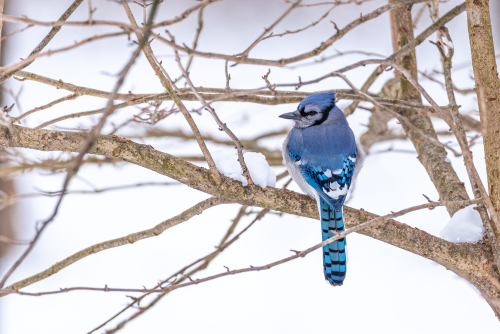
  • With the first snow of winter upon us, and the animals in our manger completely covered, I realized the bird feeder was again empty. Blue jay melissa-burovac-wL1qwZzCLX0-unsplash

    A brightly colored blue jay sat on the deck railing and looked in the window of the living room where I sat with my morning coffee. With his head cocked to the side, he seemed to stare intently at me, as if trying to pressure me into refilling the feeder.

    I laughed to myself and thought, “You were certainly not the early bird today, dear friend. You were beaten by some lovely cardinals, a host of finches, some blackbirds, and, of course, the local squirrels.”

    But I acquiesced, and threw out some remnants of a seed and fruit bread I had been saving for them. And the blue jay, being somewhat pushy, ate his fill.

    There are few things that give me a greater feeling of contentment than to watch the birds come to visit and fill-up on food I’ve left for them. Seeing their unique beauty, listening to their chatter with each other, even observing their squabbles, are some of the best moments of my day.

    I have often wondered how these extraordinary creatures weather the varied and severe storms that could prove to be a mortal danger.

    A professor in Tufts University explains that aside from a bird’s natural built-in protection such as feathers, which offer remarkable insulation from cold air reaching the skin, and feet designed so body heat is not lost to cold air, there are two things that help birds survive – location and preparation.

    Being small allows birds to take advantage of microhabitats, such as the lee side of trees or deep inside thick hedges.  He notes that wind speeds, and even the effects of driving rains, are dramatically decreased in these microhabitats. As long as the birds stay put and fluff up their feathers for increased insulation they can usually weather the worst of storms.

    But staying put also means they cannot forage for food, so an important part of their preparation for storms is to get as much nourishment as possible before the storm hits.

    Many birds can sense changing air pressure and, in preparation, spend as much time as possible foraging and eating.  Because eating produces metabolic warmth for birds, who need to consume one-third to three-quarters of their weight daily, food is imperative if they are to survive.

    It is no different for us when we are faced with so many of the severe emotional and spiritual storms that often hit without warning, and certainly the past year has provided a significant amount of those.

    We are strongest when we weather the storms from within the shelter of our faith and when we keep ourselves nourished with prayer, worship, the support of our various communities, and a grateful heart which enables us to give to others.

    Preaching in one of his weekly Angelus messages some years ago, Pope Francis taught on the Gospel of Matthew and the story of Jesus walking on the water to his Apostles during a storm. He recalled how Jesus instructed Peter to come to him on the water and, with his eyes on Jesus, Peter did just that, and walked on the water – at least for a few seconds. Peter then yells out to his Lord, “Save me!” and Jesus reaches out his hand and saves him.

    Pope Francis reminds us, “The faithful and ready response to the Lord’s call always enables one to achieve extraordinary things. But Jesus himself told us that we are capable of performing miracles with our faith, faith in Him, faith in his word, faith in his voice. Peter however begins to sink the moment he looks away from Jesus and he allows himself to be overwhelmed by the hardships around him.”

    As we enter in to a New Year, may we find strength, courage and hope in God and, though Jesus, overcome our sometimes fragile faith and believe, instead, in our ability to achieve the extraordinary.

    Photo by Melissa Burovac on Unsplash

  • It’s amazing how many interesting stories you hear when you’re cloistered in a ladies room stall. It seems that some Closed doors sheldon-kennedy-M7dI2Fvgrl4-unsplash
    people still carry the notion of children, that if we can’t see someone, they can’t see, or hear, us. That leads to a lot of uninhibited prattle destined to become tomorrow’s latest gossip.

    I’ve often thought that if I were an investigative reporter instead of a Catholic journalist I could be making a lot more money.

    On a rare journey to my local book store, two young women came barreling into the ladies room, the first one frantically texting on her cell phone, followed shortly thereafter by the other, responding to the text.

    They both seemed to be out of breath. I soon found out they had sprinted to the ladies room to escape the attentions of a young male friend who had unexpectedly shown up in the store.

    Forgoing the phone, one girl squealed, "Oh, my God, can you believe it?! Is it possible to be stalked by a friend? He’s such a …" (add in a few hundred words spoken in a few seconds and you get the picture).

    Within the next two minutes I had enough information on them, their male friend/stalker, his former girlfriend, his new girlfriend and all their family situations to write a popular sitcom. Unfortunately I didn’t have a notebook.

    They then spent the next few minutes scheming. It became the typical clandestine conversation behind closed doors scenario; the plotting, the planning, the self-assurance that comes from believing that your plans are secure. Sadly, young people are not the only ones who engage in this stealth strategy; and adults, especially Christian adults, should know better.

    But James and John didn’t know better. There was a reason Jesus called them Sons of Thunder. They had plans. These two disciples, overconfident and ambitious, used this behind closed doors strategy in an attempt to wrest the finest seats in the house of Heaven from Jesus.

    And as if that alone weren’t enough, they brought their mother, Salome, in on the plan to ask for them. Maybe on some level they realized that their accomplishments or their faith really didn’t warrant a throne next to the Son of God, so they hoped their mother’s influence, as one who supported Jesus’ ministry, might get it for them.

    Upon Salome’s request, Jesus basically responded, "Are you kidding? Do you know what you’re asking?" That’s paraphrased, of course, but he made it clear that to earn a place next to him in heaven they had to be willing to walk in his shoes. He asked them if they were willing to drink of the cup he would drink, and in their eagerness for honor and glory they replied, "No problem."

    Jesus promised them they would get their chance, but he didn’t make the promise they were hoping to hear—that they would be first in the Kingdom of Heaven, sitting at his right and left hand.

    James did, however, eventually earn the distinction of being first. He was the first apostle to be martyred, his powerful preaching having raised the ire of Herod Agrippa. It is said the man who was to lead James to his death was so moved by James’ passionate testimony as a Christian that the man acknowledged being a Christian himself and asked James to forgive him for his deception. James forgave him with a kiss and they were both martyred together.

    John, on the other hand, was the last Apostle to die and became known as the "beloved disciple," the "Apostle of Charity." It was John who received from Jesus, as he was crucified, the all-important task of caring for Jesus’ mother, Mary.

    What happened to change these brothers from the self-important, ambitious disciples they once were to the powerful, self-sacrificing Apostles they were at the time of their deaths? The Holy Spirit happened. And love happened, a love for Jesus so strong that both men allowed their hearts to be open to grace, to be humbled, to be used by God for God’s purposes, not personal ambition.

    When we end up behind closed doors, we do best to remember our plans are not always God’s plans.

    "Do not seek from the Lord high office, or the seat of honor from the king … you may be partial to the powerful, and so mar your integrity." Sirach 7:4, 6b

    Sheldon Kennedy photo on Unsplash.

  • It has always been my habit to stay up late at night, beyond the time when everyone else has gone to bed. It stemmed from having lots of little Time matt Barrett
    children in the house and very little quiet time, except when twelve little feet were tucked under the blankets.

    There was a time when it was not unusual to find me at the piano, practicing a choral piece at 3 a.m. It was amazing  that I could sit down at the piano at midnight and, in what seemed like only an hour, get up to make some tea and discover it was almost daybreak.

    Absorbed in something I love, there is often no sense of time.

    Yet, earlier in the day, when I was trying to meet a deadline at work, with a dozen other responsibilities hanging over me, time seemed to be mocking me, an ever present reminder that I may never accomplish all that needs to be done.

    Time is a funny thing. It seems to move faster as we get older. And as it pulls us along, often at a pace that seems out of control, we struggle to be masters of those precious moments, sensing that, in addition to life and faith, time is one of the greatest gifts we have.

    Time embraces life and nudges it to fullness; the flower from seed to petals; the butterfly from larvae to graceful wings; the child from embryo to adulthood. And within the womb of time rest the experiences, the formative encounters, which make us unique individuals.

    Perhaps, most profoundly, time provides the opportunity for forgiveness, for do-overs, for loving better; for surely, one of the deepest losses we face is the loss of time with a loved one. And when that loss is spurred by death, our lives are never the same.

    Still, in the face of our mortality and heavily engaged in the temporal affairs of our lives, we often find the moments of our days slipping away, unnoticed and unfulfilled because we are caught up in too many things. It seems our lives are no longer organic, integrated with the world created by our God. In a world ruled by human technology, goals and objectives, our rhythms are no longer aligned with the rhythm of the seasons. We have become foreigners in a land created for our well-being, yet we wonder how our days have gotten so out of control.

    How, then, can we reclaim time as a good?

    There is a lesson in all the religions of the world. Sacred time.

    Sacred time has the feel of those experiences of absorption, where the linear ticking of seconds disappears and our feelings of anxiety are balanced by a sense of peace.

    Being mindful of the sacredness of time encourages us to be mindful of God, and nurtures awareness. Engaging in the rituals of our faith, surrounded by sacred symbols drawn from our ordinary lives – bread, wine, water, oil, flame – reassures us that all of life is sacred. The rhythm of the liturgical year reminds us that life must have a meaningful rhythm, as well.

    We may turn also, to the wisdom of the saints, like Benedict, whose Rule included a construct of time that allowed for a necessary balance of prayer, work and leisure. For St. Benedict, the ordinary was so charged with the sacred that he wrote, "Regard all utensils as if they were the sacred vessels of the altar." Benedict wove, within the lives of his monks, times of prayer throughout the day. When hearts and minds are so often turned toward God, an awareness of God at all times and in all places grows.

    Or St. Teresa of Avila, whose wisdom shown through a poem both simple and profound in its grasp of time: "Let nothing upset you, let nothing startle you. All things pass; God never changes."

    St. Teresa was also the saint who is said to have been comfortable enough with God to complain after a carriage accident, "If this is how you treat your friends, it's no wonder you have so few!"

    I wish I could have invited her to tea.

    Matt Barrett photo on Unsplash.

  • Taking a walk during the summer months is often uncomfortable for me. I find the warm weather oppressive and yearn for the crisp enchantment
    Autumn johannes-plenio-RwHv7LgeC7s-unsplashof autumn.

    Now, as I walk with dappled leaves falling, I am stirred by vague memories of long walks home from school under a harvest moon, the smell of fall air and the delightful treat of caramel apples.

    Now that I am older and a little wiser, I realize that, on a deeper level, there is meaning in the purpose of fall itself, in the season that signals a moving into winter.

    For me there was, and still is, comfort in the latency, that period of time when growth is stilled. After the last harvests of fall, the created world begins its journey inward, when the growth of spring and the fulfillment of summer come to a halt and life begins a period of rest and renewal.

    It is in this time of rest that the gift of renewal allows for the period of growth.

    Certainly, there is an essential quality to the experience of growth. God has deemed it necessary in all areas of human existence. Think of the young Jesus, who, after traveling with his parents to Jerusalem for the Holy Days, returned with them to Nazareth where he “advanced in wisdom and age and favor before God and man” (Luke 2:52).

    Scripture teaches us something similar about Jesus’ cousin, John the Baptist: “The child grew and became strong in spirit, and he was in the desert until the day of his manifestation to Israel” (Luke 1:80).

    What we don’t hear about are the many struggles and disappointments that likely accompanied the growth of these two men.

    Personal growth can be the most painful of experiences, often stemming from great trials of loss, fear and doubt. When the trials are many and the pain becomes overwhelming, we are often encouraged to find ways to flee from the experiences, and with the escape, avoid growth.

    How blessed we are that nature seeks no such escape route. When we immerse ourselves in God’s creation, we not only restore our bodies and our mental state, we join with the popes and saints who did the same, and taught that God created all things not only for our enjoyment and benefit, but also to instruct us.

    Among those holy men and women were St. John Paull II, Pope Benedict XVI, and Pope Francis, as well as St. Francis of Assisi, patron saint of animals and the environment, and St. Kateri Tekakwitha, known as a child of nature, who made a small chapel in the woods by crafting a wooden cross, planting it in the ground and spending time there in prayer.

    St. Kateri understood that nature’s periods of stillness, of turning inward, are necessary and fruitful for all of God’s creation, most especially God’s children.

    Perhaps that is why God created autumn to be so beautiful; to encourage us to lose ourselves in the stillness for a while in order to prepare for our next season of growth.

    Photo by Johannes Plenio on Unsplash

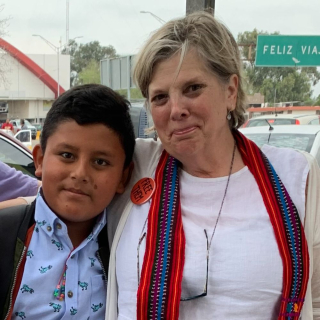
  • As a Christian, and a grandmother, I have been supporting Grannies Respond/Abuelas Responden for a long time. My small donation isn’t much compared to the personal presence of so many in the group. Their recent newsletter featured a Grannies respond Kali Bird Isis poem from Kali Bird Isis, one of the original 30 Grannies, who traveled two years ago to McAllen, Texas, “to shine a light
    on Trump’s policy of separating children from their asylum-seeking parents.”

    Kali is an ordained interfaith chaplain and grief and trauma expressive arts therapist, who returned early in the year to volunteer at the refugee encampment in Matamoros, Mexico, across from Brownsville, Texas. Her poem follows below:


    After Matamoros
    By Kali Bird Isis

    I’m between worlds.

    Back in the busy of every day,

    and of everyone and into the noise

    of traffic and laughter, and back into work

    and back to bagels and coffee and everyday

    plans.

    I’m back.

    Except I’m not.

    I’m full of the encampment in Matamoros and

    how the wind blew hard and cold one

    night and how the babies cried and the oh-so young mamas

    held them close as they lay on the hard, hard ground

     in their flimsy tents,

    and the wind rattled through the 

     bougenvilla with tent after tent packed one next to another.

    I’m back with the fence and all that barbed wire 

    and the Rio Grande,

    too dirty for drinking and not that impressive

    but it keeps most of them out-

    They want safety and they believed they would find it,

    and they wait in lines, a 1000 or more, 

    for dinner and court dates, a sham and a shame, with

    judges on screens in big white tents,

    and too few lawyers who are paid too little,

    working long hours with their own hope fading as they look in their eyes.

    They wait for the fire to catch and they wait 

    for their women to cook a meal and

    for the free store to open, 

    or to see a doctor if there happens to be one,

    for relief for the children who suffer from lice and

    from boredom, from fear.

    They wait for the sidewalk school that still somehow opens,

    for the volunteers like me who can help serve up

    a meal.

    They wait for the hurricane to end, for the rain waters to recede,

    for  new tents and masks, for continued supplies.

    They wait for justice and a little more faith.

    For Covid to end.

     They wait to believe they will finally be seen and they wait 

    for the end of long journeys and the 

     fear of returning to places where death surely awaits.  

    They wait and they wait for the rules to change. 

    They wait for compassion and a promise of safety.

    I’m between worlds and it might take awhile 

    I’m hoping forever so I never forget

    And I’ll keep going back

    And I’ll stand with others

    Who will tell these stories so everyone hears

    That there are hundreds of people each day who are dying 

    All over the globe, 

    Who have hope in their hearts and a desperate yearning 

    For everything we here already have.

    I saw them led, shackled and chained, onto predawn flights

    And flown away to alien lands.

    And I can’t forget Caleb, the young boy that I loved,

    how he helped me serve meals

    and translated the Spanish,

    and where is he now after so many miles?

    He fled with his mother and with his abuela over the mountains 

    to get here to safety and I promised not to forget

    (Please don’t let me forget),

    I don’t want to ever stop knowing

    That there are so many people

    With so many children just wanting what you and I 

    always have had.

    We have to keep seeing and telling their stories,

    We have to make sure that we never forget.


    This poem, photo and information first appeared in the Abuelas Responden/Grannies Respond September 2020 newsletter and was reprinted with permission. You may find them on Facebook @granniesrespond.

  • Plant what is right. Then you will harvest good things (Hosea 10:12)                                                                                                Seeds coffee

    As Catholics, we are taught from a young age about the power of seeds, even those as small as a mustard seed. We are taught to plant those seeds that will allow all people to harvest what is good – love, compassion, hope, unity, forgiveness, faith, respect – and to put our faith in to action, to live the Beatitudes for the good of  all God's children.

    Look around you, at the country you are living in right now. The fear and hopelessness; the division, even among families; the hatred for those who think and look differently; the chaos; the confusion; the lies; the death.

    We are reaping the fruit of seeds Donald Trump has been planting since he ran for office.

    This is how the devil works.  We must pray over it.

  • One of the things I’ve missed greatly during the past six months of living life in various stages of quarantine is time spenSeagullstaring Nelson Eulaliot with friends. And if ever there was a time when we needed those shared experiences, it’s been the past six months.  Right now, for me, all I have are memories, but they always lift my mood.

    When a seagull swooped over my head in the supermarket parking lot recently, I remembered a day many years ago when two of my long-time friends and I managed to sneak away from work on a late spring day and made some time for a beach retreat.

    It was a wonderful day, getting off to a rousing start marked by an early morning battle with the seagulls.

    We had our chairs arranged in a circle, our thermoses of coffee, snacks and other essentials within reach and were talking about recent events in our lives, when I found myself  yelling out, “Stop that seagull!!”

    My voice was barely audible over the waves, but my gesturing caught the attention of a friend opposite me who nearly flung herself out of her beach chair onto the sand to retrieve a brown bag full of bagels being dragged toward the water by a very large and brazen seagull.

    He had been standing next to her chair for an hour, sizing things up, waiting for a crumb to fall, darting forward at our slightest movements, and when he couldn’t stand it anymore he charged forward, grabbed the bagel bag and had it almost out of reach before we knew what happened.

    And he had friends.

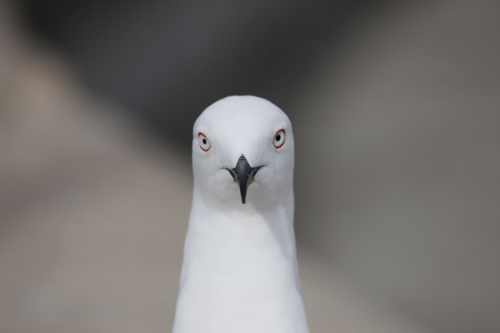
    One of them stood directly in front of me, almost on my feet, in a stare-down the entire morning. He seemed experienced in his attempt to weaken my resolve, as if his beady little eyes would entice me to drop a morsel or two for his benefit.

    But I stayed strong, and he called for reinforcements.

    As he bent his head down between his legs, I wondered at his strange way of checking out what was behind him.  I soon learned it was the ordinary prelude to a volley of loud seagull honkings.

    Almost immediately I noticed some movement out of the corner of my eye, and soon realized we were now surrounded by seagulls who seemed to be putting great effort into acting nonchalant. Nothing to see here.

    But we knew what they were up to.

    With seagulls, there really is no acting. Their motive is always obvious. It’s all about the food.

    With people, motivation is not always so clear.

    The inclination to use our wiles to get what we want is strong. But in those times, when we give in to the inclination, we put aside honesty, we compromise our integrity. When we resort to cunning and deviousness, embracing "the end justifies the means," we move away from Gospel values.

    Catholic author C.S. Lewis put it this way: "Not to be, but to seem, virtuous – it is a formula whose utility we all discovered in the nursery."

    That discovery often proves to be a great challenge to living a truly Christian life, and Scripture reinforces that "guile" is no path to God.

    Dire warnings about the consequences of cunning behavior are repeated in Psalms and Proverbs, but in the Gospel of John there is a delightful, even humorous story, that reflects the importance for disciples to be "guile-less."

    Jesus was gathering disciples. Andrew had already joined him when Jesus also found Philip and invited him, saying, "Follow me."

    Philip then found Nathaniel and extended the same invitation to follow Jesus, "the son of Joseph from Nazareth."

    Philip replied, "Can anything good come out of Nazareth?"

    When Jesus saw Nathaniel coming toward him, he said of this new disciple, "Here is truly an Israelite in whom there is no deceit!"

    Jesus valued Nathaniel’s forthrightness because Jesus recognized that Nathaniel’s heart, and motives, were pure.

    If we take the Gospel seriously, it is important for us, then, as disciples, to routinely examine our own hearts and motives to be certain our God will see the same thing in us.

    As for the seagulls, there were no bagels for them that day. Don’t get me wrong, I love seagulls, but once you feed a scavenger, you will never get rid of them.

    The next time we retreat to the beach, it’s bright colored umbrellas for us, bagels and a side of water pistols.

    Nelson Eulalio photo on Unsplash.

  • A lovely virtual Mass, marked by the lilting tones of an equally lovely Irish monsignor, was an opportunity to reflect on a Derrycunihy Church  Co Kerry Dimitry Anikin on USphomily which contrasted King Midas, of Greek mythology fame, and King Solomon, beloved of God and biblical author.

    Both kings were given the opportunity to have one wish fulfilled. For King Midas the offer came from the god Dionysius. Midas, who was already extravagantly wealthy, wished that all he touched would turn to gold.

    Dionysius warned him to think carefully, but Midas insisted this is what he wanted.  His wish was fulfilled, but when his food turned to gold and he nearly starved, and his daughter turned to gold when he hugged her, Midas realized he had made a terrible mistake.  The blessing had become a curse.

    Solomon, who was also wealthy as kings go, saw the Lord, God, in a dream. God said to him, “Ask, and I will give it to you!”

    Solomon responded, “Give your servant an understanding heart to judge your people and to discern between good and evil,” explaining to God that he wanted only to know how to govern God’s people well.

    God was so pleased with Solomon’s request, he gifted him with riches and honor and long life, for as long as Solomon kept God’s statutes and commandments.

    Solomon asked for wisdom and God rewarded him, also, with insight and understanding beyond measure, making him the wisest of all men.

    When the Irish monsignor came to the end of his homily he asked, “If God were to grant us that wish, what would we ask for?”

    I wanted to raise my hand and ask for clarification.

    Does the wish have to be just for me, can it be for someone else?  Everyone else?  Really, at this very moment, wouldn’t someone want to ask for an end to the pandemic?  But maybe in my humanness I’d want to ask for something for my family. Can my wish be worded to cover more than one thing, like “abundance of health, happiness and safety?”  What are the parameters of the question??

    I felt like a teenager who didn’t understand the essay assignment. I chastised myself, thinking, it’s not a hard question, what is your problem?

    The problem is I’m a human being, one of those we all know to often be impulsive, short-sighted and quick to give in to emotions that override our ability to spend a bit of time in quiet contemplation. And there is the root of the problem. 

    Wisdom is the fruit of silence, of listening, of a desire to see what is real and what is of God.

    In his 2014 series of talks about the Gift of Wisdom, Pope Francis explained that wisdom “is the grace of being able to see everything with the eyes of God. It is simply this: Seeing the world, situations, conjunctures, problems, everything with God's eyes. This is wisdom. Often we see things as we want to see them or according to our heart, with love, with hate, with envy.  No, this is not God's eyes. Wisdom is what the Holy Spirit does within us so that we can see everything with God's eyes. This is the gift of wisdom.”

    Pope Francis also stressed that wisdom cannot be learned, which is why we must ask God for the gift of the Holy Spirit and the gift of wisdom that teaches us, also, “to feel with God's heart [and] to speak with God's words.”

    I’ll be going back to that Irish parish for Mass next Sunday. I’m looking forward to the next homily.

    Dimitry Anikin photo on Unsplash.