• Many years ago, while visiting Ocracoke Island, one of the barrier islands of the Outer Banks in North Carolina, I visited an old graveyard dating Birdsinging  Andy Holmesback to the time of the Civil War. The headstones were lined up in tight rows, almost touching one another.

    What caught my eye were the stones in the front row, all with the same surname.

    Several children from this large family had died just days apart from each other, most likely from a plague of some kind, and several more within a year or two. If I remember correctly, the mother lived to see the death of all her children and her husband.

    As a mother myself I wondered how this woman could survive such an ordeal. I stood for a long time in front of all those graves and prayed for that family which so long ago suffered such terrible losses. I’m not ashamed to say I cried, as well.

    There are many obstacles in life that can knock us off our feet, but none seems to have the power to undo us as the death of someone we love. It is then that the substance of our hearts and souls becomes visible as we become most vulnerable. Often we succumb to anger, despair and loneliness, unable to find any peace or consolation, even in the God we thought we knew.

    To endure multiple deaths close together, then, could easily be more than the fragile human spirit could handle.

    This was the experience of my friend and fellow alto, Mary Beth, who, three weeks after the sudden death of her husband, would be singing the “Ave Maria” at her mom’s funeral Mass.

    I was deeply touched by the resilience that allowed her to sing this moving and emotional hymn following such deep loss, but I was not surprised.

    Her powerful love of her family and her devoted care of two ailing parents could only be fed from a deep spring of love for God.

    Though I didn’t know the mom from Ocracoke Island, it is not hard to imagine that she shared something special with Mary Beth – a similar substance of soul, an attachment to God woven so tightly into the fabric of their lives that nothing could keep them from gathering strength in the arms of their Father and moving forward in faith. 

    Being with Mary Beth as she sang for her mom brought a new depth of meaning to my own favorite hymn, the traditional Shaker hymn, “How Can I Keep From Singing.”

    The refrain will always remind me of the power of her faith, her belief that death is not visited upon us by God but, rather, that God walks with us in our Garden of Gethsemene: “No storm can shake my inmost calm, while to that rock I’m clinging. Since love is Lord of heaven and earth, how can I keep from singing?”

    Today, as we all face often overwhelming losses brought about by this pandemic, or struggle with anxiety, anger, fear and despair, I pray the words of the final verse will soon reflect our own experience: “I lift my eyes, the clouds grow thin, I see the blue above it. And day by day this pathway clears, since first I learned to love it. The peace from love makes fresh my heart, a song of hope is ringing. All things are mine, since truth I've found. How can I keep from singing?”

  • The morning news disturbs me.                                                                                                                                                                                                                Heart omer salom   
    I know what I’m going to see and, yet, I am regularly overwhelmed at the capacity of human beings to hurt each other, not just in small ways, which are damaging enough, but with viciousness and a total disregard for the life of another person. I am often reminded of my father’s prediction when there was a steady stream of bad news: The world is going to hell in a hand basket.

    The morning news scares me.

    It seems our ability to be self-focused at the expense of others is gaining ground. In fact, there are days when it seems to be snowballing out of control. If we were really to examine even our own lives honestly we might be surprised at the depths of our ability to be selfish, to rationalize our need to put ourselves first – our wants, our needs, our political ideologies, our race, our ethnic group, our religion.

    The morning news propels me.

    The more disturbed, scared, confused or hurt I am, the more I turn to God.  I have found that when I ignore Scripture and put my faith only in my own thoughts and feelings, I become less than I am meant to be and less capable of being a part of the goodness in the world.  Bad news propels me to turn again to God’s command, “Trust in the Lord with all your heart, on your own intelligence do not rely.”

    The morning news reminds me that we are the ones who make life more difficult and more painful for ourselves and for others because we allow our lives to be ruled by our feelings. 

    I was reminded of this during Mass when the pastor preached on the story of Abram and Lot who found it necessary to separate their flocks.

    Abram put Lot first and allowed him to choose the land he wanted. Lot chose what he thought was the choicest land for himself, “all the valley of the Jordon,” near the city of Sodom, without consideration of what would happen to Abram, who was left with the dust of the land on which he stood. But Lot’s happiness and prosperity would be short lived. Moses reminds us that, “This was before the Lord destroyed Sodom and Gomorrah” (Genesis 13:10).

    Lot would lose everything, but God blessed Abram for his faithfulness, and promised to give him all the lands for as far as his eyes could see, including the valley of the Jordon.

    Reflecting on the choices of two very different men, the pastor stressed that we are also “called to go beyond what we feel and make choices from our hearts.”

    This may seem like a contradiction, since in our society we treat the heart as the center of all feeling.  But in Scripture, the heart has much more depth and purpose. As the organ of life, it is the seat of will, the center of both emotional and intellectual life. It reflects our nature and our true character.

    When we allow the heart to be formed by God, it will lead us to do good rather than cause harm. The heart molded after the heart of God can transform the bad news of the world, of our communities, our workplaces, our parishes, schools and families, into good news.

    And who couldn’t use some Good News.

    Photo by Omer Salom on Unsplash.

  • Biblesun aaron burden

    In the morning I cry,

    O Lord,

    tears fill my eyes

    and so gently slide

    down my cheeks.


    Why do I shed tears at the break of day?

    Maybe it is the time I stop and remember

    the pain and grief that surrounds me.

    Another request for prayer,

    another admitted to Critical Care,

    a call to move a name from one petition to the next,

    or wait to pray a pardon over the phone.

    May their souls rest in peace.


    In the morning I cry

    because I can be weak before you.

    My heart breaks with the

    uncertainty of what the day will bring.

    The cry of those who mourn,

    the tentative hope of those who seem to recover.

    All tears shed, all emotions raw; to the bone.


    In the morning I cry

    as I pray, “Am I doing enough?”

    Am I caring for the people placed in my care?

    Am I showing forth your face of compassion and strength

    so they will find hope?

    Am I affirming those who spend their days fighting this virus?

    Do I comfort the weak and

    witness to all where our true strength comes from?

    Am I enough?


    In the morning I cry

    as I hear your Word in the pages of my prayer book

    and know you are with all of us, the Living and the Dead.

    How my prayer time gives me confidence

    to face each day with Hope,

    and not be afraid to laugh and to cry with those I encounter.


    In the morning I cry

    as I am reminded that I am to be Christ to all,

    and I am to see Christ, in all.


    In the morning I cry,

    because your Divine hands cup my face

    and remind me You are with me.

    You are with us all …


    SAS, 2020

  • Adding Memorial Day to the long list of observances that would need some reinvention since New Jersey went on corona

    SRB vol Peggy Klotz donation of fresh fruit to distrub table

    Co-Cathedral of St. Robert Bellarmine parishioner, Peggy Klotz, brings donations to a distribution table

    lock down March 21 is a given.

    Cemeteries will be open so that families and friends can pay homage to their beloved dead for their legacy of sacrifice and devotion. So will parks and most beaches and boardwalks. But public celebrations – parades, block parties and big backyard barbecues – are off the table for everyone following the rules.

    Such Memorial Day observances have always been a big deal in my family. As a child, I played a pretty bad glockenspiel in several parades with a VFW at the Bayshore and always enjoyed a really good wreath drop over the waters of Ocean County, a parade and a family barbecue.

    So as the days of May dwindled to a precious few, I was feeling down and out. Not as seriously down and out as I was before realizing that live stream liturgies would lend a salvific glow to my home office/makeshift chapel during Holy Week and Easter. But pretty down.

    Then suddenly, there it was, an announcement on the Facebook page of my parish – St. Robert Bellarmine Co-Cathedral in Freehold Township – that public participation was requested on this special day in the church parking lot.

    “We ARE collecting on Memorial Day so come by!”

    So read the notification that the Monday food collection for the Open Door food pantry would be running as usual from 10 a.m. to 1 p.m. in the church parking lot. The Open Door is the independent food pantry started by the Freehold Clergy Association years ago.

    The post was accompanied by photos showing volunteers on May 18, “working hard” as they took possession of “the continuous, generous donations” from the SRB community. “Our volunteers were able to pack 161 emergency food bags for Open Door. We also received a generous donation of diapers, detergent, toiletries and paper products that were desperately needed.”

    Knowing the collection was on lifted my Memorial Day gloom immediately. On this day of remembrance, there would be a stream of masked people to share a socially distanced good work with.

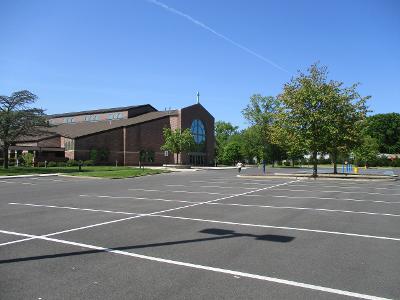
    SRB parking lot

    Co-Cathedral of St. Robert Bellarmine, Freehold.

    I should have known the Memorial Day invitation to the parking lot would come. It reflects the declaration of the rector, Msgr. Sam A. Sirianni, a few weeks back that “the parking lot is always open.”

    The primary emphasis, of course, was to be on prayer.

    That announcement came by way of a Facebook message that a light had been installed to illuminate the tabernacle. All were invited to come in and park in front of the church, which like all houses of worship in New Jersey had been closed and locked for weeks due to the shut down

    All were welcome to pray in their cars, come as close to the church as they could and pray before the tabernacle. “The thing we are very much aware of,” Msgr. Sirianni said at the time, “is that fasting from the Eucharist has been hard.”

    “We know people come to pray in front of the church. In those moments when you don’t know what to do, you know that the parking lot is open. If you want to draw closer to Our Lord in the tabernacle, our parking lot is peaceful.”

    “It’s a place where you can gather your thoughts and pray,” he said. “I remember early on in this (corona shut down), a car rolled into the parking lot driven by a nurse. She said, ‘Father I just wanted to pray before I go to work.’ Ever since I came to St. Robert Bellarmine, I would find people in the parking lot being quiet, at prayer.

    “… I would say bring your favorite prayer book or the Bible and enjoy the quiet. The thing is that we are being bombarded with uncertainty and we need the quiet to realize God is with us.”

    From keen observation on several visits, people also seem to thrive in the parking lot as they grab a slice of what used to be just regular life: teaching their toddlers how to ride bikes and their teens how to drive cars, for instance, or resting awhile in the prayer garden, as they savor the peace that pervades that green space between the church and Dentici Hall.

    I have found it's also a place to find solace while meeting with an old friend to mourn the death of one of our classmates whose memorial Mass is yet to be held.                                                                                                                                               

    SRB MsgrS

    Msgr. Sam A. Sirianni, Co-Cathedral rector, and parish volunteer, Linda Altini.

    It's a great destination on some weekdays when you get to break the self-isolation with prayer and then tune into the
    activity that hums during the Monday food collection and a food related fund raiser with the Cousins of Maine Lobster truck every Thursday from 11:30 a.m. to 7 p.m.

    On a recent Thursday, many folks from the neighborhood strolled in, joining motorists from around the area for that event which earmarks funds for the Freehold food relief program.

    “The Freehold Clergy Association is involved as a resource to support this effort and the donation is made to the association,” said Msgr. Sirianni. This fund, he said, involves cooperation between agencies that take care of people in the borough, township and surrounding area, and area restaurants which prepare healthy meals for $7.00.

    SRB2

    Deacon Michael Lee Foster, St. Thomas Moore Parish, Manalapan, helps out at Monday food drive.

    “So far, they have shipped out over 300 plus meals to people who are sick and can’t leave their homes. People who are really in desperate need and can’t prepare a meal. We are joyful about how well it is going,” he said.


    ~Lois Rogers photos

  • Many years ago, when I thought I would be boiling and coloring eggs and planning a dinner for my large family, I ended Essential Sharon McCutcheonup spending the week before Easter in the hospital with my youngest son. It was certainly unexpected, but life doesn’t ask you if you’re prepared before it throws the unexpected your way.

    After rushing a very ill 18 year old to the emergency room, we spent the next eight hours waiting for a room, with nothing to do except observe what was happening around us.

    Being present in an emergency room places a person in close proximity to the vulnerability of others. Here, amid the woundedness, amid the relationship of sufferers and caregivers, are powerful lessons to be learned. Just observing how each person dealt differently with suffering was an education for me.

    There was the young woman, hysterical and in great pain, who was inconsolable until her husband arrived. His presence calmed her immediately.

    Then there was a middle aged man, involved in a car accident, who repeatedly entered into verbal warfare with a person in the room, attempting to place the blame for his injuries on someone else, as if that would make him hurt less. He made care-giving difficult.

    But the patient who touched me the most was a little old lady, obviously suffering from some form of dementia as well as physical problems, whose repeated outbursts had the tone of a raspy voiced boxer. Time after time, throughout the course of a very long day, she called out to children who were not there, “Carol, I need my puffer!!”

    “Carol, are you listening to me??”

    “Carol, you’re killing me here!!”

    Obviously this little lady realized she was totally dependent on others and had no choice except to surrender to their care, but she seemed to also know that surrender didn’t mean giving up the fight.

    In fact, after one especially loud round of outbursts, a very wise nurse was heard to say, “She’s a contendah!!”

    And that she was. Still, every once in a while this suffering woman with the cartoon character voice would lose her feistiness and plead with an absent son: “Help me, please, please, please!”

    It was at those times that her anger would give way to the vulnerability that is manifest when a person acknowledges their needs. This is the time when true strength rises in the heart of a person; a time when we are strong enough to be humble.

    In the absence of her family, this aging woman was comforted, attended to and cared for by a wonderful staff of compassionate nurses. They spoke to her in gentle tones, encouraged her to tell her stories, rubbed her arms and legs with lotion, made her laugh.

    It was a beautiful thing to see her smile, especially in the midst of her pain. It was a miracle. Not the supernatural kind, but the kind that arises from love, from letting go of self long enough to embrace another in their hour of need.

    A lesson was confirmed for me during that very long night in the emergency room, and a longer week in the hospital: the surest way though pain is with love – whether it is the self-giving of family or friends, the compassionate presence of a priest or rabbi, chaplain or minister, or the exceptional care of nurses and doctors who choose to make a person feel as if they really do matter.

    A wise bishop once told me that Easter was the greatest love story ever told. For Christians, it truly is. But for each of us, no matter our religious tradition, or if we have none, any day is a good time  to walk with another person through their suffering and see our love give rise to the amazing grace of resurrection in another’s life.

    Love is a miracle in and of itself. Giving it loosens our grip on the attachments that weigh us down. Receiving it reminds us that we are enough as we are, in this present moment, and that’s all that matters.

    Thoughts to Ponder

    “Did I offer peace today? Did I bring a smile to someone's face? Did I say words of healing? Did I let go of my anger and resentment? Did I forgive? Did I love? These are the real questions. I must trust that the little bit of love that I sow now will bear many fruits, here in this world and the life to come.” ~ Henri Nouwen

    “Miracles occur naturally as expressions of love. The real miracle is the love that inspires them. In this sense everything that comes from love is a miracle.” ~ Marianne Williamson

    Sharon McCutcheon photo on Unsplash.

  • “What are we going to do without Mike?”                                                                                                                                                                                            Starsky

    The sentiment came from a Facebook post after the death of a family member, the cousin of a special friend of mine.

    As I read it, I suddenly became acutely aware of the thousands of Mikes who have left our lives because of this pandemic.

    Suddenly, the grief of tens of thousands of loved ones, friends, family members and acquaintances, made me catch my breath in a painful moment of awareness.

    Those who have died are more than just numbers on a screen or data in a news report. They were people whose lives impacted others.

    Mike was described as a beautiful soul, the source of special joy, comfort and peace, someone who made everyone’s day better, a light to those who knew him, a light to the world.

    My God, I thought. As we fight over the accuracy of death toll numbers and beat our chests, demanding our freedom to break free of quarantine, the lights of the world are going out.

    I imagined the night sky I once had the privilege of sleeping under in Montana, filled with so many stars they seemed to hide the black sky from sight. Now, in this moment, I saw those glimmers of light dim and go out, one by one, until the darkness rolled over the light.

    I thought about how blessed Mike’s family was to have such a bright light among them, bringing so much love and peace and joy to others.

    And I thought about all those others whose lives have been diminished in some way by the losses this virus has inflicted on them.

    But the loss is not just a loss for others. It is a loss for all of us.

    We, the collective community, have lost the minds and hearts and passions of thousands of souls. Souls who had a place and a purpose in the world.

    The loss is immeasurable. If we are going to beat our chests about anything, it should be this.

    Photo by Ivana Cajina on Unsplash

  • I’ve always been fascinated by the story of Jonah and the Whale.                                                                                                        Jonah

    As a child, reading my full-color illustrated book of Bible stories, I was most interested in how Jonah got in the whale and what it might have been like for him sitting in the whale’s belly for three days. I never questioned the veracity of the story because, after all, if God can create a universe, God can certainly arrange for an errant Jonah to have a time-out in a most unusual place.

    As I grew older, I thought more about how Jonah, the reluctant prophet, ended up in trouble because he tried to run away from God, and I often thought my life was going in a similar direction. If I didn’t stop disobeying what I knew God was telling me to do, or not to do, I could end up underwater myself.

    As a college student, reading the classics, I found myself wondering if Jonah ever felt like Francis Thompson, the English poet who wrote the exquisite poem, The Hound of Heaven, which describes an unrelenting God pursuing  a soul seeking to hide itself as a hound relentlessly follows a hare.

    As an adult I have learned that there is more to the story than a man running from God and ending up in the belly of a big fish.  The essential element of the story is the “why.”

    God had a job for Jonah to do – to preach repentance to the Ninevites, whose reputation for evil was known to God. Jonah didn’t want to be that prophet so he ran from God and tried to sail away to Tarshish.  While he slept in the hold of the ship a storm arose and the seas threatened to capsize the boat.

    The sailors figured out that Jonah was fleeing from his God, so to appease God they threw him overboard and the storm ceased. But God saved Jonah by providing a big fish which swallowed him and kept him safe for three days – the length of time it took Jonah to repent for running away.

    God hears Jonah’s prayers and commands the fish to spit Jonah up on the shore so Jonah can finally undertake the task God asked of him – go to Ninevah and preach to the Ninevites so they change their ways and turn back to God. 

    Jonah preached and the Ninevites listened. Everyone, including the King, fasted, put on sackcloth and ashes and repented.  Scripture says, “When God saw by their actions how they turned from their evil way, he repented of the evil he had threatened to do to them; he did not carry it out.”

    And Jonah was angry. His reaction was essentially, “I knew this was going to happen!” Jonah admits to God this was the “why,” the reason he ran away from God in the first place. He didn’t want God to forgive these enemies of Israel.

    Jonah responds to God, “O Lord, is this not what I said while I was still in my own country? This is why I fled at first toward Tarshish. I knew that you are a gracious and merciful God, slow to anger, abounding in kindness, repenting of punishment. So now, Lord, please take my life from me; for it is better for me to die than to live.”

    God simply asks, “Are you right to be angry?”

    Reflecting on my own life, I realize I had to learn the difference between being angry at someone’s bad behavior and being angry at the thought of God treating them with mercy and forgiveness should they repent.

    There are times when I am like Jonah, not yet ready to forgive. But with God following on my heels, I may get there eventually.


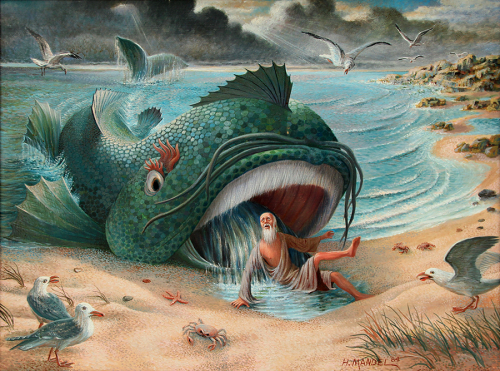
    Image – Jonah and the Whale, by Herbert Mandel

    Mary Clifford Morrell is the author of "Things My Father Taught Me About Love," and "Let Go and Live: Reclaiming your life by releasing your emotional clutter," both available as ebooks on Amazon.com.

  • So, here we are. Stuck at home.                                                                                                                                                                                                                   Home Joshua Hanks

    For many, the situation is challenging, frustrating and claustrophobic.  With children home from school, it may seem impossible to meet everybody’s needs all at the same time.  Many of us are also working from home, trying to meet deadlines, sanitize every surface and hidden crevice and figure out how we are going to get groceries without leaving the house and putting ourselves or our families in jeopardy.

    There may be chaos and clutter and confusion, but there is something else – love.

    Where there is love, there is God.  We may be confined for a time, but it may make a difference to know we are confined in a sacred place.

    My understanding of home as a sacred space came about slowly as I grew up, but one ordinary experience was an important lesson.

    When I was in high school, I took the city bus to school every day, even in the snow. One winter evening, after a day-long snow fall, I got off the bus to walk down the street to my house – a walk I took daily. It was a crisp night, frosty enough for my breath to be visible but not so cold as to be uncomfortable. Except for the crunch of my boots on the snow, there was a calm silence.  

    The moon hung brightly in the sky, making glitter out of the snow falling around me.  I looked down the street into the dark night and saw a warm light shining from a front porch, illuminating the steps and the holly bushes nearby.

     I felt warm inside because it was my house. The light was meant for me. My mother always made sure the light was on, leading me home.

    How blessed I am, I thought, to belong.  I walked home with a new understanding that home was sacred.

    I’ve thought a lot about that over the years, the meaning of home for each person and, especially, for children. I’m thinking about it more now that, for many of us, home is the only place we are supposed to be.

    In our homes we are in the world, yet apart from the world. If we love our families, our homes are sanctuaries where we come to be ourselves, to step away from the world and still be loved for who we are.

    We build this sacred space by being co-creators with God, by bringing life to our families through love and letting that love spill out into the lives of others.   We establish traditions and create rituals that reinforce faith and family. Simple things, like taking off our shoes at the door, even when we are not in the middle of a pandemic, show respect for our home and the people in it, including ourselves, before we even enter the rooms.

    By sharing meals and chores, prayers and conversations we establish bonds that are difficult to break, unless we forget to love.  And in the building of this little community we are following Jesus’ command to “love one another as I have loved you.”

    Our homes, as our efforts to love, may not be perfect, but that doesn’t diminish the power of home in the life of a family, even if we are now only a family of one.

    While we are confined to our sacred place, let us all pray for those who have no experience of belonging and no physical place to call home, those who are displaced, those who are not loved, or those who are homeless due to violence of any kind or poverty.

    St. Theresa of Calcutta teaches us, “We think sometimes that poverty is only being hungry, naked and homeless. The poverty of being unwanted, unloved and uncared for is the greatest poverty. We must start in our own homes to remedy this kind of poverty.”

    Joshua Hanks photo on Unsplash.

  • When my second son began preschool, an experience relished by his five brothers, his reaction was less than enthusiastic. As we approached the Flood brightly painted door that led to his classroom, I felt myself being pulled backward by the pressure of his tiny hand tugging on mine.

    Looking down I saw the big brown eyes welling up with tears, a look of fear crossing his flushed face. A kindly, gray-haired lady came out and wrapped her arm around his shoulder, ushering him in to join the other children. As he turned to look at me with wide doe-eyes, I was sure the lump in my throat would choke me. I waited for the inevitable with baited breath.

    “MOMEEE!” came the blood-curdling scream. It wasn’t so much the word as the impassioned, gut-wrenching way in which it was delivered that pierced my guilty-mother heart as I tore myself away, leaving him there in the obviously adequate care of his new teacher.

    New beginnings were not his cup of tea.

    And so it is for many of us, even as adults. New beginnings, while often exciting and challenging, also signify endings. With each new beginning we are called to give up the security and comfortableness of old ways to move forward into the unknown. Even routine, boring or painful daily experiences may be difficult to relinquish because they have become an anchor holding us in place.

    New beginnings require a trust in the Lord and acknowledgement that he is the author of both beginnings and endings. Moving forward is sure to be difficult without the hand of the Lord to lead us.

    Talking to a young man who wished to follow Jesus, but only after he had returned home to say good-bye to his family, Jesus explained the importance of letting go of the past: “No one who sets a hand to the plow and looks to what was left behind is fit for the kingdom of God.”

    Jesus was not saying, as many believe, that the past is something that should be forgotten or ignored, but rather, that when the time comes for a decision to be made for the future, the past must take its place as the port from which one sails.

    To continue to look back may prevent us from making what one Bible commentary refers to as an “instant decision of purpose” – the kind we must make when God calls us to something new and, often, something frightening.

    My experience with decisions of “purpose” has taught me a lesson I try hard to remember—when the challenges of any new beginning bring cries for help, recall the words of Jesus as he rebuked the storm, saying, “Quiet! Be still!” and his remonstration of the Apostles, of whom he asked, “Why are you terrified? Do you not yet have faith?”

    I want to answer assuredly, “You know I do!” But sometimes, my behavior belies my shaky faith, and I wonder, almost hopefully, if Noah’s first response to God – not recorded in Scripture – might have been along the lines of a muffled, “Seriously?”

    I would feel so much better knowing someone who navigated so well the stormy sea of change through faith in God, also had his moments of doubt.

    Mary Clifford Morrell is the author of "Things My Father Taught Me About Love," and "Let Go and Live: Reclaiming your life by releasing your emotional clutter," both available as ebooks on Amazon.com.

  • Lent is a good time for introspection, reflection and lessons that lead to change                                                                                                                        Crayons Kristin Brown

    When you have children, or grandchildren, you can be certain lessons will be abundant and often tied to the latest munchkin meltdown.

     Last week it was a box of crayons.

    My two-year-old grandson knocked his box off the play table, scattering crayons everywhere.

     We worked together to pick them all up, but when we were done, one was still missing.  I told him not to worry, it was just one crayon.  When I tried to close the box to put them away, the tears started.

    “No!” he exclaimed between sobs, attempting to pull the box from my hands, adamant that we could not close the box without the missing crayon. He felt the incompleteness of it. It was just one crayon, but one crayon that counted.

    His meltdown came on the heels of an assignment for me to write about the 2020 Census. The purpose of the story was to explain why it’s important for everyone to participate, and to highlight how faith-based entities are offering programs to educate and assist hard-to-count populations so they may participate.

    One of the people I interviewed was a prominent program director. When he was done emphasizing the importance of all citizens participating so that crucial programs would receive the funding needed to help meet the needs of each community, he offered another simple yet profound statement which was his bottom line.

    He said, “The most important reason for everyone to participate in the census is because everyone counts.”

    He was saying emphatically that everyone matters, everyone has an inherent dignity that gives their life importance.

    When I replay those two words in my head – everyone counts – I struggle with what I see and hear every day, on the news, in my community, in the supermarket parking lot. It’s obvious that, for many, not everyone counts.  For some, no one counts more than them.

     This is not what Jesus taught us. He modeled love, compassion, empathy, mercy, forgiveness and unity. He prayed for it and offered parables as lessons.  For me, some of his most powerful lessons were about humility. He said, “For everyone who exalts himself will be humbled, but the one who humbles himself with be exalted.”

    He reminded the host of a dinner: “When you hold a lunch or a dinner, do not invite your friends or your brothers or your relatives or your wealthy neighbors …. Rather, when you hold a banquet, invite the poor, the crippled, the lame, the blind; blessed indeed will you be because of their inability to repay you.”

    After writing the census story, and remembering my grandson’s insistence that every crayon in the box was needed, I had to ask myself: “Who counts in my life?” beginning with my family and expanding out to my friends, the broader community and other countries. 

    One answer came from paying attention to the posts I skimmed over on Facebook. It was a hard reality to face.

    Making personal change can be hard, and we may not know where to start. When I get stuck, I pay attention to my grandchildren. 

    Jesus held children up as an example for the disciples to follow, mostly because of their humility in relying on their mothers and fathers. They are an example to every disciple of the need to rely on God in all things.

    But being who he is, I believe Jesus was well aware of the inherent wisdom in children, and their ability to remind us that, even in a box of 64 crayons, every single one counts.


    Mary Clifford Morrell is the author of "Things My Father Taught Me About Love," and "Let Go and Live: Reclaiming your life by releasing your emotional clutter," both available as ebooks on Amazon.com.